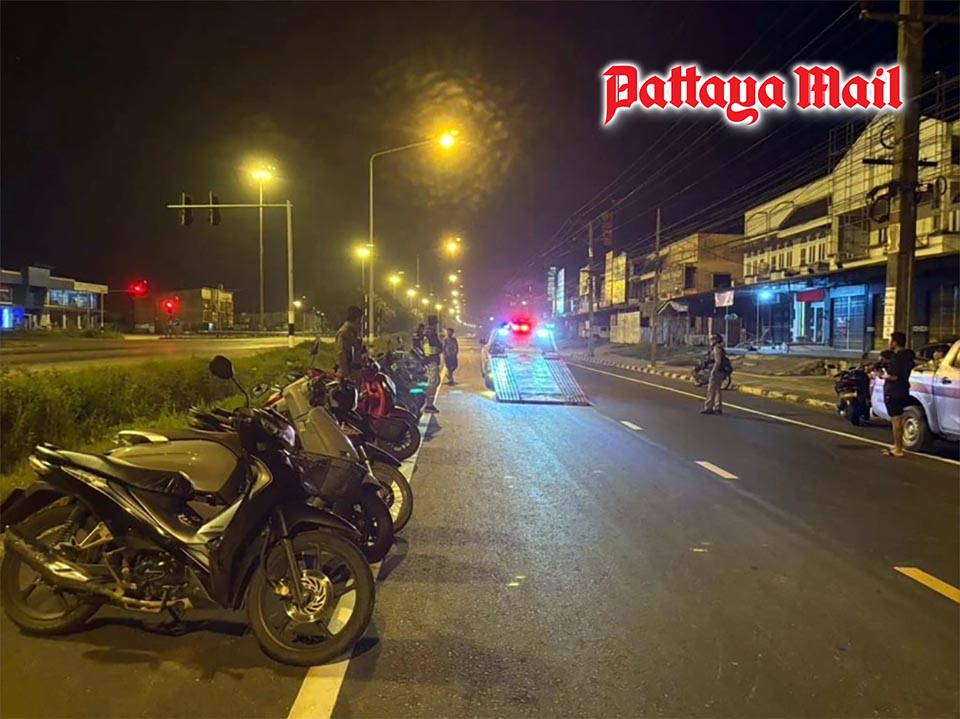
PATTAYA, Thailand – When police in Phatthalung proudly showed their late-night operation seizing 19 motorcycles from teenage street racers at 3 a.m., the message was simple: enforcement is possible when authorities decide to act. Officers worked through the night, chased offenders into roadside brush, and removed a nuisance that had been disturbing residents and road users.
That example has not gone unnoticed in Pattaya.
In Pattaya, complaints about noise, reckless riding, illegal racing, public disorder, and late-night disturbances are constant. Residents living near main roads and tourists staying along beach routes regularly report sleepless nights caused by racing motorcycles, modified exhausts, and groups treating public roads like private tracks. Yet meaningful crackdowns remain sporadic, often reactive, and usually short-lived.
The frustration is not about resources. It is about consistency.
Pattaya is one of Thailand’s most important tourism cities, hosting millions of visitors each year. Tourists expect safety, order, and visible law enforcement. Residents expect the same. Instead, many see long stretches of inaction, followed by brief enforcement campaigns that fade as quickly as they appear.
The Phatthalung operation shows that late-night enforcement is not impossible. Police worked at an hour when disturbances actually happen. They acted before accidents occurred, rather than after. And they made the result visible to the public.
In Pattaya, enforcement too often feels selective. Noise complaints pile up. Reckless riders reappear night after night. Illegal street racing moves locations but never disappears. When action does come, it is frequently after social media outrage, viral videos, or serious injuries.
Tourism promotion campaigns talk endlessly about recovery, confidence, and safety. But confidence is built on what visitors experience on the street, not what is written in brochures. A tourist kept awake until dawn by racing bikes or frightened by reckless riding does not leave with good memories, no matter how many events or festivals are advertised.
Residents, too, are reaching a breaking point. Many feel they are asked to tolerate disorder in the name of tourism, while basic quality of life issues are left unresolved. That trade-off is no longer acceptable.
What Pattaya needs is not another announcement or short-term sweep. It needs sustained, visible enforcement at the hours problems actually occur. It needs police presence that deters misconduct before it escalates. And it needs to show both locals and visitors that rules apply consistently, not occasionally.
Phatthalung’s operation was not extraordinary. It was basic policing done properly.
That is exactly why Pattaya’s residents and tourists are asking a simple question: if it can be done there at 3 a.m., why not here?