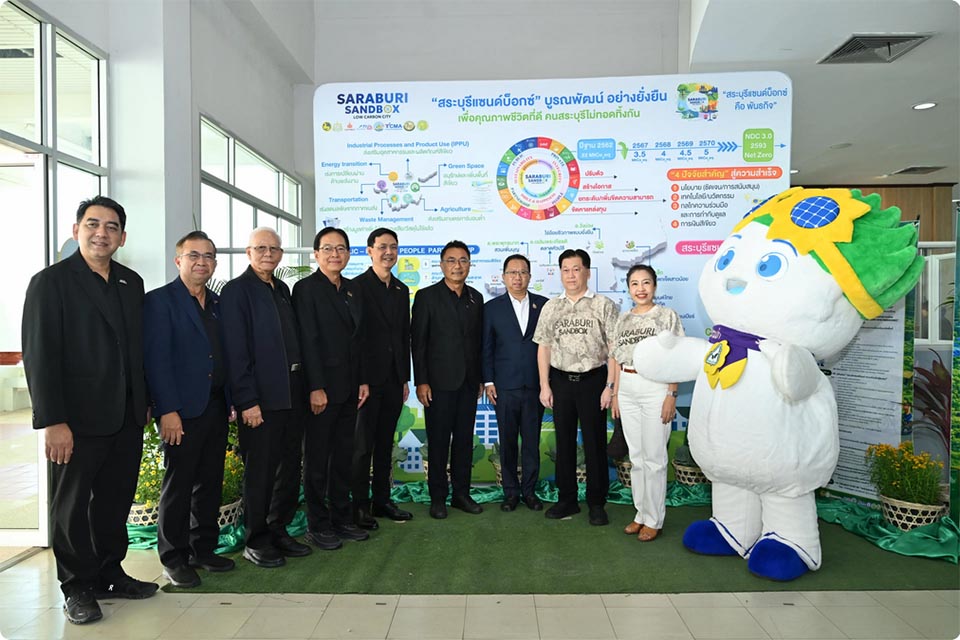
BANGKOK, Thailand – The Thai Cement Manufacturers Association (TCMA), together with Saraburi Province and partners from the public, private, and civil sectors, is advancing Thailand’s first low-carbon city through the “SARABURI SANDBOX: Edible” initiative, transforming Saraburi into a model for area-based Net Zero development while laying the groundwork for a provincial-level carbon market.
Launched in 2023 under a Public–Private–People Partnership (PPP), SARABURI SANDBOX has delivered concrete outcomes across clean energy transition, green industrial development, value-added waste management, low-carbon agriculture, and expanded green spaces. TCMA Chairman Dr. Chana Poomee said the initiative demonstrates that carbon reduction can generate economic value rather than impose constraints, aligning local action with Thailand’s Net Zero target by 2050.
This year marks a key milestone as the project evolves into what TCMA calls an “edible carbon market,” enabling greenhouse gas reduction efforts to be converted into carbon credits that create income for communities, industries, and the broader economy. The concept of Net Zero that is “edible” emphasizes tangible benefits such as job creation, local economic upgrading, and improved environmental quality through market-based mechanisms.
Saraburi Governor Bancha Chaowarin said the project’s success stems from integrated cooperation among all sectors, guided by the principle that no one is left behind. He noted that the province is linking environmental stewardship with livelihoods and community development to ensure public participation and long-term sustainability.
Looking ahead, Saraburi plans to scale SARABURI SANDBOX from a pilot into a core development mechanism, building a comprehensive low-carbon economic ecosystem that can be replicated nationwide. The initiative highlights a new pathway for Thailand, where Net Zero becomes an opportunity that is practical, scalable, and economically meaningful. (NNT)