PATTAYA, Thailand – A traffic crash on a provincial highway has laid bare a familiar and uncomfortable reality on Thailand’s roads, where traffic rules are well known, routinely ignored, and weakly enforced.
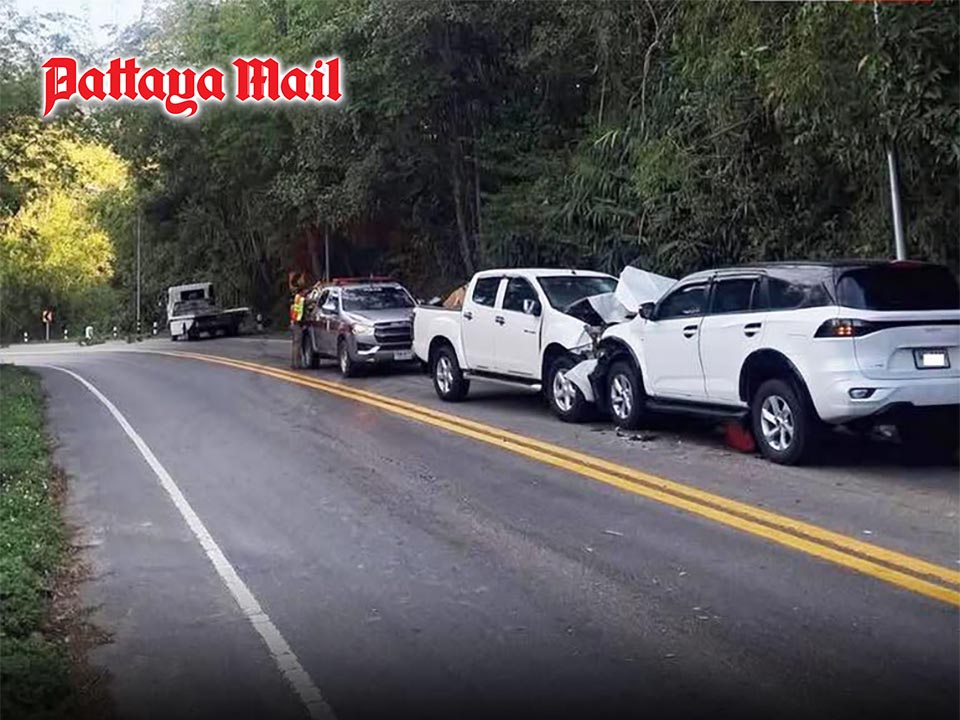
Police at Nam Nao station in Phetchabun were called to a collision on the Lom Sak–Chum Phae Road near kilometer marker 395, where two vehicles were left heavily damaged and one traffic lane blocked. Preliminary findings indicated that an MU-X travelling toward Nam Nao National Park lost control on a curve, crossed into the opposite lane, and struck an oncoming D-Max heading toward Lom Sak district. Five people were injured. No public property was damaged.
The details are familiar. A curve. Excessive speed or poor control. A vehicle crossing lanes. Injuries that could easily have been fatalities.
Across Thailand, similar accidents occur daily on highways, rural roads, and city streets alike. Warning signs are present, speed limits are posted, and public campaigns urging drivers to “slow down” are repeated year after year. Yet behavior on the road often tells a different story—one of impatience, overconfidence, and a casual disregard for basic traffic rules.
Thailand has long ranked among the countries with the highest road accident rates in the world. While officials often point to festivals or long holidays as high-risk periods, accidents continue even on ordinary days, on ordinary roads, driven by ordinary behavior. Curves are taken too fast. Lanes are crossed carelessly. Seatbelts and defensive driving are treated as optional rather than essential.
Critics argue that the problem is not a lack of laws, but a lack of consistent enforcement and road discipline. Drivers frequently assume they can bend the rules without consequence, and too often they are proven right—until an accident happens.
Each crash leaves behind injured victims, traumatized families, traffic disruptions, and rising medical costs. Yet once the wreckage is cleared, the lesson is quickly forgotten, only to be repeated at the next curve, the next intersection, the next stretch of road.
The message painted on road signs remains painfully simple: slow down and respect traffic laws. Until that message is taken seriously—not just during holidays, but every day—Thailand’s accident statistics are unlikely to change, and stories like this will continue to fill police logs across the country.