A year-end perspective from a tax, business law, and investment lawyer
Today is the last day of the year. It is the moment when investors stop looking at charts and start asking harder questions: What did we miss? And more importantly where should capital go next? After years working at the intersection of taxation, business law, and investment structuring, one lesson has become clear to me, Capital never moves randomly. It follows power, policy, scarcity and fear. As we close this year, one asset stands out as a remarkably accurate mirror of where the global economy is heading. It is not technology stocks. Not crypto. Not even gold. It is silver.
When silver is no longer just a precious metal but the infrastructure of the next economic cycle
By the end of 2025, silver prices surged dramatically, briefly reaching USD 75-80 per ounce, a gain of more than 150% in a single year. To short term traders, this may look like speculative excess. To those who understand structural economics, it looks very different. This is not a price spike. It is a repricing.
- A supply crisis the market prefers to ignore
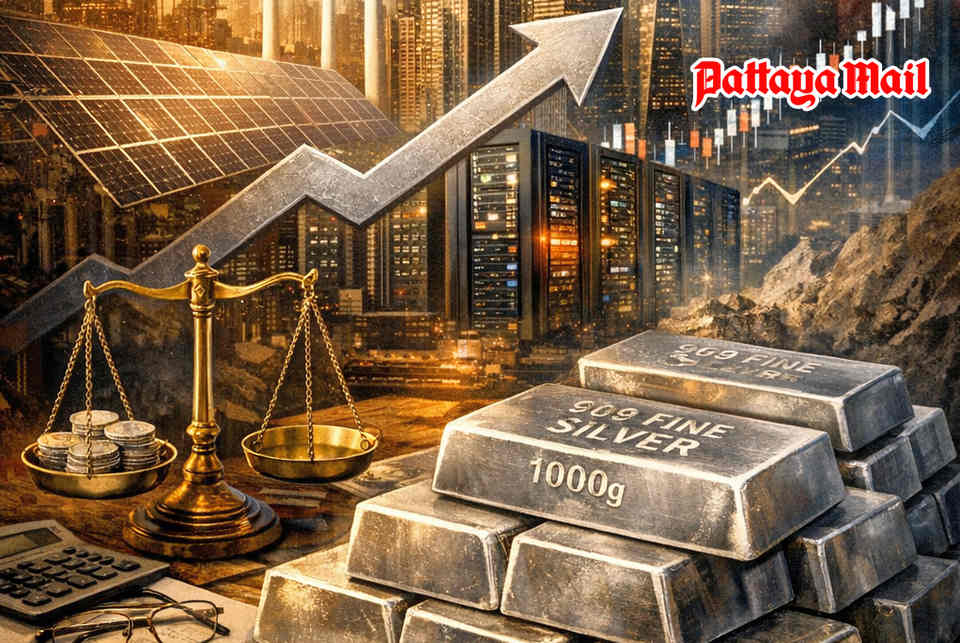
The most important driver behind silver’s rise is not sentiment it is physical scarcity. The world has now experienced a physical silver deficit for five consecutive years. Inventories in key global vaults, particularly in London and Shanghai, have fallen to multi year lows, while new production struggles to expand due to rising costs, environmental regulation, and geopolitical constraints. From a business-law perspective, the implication is straightforward. When physical supply tightens, paper markets eventually lose credibility. At that point, price discovery shifts decisively to those holding real metal, not derivatives.
- Silver as a strategic metal for energy and AI
Silver’s role in the modern economy has fundamentally changed. It is now a strategic input for, Solar panels and renewable energy infrastructure, Electric vehicles, which use significantly more silver than internal combustion cars, Data centers, semiconductors, and AI driven electrical systems. Simply put, Without silver, the green transition and the AI economy stall. Gold may represent stored wealth. Silver increasingly represents future capacity.
- The gold silver ratio: A professional investor’s signal
As gold surged beyond USD 4,500 per ounce, institutional investors began to quietly rotate. Historically, when gold reaches perceived saturation levels, capital seeks leverage through silver. The Gold Silver Ratio compresses, and silver tends to outperform on a percentage basis during late-cycle expansions. This is not a retail narrative. It is a balance sheet decision.
- Falling rates, rising debt, and capital leaving the system
Looking ahead, expectations of continued interest rate cuts combined with historically high U.S. public debt levels create a familiar pattern. Capital begins to move away from certain paper assets and toward instruments outside the traditional financial system. Silver benefits uniquely here, because it occupies two roles at once, A safe-haven asset, An industrial necessity. Very few assets can credibly claim both.
- China: The quiet hand on the market
China, one of the world’s largest producers and consumers of silver, has begun restricting exports to protect domestic supply chains. From a trade-law standpoint, this is a classic signal of strategic resource management. From an investment standpoint, it suggests that global supply may tighten far faster than markets currently price in. When China moves quietly, markets tend to react loudly later.
High potential comes with high volatility
Silver is not an asset for the impatient. Its price movements are sharp, emotional, and unforgiving. Many investors lose money not because their thesis is wrong, but because they lack the discipline to withstand volatility. In legal terms, this is a risk-management problem, not a market problem.
Year End conclusion
Silver’s surge at the end of this year is not accidental. It reflects, Genuine physical scarcity, A technology driven demand shift, And a global financial system under growing strain. As we move into the coming year, capital will not drift aimlessly. It will move toward what the world cannot function without.
Silver now sits at the intersection of industrial necessity and financial protection a position few assets ever occupy at the same time. And that is precisely why it deserves attention as the year turns.