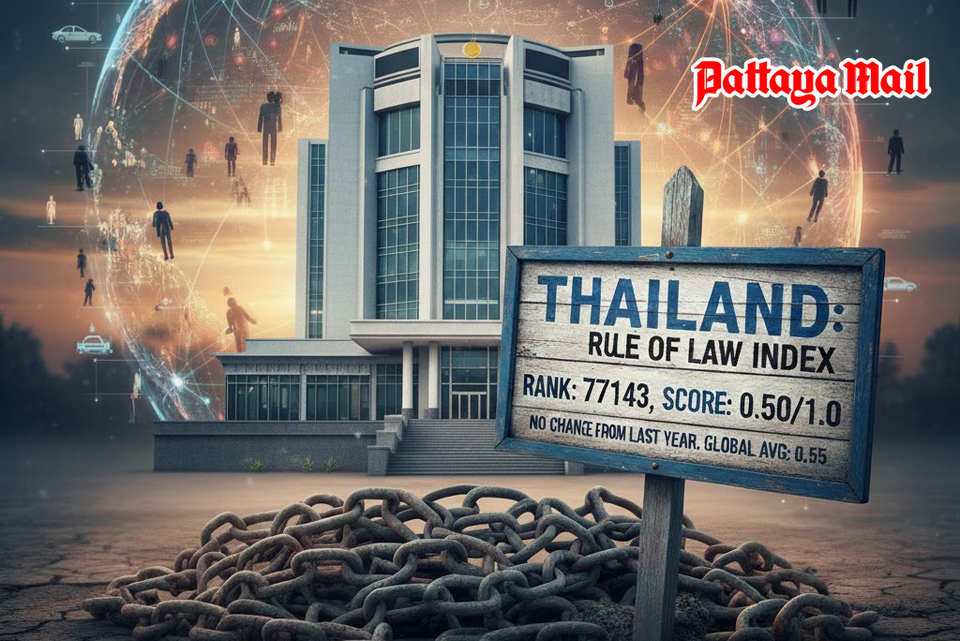
BANGKOK, Thailand – On 17 December in Bangkok, a new report quietly confirmed what many people in Thailand already feel in their daily lives: the country’s rule of law is not getting worse, but it is not getting better either. The Thailand Institute of Justice, together with the World Justice Project, released an in-depth study on the rule of law in Thailand for 2025. The conclusion was simple and troubling at the same time. Thailand remains stuck in the middle of the global rankings. Out of 143 countries worldwide, Thailand ranked 77th, with a score of 0.50 out of 1. This is unchanged from last year, but still below the global average score of 0.55. In Southeast Asia, Thailand sits behind Singapore, Malaysia, and Indonesia. The gap with the region’s leaders remains wide.
The report shows a country with a clear split personality. On the positive side, Thailand performs strongly in public order and security. Crime and internal conflict are relatively well controlled, and this area scores higher than the world average. Everyday life, for most people, feels safe and predictable. But this strength is dragged down by two long-standing weaknesses, corruption and inconsistent enforcement of the law. Thailand scores poorly when it comes to freedom from corruption and the reliability of law enforcement. Rules often exist on paper but are applied unevenly in practice. This uncertainty damages public trust and sends a negative signal to investors who want fairness, clarity, and predictability.
The voices of ordinary citizens make this problem even clearer. Based on interviews with more than 1,100 households across the country, the survey shows that freedom of expression has improved. More people feel able to criticize the government openly and join social groups without fear. In that sense, Thai society has become more open. At the same time, discrimination has increased sharply. Reports of unfair treatment based on age, appearance, or gender have nearly tripled over recent years. Most worrying is everyday corruption. Nearly one in five people now report having to pay a bribe to obtain permits or deal with public authorities. This is not corruption at the top it is corruption in daily life, where citizens meet the state face to face.
Public confidence reflects this reality. Almost half of respondents believe that members of parliament are corrupt, and more than a third believe the same about the police. Trust in judges and prosecutors remains relatively high, but the overall picture is one of fragile faith. Government leaders acknowledge the challenge. Senior officials described the rule of law as an “invisible infrastructure” of the nation just as important as roads or airports. Without trust in justice and fair enforcement, foreign investors hesitate, and long-term growth suffers.
Thailand’s ambition to join the Organisation for Economic Co-operation and Development by 2027 makes these issues even more urgent. Membership requires higher standards of transparency, accountability, and good governance. Experts at the event agreed that reform cannot rely on words alone. International standards can help pull Thailand forward, but real change must be pushed from within by government agencies, businesses, and civil society working together. The final message of the report is quiet but clear. Data alone will not fix the rule of law. But ignoring the data guarantees that nothing will change. For Thailand, the challenge is no longer understanding the problem. It is finding the courage and consistency to solve it.