
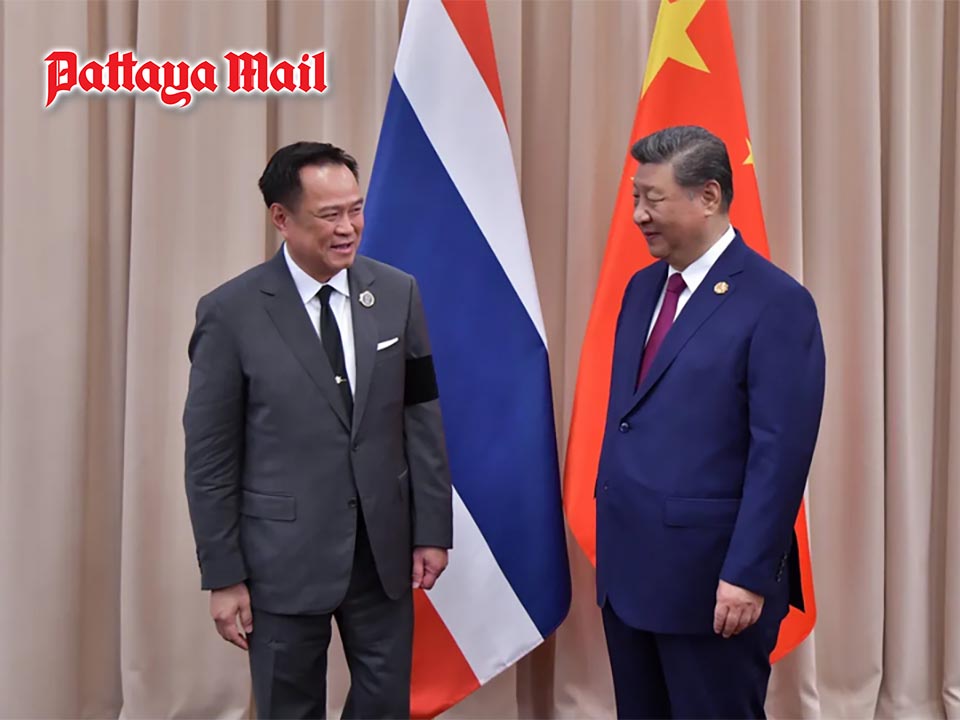
PATTAYA, Thailand — Chinese President Xi Jinping has praised Thai Prime Minister Anutin Charnvirakul’s firm stance against legalizing casinos, emphasizing that China will not interfere in Thailand’s domestic policies but will discourage Chinese tourists from traveling solely for gambling purposes.
The discussions took place Friday, October 31, at the Kolon Hotel in Gyeongju, South Korea, during APEC Economic Leaders’ Week. Prime Minister Anutin also thanked President Xi for expressing condolences over the passing of Her Majesty Queen Sirikit, the Queen Mother, and said he will relay China’s tribute to the Thai Royal Family.
Highlighting economic ties, PM Anutin noted that 2025 marks the 50th anniversary of diplomatic relations between Thailand and China, a milestone offering an opportunity to redefine a shared vision for a secure and prosperous future. President Xi confirmed China’s commitment to cooperate with Thailand across trade, investment, tourism, and people-to-people connections. PM Anutin also emphasized opportunities in innovation, science and technology, digital economy, clean energy, and future-oriented agriculture.
Cybersecurity cooperation was another key topic. PM Anutin noted that cybercrime is a national priority for Thailand, and China’s commitment to collaborate will enhance regional efforts to prevent and combat such threats.
Infrastructure and connectivity were also discussed, including the Thai-Chinese railway and the second Thai–Lao Friendship Bridge (Nong Khai–Vientiane), which will facilitate efficient rail links connecting China to Southeast Asia.
Crucially for Pattaya and Thailand’s tourism sector, PM Anutin reiterated that the government will not rely on casinos to drive economic growth, believing instead that Thai talent, products, and technology offer better alternatives. President Xi praised this approach and noted that China will respect Thailand’s domestic decisions.
This stance builds on PM Anutin’s earlier efforts to permanently halt the “Entertainment Complex” or casino legislation, which had faced strong opposition from both the Thai public and China. In July, Anutin highlighted that proceeding with the law despite Chinese warnings had already caused a severe drop of over 90% in Chinese tourist arrivals, devastating the local tourism sector, hotels, restaurants, and retail businesses. By officially withdrawing the proposal and committing not to revisit it, the government aims to restore confidence among Chinese visitors and revive Thailand’s tourism economy.
For Pattaya, historically popular with Chinese tourists, the message is clear: casino tourism is off the table, but the city’s potential as a top destination remains strong—provided it focuses on safety, hospitality, beaches, culture, shopping, and culinary experiences. Officials see this as an opportunity to rebrand Pattaya as a premier leisure and lifestyle destination.
On trade, discussions advanced on the sale of 500,000 tons of Thai rice to China, which consumes nearly 150 million tons annually. PM Anutin also invited President Xi to attend the Mekong–Lan Chang Summit in Thailand later this year, reinforcing closer regional collaboration.
“Overall, the discussions reflected a friendly and constructive atmosphere. China’s responses signal a positive shift, reviving Thailand-China cooperation that had stalled. Strong bilateral relations are built on trust and mutual respect,” said PM Anutin.
For Pattaya, the key takeaway is clear: Chinese tourists remain vital, but their focus must shift from gambling to leisure, culture, and high-quality experiences. With strong infrastructure links, safety measures, and diversified attractions, the city has a chance to capture this lucrative market in a sustainable way while avoiding the economic pitfalls of casino tourism.