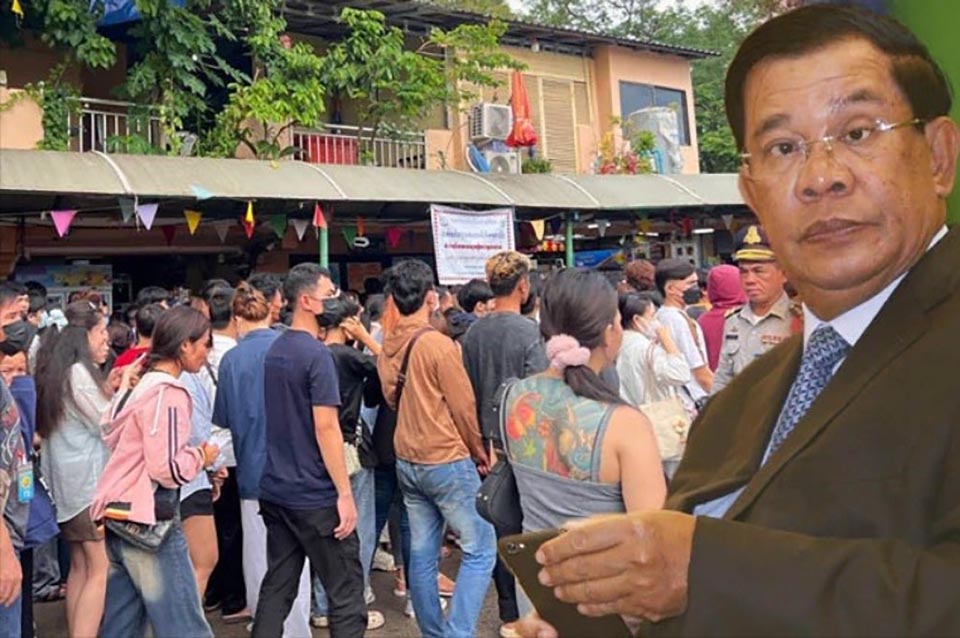
PHNOM PENH – Cambodia’s Senate President, Hun Sen, has issued a public plea to Cambodian migrant workers currently residing in Thailand to return home voluntarily — even if they lack legal documentation — warning that they may soon face forced deportation due to escalating tensions between the two countries.
In a Facebook post published on June 14, Hun Sen addressed his “brothers and sisters” living in Thailand, stating:
“I appeal to all Cambodians in Thailand: return to our homeland before the Thai authorities expel you and humiliate you.”
The former prime minister’s comments come amid a deepening border dispute between Cambodia and Thailand, following Phnom Penh’s recent submission of a legal complaint to the International Court of Justice (ICJ). While the specific legal details of the case have not yet been disclosed, observers believe it is linked to long-standing territorial disagreements.
Hun Sen expressed concern that the legal battle could intensify nationalist sentiment in Thailand, saying:
“I understand very well that the Cambodian-Thai border dispute will drag on for a long time, especially now that Cambodia has filed a petition with the ICJ. When the time comes, extremist groups in Thailand and some elements within the Thai military may try to harm our people.”
He emphasized that the Cambodian government will not abandon any of its citizens — regardless of their legal status in Thailand.
“Anyone who is Cambodian, whether or not they have proper documentation, will be accepted without discrimination by the Royal Government of Cambodia.”
Hun Sen also acknowledged that many Cambodian workers in Thailand wish to return to care for their aging parents or reunite with their families but are hesitant due to a lack of identification papers. He stressed that returning home would not lead to penalties, and that arrangements were being made to assist in the repatriation.
His statement comes in support of recent policies announced by Prime Minister Hun Manet, his son and successor, who has instructed Cambodian agencies to prepare for the possible return of large numbers of migrant workers. These measures include temporary shelters, reintegration programs, and employment support for returnees.
There has been no official response from the Thai government regarding Hun Sen’s comments, but Thai immigration authorities have recently increased scrutiny of undocumented workers amid broader concerns about border security and labor law enforcement.
As of 2025, hundreds of thousands of Cambodian nationals are estimated to be living and working in Thailand, many in construction, agriculture, and service sectors. A significant portion of them are believed to be undocumented or working under semi-legal arrangements.
Hun Sen’s public appeal marks one of the most direct warnings yet to Cambodian workers abroad, underscoring the growing uncertainty for migrant communities amid geopolitical tensions in the region.