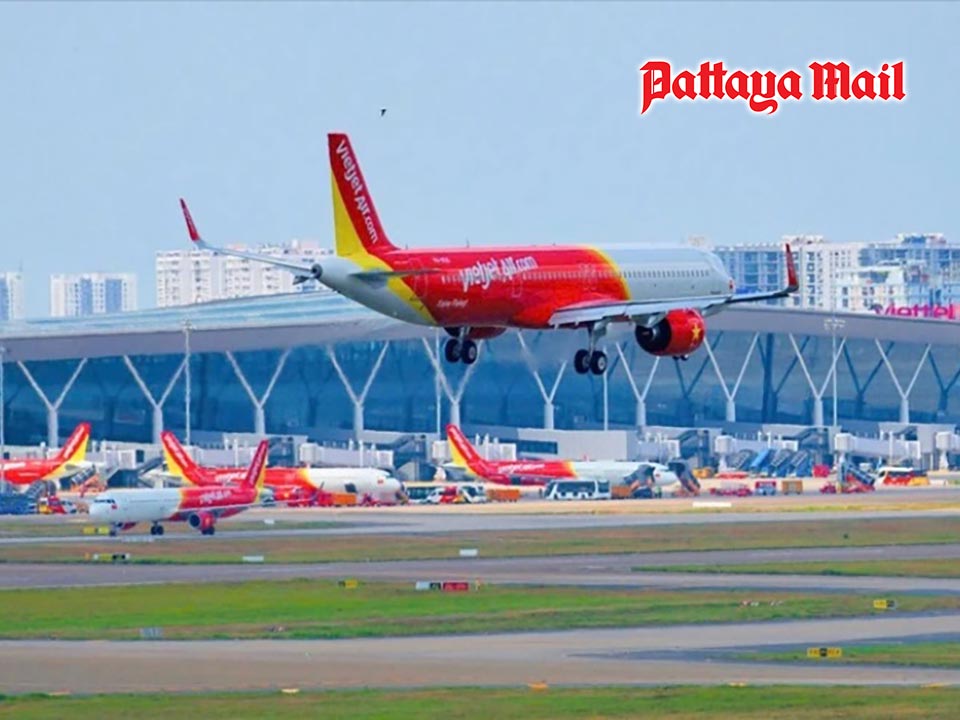
PATTAYA, Thailand – As Thailand continues to position itself as a global tourism destination, the country is facing intensifying competition from regional neighbors — particularly in the aviation sector, where carriers like Vietnam’s Vietjet are rapidly expanding their footprint and capturing market share with aggressive growth strategies.
Despite Thailand’s long-standing appeal as a travel hotspot, the country’s tourism outlook for 2025 may not be as robust as hoped. With the Thai baht on a strong appreciation trend — having gained 2.64% since the beginning of the year and reaching a 7-month high of 32.565 baht per U.S. dollar as of May 13 — the rising currency could make Thailand a more expensive destination for many international travelers, especially those from countries with weaker currencies. Analysts project the baht could strengthen further, potentially falling below 33 baht per U.S. dollar by the end of 2025, even though underlying economic fundamentals don’t fully support this appreciation.
Meanwhile, regional competitors are not sitting still. Vietjet, the fast-growing Vietnamese low-cost carrier, has emerged as a major player in Asia’s aviation landscape. The airline recently reported a 24% surge in profit in Q1 2025, generating total revenue of $690 million. Vietjet’s performance underscores not only its operational efficiency but also its strategic expansion into international markets.
Vietjet now operates a modern fleet of 106 aircraft and serves a network of 137 routes, including 97 international destinations. In the first quarter alone, the airline flew nearly 6.87 million passengers across 38,700 flights, reflecting year-on-year growth of 9% in passengers and 12% in flight frequency. Its impressive load factor of 87% and technical reliability rate of 99.72% further highlight its operational strength.
In terms of international strategy, Vietjet has significantly broadened its reach. New routes have been launched connecting Vietnam’s key cities — Hanoi and Ho Chi Minh City — to Beijing, Guangzhou, Bengaluru, and Hyderabad, tapping into the booming demand for cross-border travel within Asia. Looking ahead, the airline is preparing to introduce new direct routes to Singapore and New Zealand by the end of 2025.
Moreover, Vietjet’s strategic partnerships and financial backing are solidifying its long-term position. The airline recently signed a $300 million aircraft financing agreement with Carlyle Aviation Partners and is building on existing deals with Boeing, GE, and Pratt & Whitney. Its collective collaboration value with U.S. and global partners now approaches $50 billion.
Thailand, by contrast, faces growing pressure to retain its competitive edge in both air connectivity and tourist appeal. The strong baht, combined with policy uncertainties and regional players’ aggressive strategies, may lead travelers and investors alike to look elsewhere in Southeast Asia.
If Thailand wants to remain a preferred gateway in the region, it will need to respond decisively — through strategic incentives for airlines, infrastructure upgrades, and tourism diversification — or risk losing ground in the fast-changing battle for Asia’s skies and tourists.