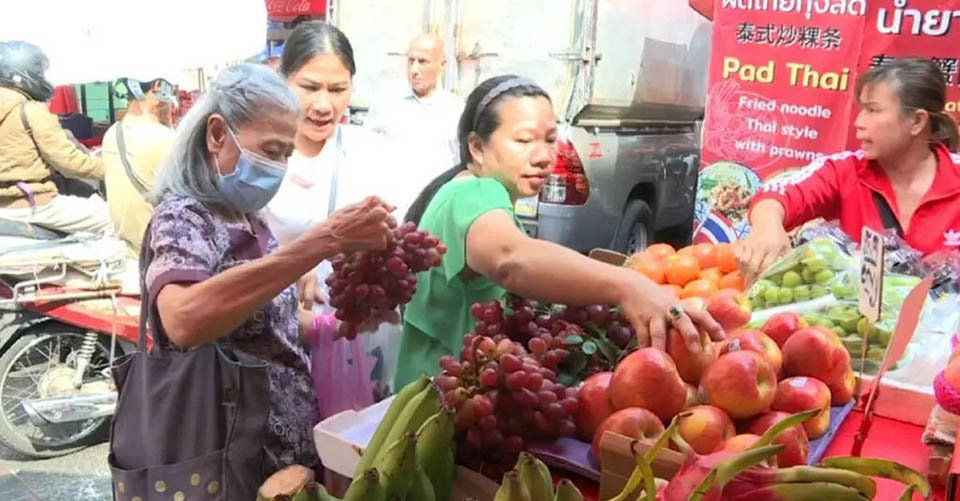
BANGKOK, Thailand – Vendors and residents have reported a noticeable decline in spending during this year’s Chinese New Year festivities in Yaowarat compared to last year, attributing the drop to the sluggish economy. Gold shops also revealed a 20-30% decrease in sales from the previous year.
The atmosphere at Yaowarat during this year’s Chinese New Year festival remained active, with people continuing to shop. However, many vendors noted a significant reduction in sales compared to last year due to the struggling economy. They observed that most people completed their shopping over the weekend, leaving today’s crowd relatively sparse. Some vendors admitted to ordering fewer goods than last year and refrained from increasing prices, opting to sell at the same rates.
Shoppers exhibited mixed behaviors: while some continued their usual purchases, citing the importance of tradition, others adjusted their spending, buying fewer items than last year. For example, shoppers purchased fewer fruits and opted for preserved goods like dried pork and pork floss, which have longer shelf lives, instead of fresh pork.
A price survey of goods in Yaowarat revealed slight price increases for some traditional items due to higher raw material costs, such as sugar and glutinous rice flour. For example, Chinese rice cakes (khanom kheng) now cost 30-40 baht per pair, and stuffed rice cakes (khanom tien) are priced at 10 baht each.
Other key items included boiled pork belly at 250-280 baht per piece, fresh chicken at 150 baht per kilogram, boiled Thai chicken at 550-600 baht per piece depending on size, broiler chicken at 350 baht per piece, and braised duck at 420-500 baht per piece depending on size. Prices for ancestor worship paper offerings remained steady, while popular fruits for rituals, such as oranges, were priced at 150 baht per kilogram. Japanese Fuji apples were 100 baht per kilogram, and grapes were 250 baht for half a kilogram.
Gold sales also saw a significant dip this year. Worachai Tangsitphakdee, Deputy Secretary-General of the Gold Traders Association, revealed that sales dropped by about 20-30% compared to last year, largely due to a sharp increase in gold prices. This year, gold ornaments are priced at 44,050 baht per baht weight, a dramatic rise from last year’s 33,000 baht during the same period—an increase of approximately 10,000 baht. Many businesses that previously purchased gold as Chinese New Year gifts turned to other products instead due to the high prices. Meanwhile, the general public opted to redesign existing gold jewelry rather than buy new pieces.
Previously, the market had anticipated that gold prices would ease following Donald Trump’s inauguration as U.S. President. However, prices continued to rise instead, prompting investors to delay purchases. Additionally, ongoing geopolitical conflicts, the BRICS nations’ accumulation of gold reserves, and central banks worldwide continuing to stockpile gold suggest that prices may climb further. Analysts project that gold prices could reach 48,000 baht per baht weight this year. (TNA)