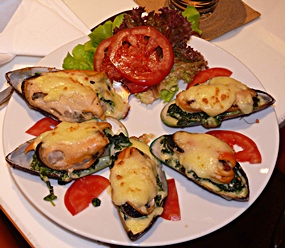
 Did
you know that some of the highest paid professional photographers are those who
photograph food?
Did
you know that some of the highest paid professional photographers are those who
photograph food?
Ask food and wine critics about menus. What is the best style
and layout of a menu? Menus that have photographs in them. It is all very well
having ‘vol au vent’ on the menu, but if the diner doesn’t know what it is, he
is not going to order it. With international clientele in Pattaya, where English
may not be their language, only a photograph can tell them what is on your menu.
OK, so there needs to be a photograph, but if that final
photograph does not make the food look appetizing, the diner isn’t going to
order it anyway - and will probably go somewhere else to eat next time.
Photography is one of the least truthful pastimes you can
take up. For the pro photographer much of the time is used in working out how to
either show the product in a favorable way, or to disguise some defect or other.
There is a veritable army of people out there who love to go through advertising
brochures and look for minute imperfections and write to the manufacturer saying
“Do all of your watches have scratches on them?” And who gets the blame? Not the
manufacturer who sent over the product, but the poor old photographer, that’s
who. This can really be an enormous problem when you may be photographing a
pre-production item and this is the only one in captivity.
And so to the food. This is one area where there are more
fraudulent practices than any other. Cold food can be made to look hot by
sprinkling chips of dry ice to give “steam” coming off the dish. Not palatable,
but it looks OK. Cooking oil gets brushed on slices of the cold meat so that
they look moist and succulent.
That is just for starters. In the commercial photography
studio, the dedicated food photographer would erect a “light tent” of white
polystyrene and bounce electronic flash inside. Brightness is necessary to stop
the food looking grey and dull. If you want a “warm” look to the food, then you
can use internal reflector tungsten bulbs as well, but be warned, that if you
use the tungsten light as the sole source the food will turn out very orange.
Lighting is just so important. If you do not have bright sparkly light then
potatoes will look grey, and even the china plates look drab and dirty.
But let’s get back to a few examples where the food
photographer has to stretch the truth somewhat. Ever tried photographing
champagne? There’s never enough bubbles to keep Art Directors happy, so the
photographer drops some sugar into the glass. Only a few grains are enough to
give the almost still glass of champers that “just opened” fizz look to it. You
also have to bring the light in from the back of the glass, as well as from the
front. This takes two flash heads, or at least one head and a reflector.
While still on wines, if you try and shoot a bottle of red
wine, it comes out thick dark maroon or even black. Professional restaurateurs
but amateur photographers who have tried photographing their own wines will
agree. So what does the pro shooter do? Well he has a couple of courses of
action. First is to dilute the red wine by about 50 percent and secondly place a
silver foil reflector on the back of the bottle. So what happens to the half
bottle of red that was removed to dilute the wine? The photographer has it with
dinner.
In places such as the USA, there are very firm rules about
photographing food. Mainly the fact that you are not allowed to use substitute
materials which “look” like food, but are actually not. This covers the old
trick of using shaving cream as the “cream” on top of cappuccino coffee for
example, or polystyrene foam as “ice cream”. Personally I think this is a load
of ballyhoo, because the photograph is just to represent what the food will look
like - you don’t eat a photograph, now do you!
Never believe everything you see!