Source: Schroders, April 2012
So why should investors invest in small cap shares,
especially those in the riskier area of the market, namely emerging markets?
Have we not forgotten the lessons of 2008 in which liquidity
became so scarce and small cap shares collapsed as investors ran for the exits?
Investors need to be aware of this as liquidity remains an
issue - especially in smaller emerging markets. However, this also creates an
opportunity as investors shy away from these shares leading them to sometimes
trade on lower multiples, or not be researched at all.
By now most market participants are terribly familiar with
why emerging markets offer long term investment opportunities, be it strong
growth, lack of debt, resources, rich economies, etc.
What many investors may not be aware of is that small cap
investing might be the better way to achieve returns from this long term
economic growth story.
Source: Schroders, April 2012
In a recent meeting with Matthew Dobbs of Schroders, this
point was made incredibly clear. Just to give the meeting some colour, Matthew
Dobbs is quite easily one of the most impressive fund managers around; an out
the box thinker, who truly sees life from a different perspective.
It was largely due his passion and knowledge on small cap
companies that he piqued my interest in emerging market small cap investing.
Matthew is the Head of Global and International Small Cap Equities at Schroders
and runs a number of successful funds.
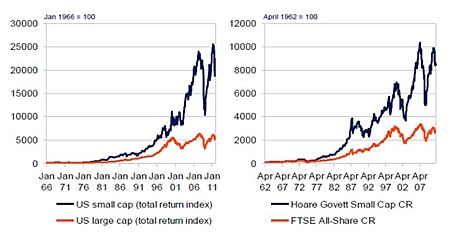
In a well diversified equity portfolio, small cap shares
deserve a place, especially if one has a longer term view (as can be seen by the
huge outperformance over the long run in the Small Cap Performance chart this
page).
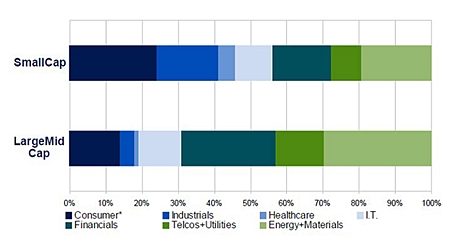
Small cap shares concentrated in emerging markets also offer
the investors a more balanced approach to investing in these economies, as they
tend to cover a greater mix of sectors, unlike the indices which tend to be
dominated by a few large players.
To illustrate this point, the Russian index is dominated by
five companies which make up about 45% of the market, with three of the largest
being state owned, namely Gazprom, the world’s largest gas producer, Sberbank,
the largest Russian bank, and Rosneft.
China is a little less concentrated, with its top five
companies making up a bit less than 30% of the market, four of them being
PetroChina, Bank of China, China Construction Bank and the Agricultural Bank of
China.
It is not only the concentration of a few large companies
that dominate emerging stock markets, but it is also the fact that the top end
of the markets is predominantly in either finance or commodities, usually oil.
The S&P Breakdown shows how much more heterogeneous the small cap sectors are in
emerging markets.
A very important point to note for those wanting to invest in
emerging markets is that small cap shares tend to be more domestically focused
and 80% are less directly impacted by currencies and global trade.
Furthermore, if one considers the rise of the middle class in
emerging markets, with predictions showing that by 2030 over 90% of the world’s
middle class consumers will reside in the developing markets, relative to 50%
today, the case for emerging market small cap becomes even stronger.
There is also a huge choice, some of 2,894 potential investee
companies, 1,747 of which have market capitalisations in excess of $300m
(including Developed Asia).
Small cap shares offer investors an earlier stage in their
growth path. Remember, Microsoft and Apple were not always the behemoths they
are today. Small caps also offer a purer exposure to new technologies, products
and market segments. What is also important is that this sector of the equity
space also offers the ability to buy focused and directly incentivised
management, as many would have been born out of private companies.
Looking at all the positives for investing in emerging market
small cap stocks, one would be inclined to have a fairly large portion of one’s
portfolio allocated to this segment of the market. However, valuations relative
to large cap stocks are not as cheap as they used to be and hence one needs to
be aware that the margin of safety is less than it used to be.
Investors need to be aware that when investing in small caps
stocks there is risk and, what is more, emerging market stocks also offer risk
and here you have a scenario of small cap emerging market stocks! So please be
careful.
But if we are going into a world of slower growth for
developed economies then it is more than conceivable that most of the growth
will be harnessed in emerging markets. So, taking a bit of a risk, provided it
is part of a well diversified equity portfolio should reward investors.
|
The above data and research was compiled from sources
believed to be reliable. However, neither MBMG International Ltd nor its
officers can accept any liability for any errors or omissions in the
above article nor bear any responsibility for any losses achieved as a
result of any actions taken or not taken as a consequence of reading the
above article. For more information please contact Graham Macdonald on
[email protected] |