|
|
 |
| AUTO MANIA:
by Dr. Iain Corness |
|
|
|

EVs in the news again
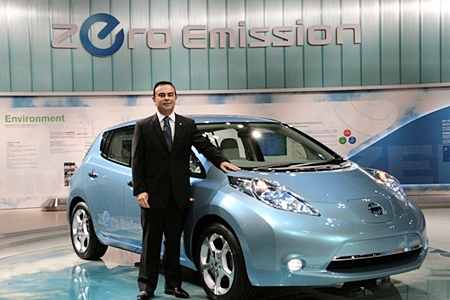
Renault Leaf.
Bangkok is going to have some electric vehicle (EV)
recharging stations. As reported in the Pattaya Mail, the
Metropolitan Electricity Authority (MEA) unveiled Thailand’s first EV
charging station for the public, with a total of 10 stations expected to be
launched by the end of this year.
According to MEA Governor Atorn Sinsawat, the agency
supports the use of environmentally-friendly electric cars, as the vehicles
run on clean energy. The first EV station is now open for use at the MEA’s
headquarters, with nine more to be built before the end of December. Members
of the public can use the station’s services for free until July 31, 2013.
The agency also plans to order 20 electric cars for its
own use within the next four years. This is good, as I do not know of too
many EV’s running along Sukhumvit at present to use their free top up
charge!
However, is the push for EV’s just a passing fad and
Bangkok is leaping on the wagon a little too late? Are EV’s something that
will again go on the back burner when it becomes obvious we won’t run out of
oil?
One interesting group in the manufacturers is the Renault
Nissan Alliance, led by Carlos Ghosn. This was founded in 1999, and its
objective is to rank among the world’s top three vehicle manufacturers in
terms of quality, technology and profitability. And the Renault Leaf EV
technology is now available through your friendly Renault Nissan dealer (as
long as there is a recharging station around the corner).
Carlos Ghosn, President and CEO of Renault and President
and CEO of Nissan said, “To reconcile the demand for individual mobility
with the preservation of the environment and high cost of oil, the Renault
Nissan Alliance is committed to the development of “zero-emission” vehicles
(ZEV).”
The ZEV concept was not just an American movement, as in
November 2008, UPS announced an order of twelve electric vehicles from
Modec, the manufacturer of the world’s first purpose-built zero-emission
van. Six vehicles were introduced into UPS’s UK fleet in February 2009. The
remaining six were in operation in Germany.
Modec vehicles were designed around a large, removable
battery cassette. Two battery capacities were available; offering 160 km
range or a 100 km range, on a single overnight charge. However, this was
Utopia, as Modec went bust last year. The world is still not convinced that
“clean energy” is top priority.
Interestingly, globally, the UPS people have been
utilizing alternative fuel vehicles for more than 70 years. It currently
operates the transportation industry’s largest private fleet of alternative
fuel vehicles. UPS’s use of alternative fuel vehicles dates back to the
1930’s with electric vehicles in New York City, and today the company uses
alternative fuel vehicles in Brazil, Canada, France, Germany, Mexico, the UK
and the US. But this alternative fuel position didn’t stop Modec going to
the wall.
|
|
 |
Do you know where your car is. Right now?
Wouldn’t it be great if someone stole your car, but you could
hit a “kill switch” and make it stop right where it is. Right now! Well, that
technology is with us, right now.
I spent an interesting hour with Rob Scarr at Securitas to
see the latest developments in GPS trackers, and came away amazed at the
technology, and quite frankly, amazed at how inexpensive it is.

Securitas vehicle tracker.
Today’s trackers provide ‘real-time’ vehicle tracking and
history which is so detailed it will take your breath away. The very small
device (and it really is a black box) will return information such as going over
the pre-set speed limits, time sitting idling, collisions and towing. All this
is available through GPRS/GSM data-loggers.
All the above is in addition to giving an accurate position
of where the car is to within five meters, and you can even see it on Google
Earth/Google map. You can erect ‘geo-fences’ which will automatically let you
know if the vehicle strays outside from where it should be.
Of course the “kill switch” feature, by which you can cut the
car’s ignition circuit will also make stealing your car far more difficult. With
one of these, your stolen car won’t even get to the Cambodian border!
Despite the fact that most new vehicles have burglar alarms,
have you ever seen anybody do anything about a car parked at the side of the
road with the flashers and horn going? Even when it is being winched onto a
slide-on truck!
With the costs of vehicles these days ranging from 500,000
baht for a cheapie, up to several millions of baht for luxury cars, simply
having insurance does not get your car back, but a tracker can. The Securitas
tracker costs 795 baht + VAT per month on a three year contract, complete with
free fitting, monitoring and reporting. I reckon that’s a bargain.
If you want to know more, contact Rob Scarr at Securitas
Thailand, 081 377 0122 or email Rob.Scarr@securitas. co.th.
|
|
Our Mitsubishi Mirage an econo-hit in Japan
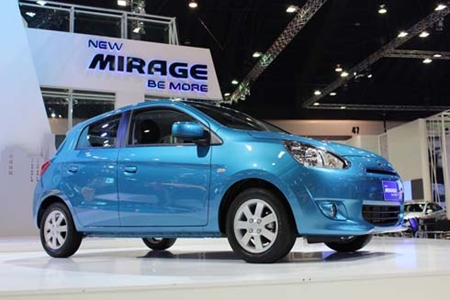
Our Mitsu Mirage.
Our Thai Mitsubishi Mirage has gone on sale in Japan
returning fuel consumption as low as 3.7 liters per 100 km on the Japanese JC08
test cycle, for the smallest engine version.
In Japan, even the larger engines Mirage where it goes
without fuel-saving idle-stop technology and aerodynamic enhancements, results
in a higher Japanese fuel consumption figure of 4.3 L/100 km, but even that is
frugal.
Mirages fitted with idle-stop are claimed to be the most
economical non-hybrid petrol cars available in Japan and qualify for the
Japanese government’s “eco-car” tax breaks, as it does in Thailand.
Japanese market Mirages use a 1.0 liter three-cylinder petrol
engine producing 51 kW of power at 6000 rpm and 86 Nm of torque at 5000 rpm, and
are sold exclusively with an automatic continuously-variable transmission (CVT).
The variant here has the 1.2 liter three-cylinder producing
57 kW at 6000 rpm and 100 Nm at 4000 rpm, with CVT.
The good fuel consumption figures reflect the weight of less
than 900 kg and claimed drag coefficient of 0.27.
The Mirage has been a sales success and more than 33,000
orders have been taken since the books opened on March 28 this year.
In Japan, more than 5000 Mirages have already pre-ordered
since June 26 and Mitsubishi has set a sales target of 30,000 units for its
domestic market by the end of its fiscal year ending on March 31 next year.
|
|
Ground Control to Major Tom
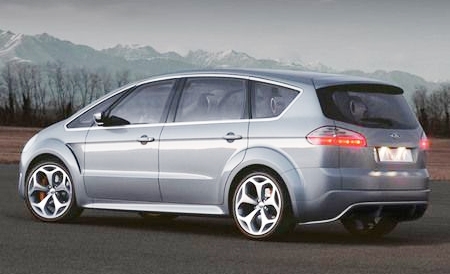
Ford S-Max.
Ford Motor Company has begun real-world testing of future
technologies as part of a research program aimed at advancing car-to-car and
car-to-infrastructure communication on European roads. Benefits from this
research will eventually be seen in the Ford Global Cars of the future.
“Car-to-car and car-to-infrastructure communications
represent the next major advancements in vehicle safety,” said Paul Mascarenas,
chief technical officer and vice president, Ford Research and Innovation. “Ford
is committed to further real-world testing here and around the world with the
goal of implementation in the foreseeable future.”
Ford is contributing 20 specially equipped S-MAX models to a
120 vehicle fleet being used to test 20 experimental driver assistance
technologies as part of the four-year research project “Safe Intelligent
Mobility - Testfield Germany” or more simply known as simTD. The project’s goal
is to better understand the potential for car-to-car and car-to-infrastructure
communication technologies to improve traffic safety and personal mobility.
Experts believe roads could be made safer and traffic
congestion reduced by using mobile communications technology to integrate
vehicles with each other and with transport infrastructure. Engineers from
Ford’s European Research Centre in Aachen, Germany and simTD research project
partners have up to now tested the developmental technologies in a controlled
environment. The technologies will now be tested on public roads in and around
Frankfurt in real-world driving conditions.
Technologies being tested as part of the simTD research
project include:
Electronic Brake Light, which delivers a message from the
vehicle in front to a following vehicle if an emergency braking procedure is
carried out, even if the incident occurs out-of-sight, for example around a bend
in the road. Ford is leading the development and integration of this application
Obstacle Warning system, which enables a vehicle to inform other road users of
the presence, position and type of potentially hazardous obstacles on the road.
Traffic Sign Assistant, which remains in continuous contact
with traffic management centers to access up-to-date information on variable
speed limits, temporary restrictions and diversions, as well as providing
details of current and approaching permanent regulations, such as fixed speed
limits and right of way.
Public Traffic Management, provides exact traffic prognosis
based on comprehensive information. This includes identifying likely traffic
scenarios and their impact at the point in the journey when they are encountered
rather than at the point of departure. In-car internet access, which, for
example, can enable the driver to reserve and pay for parking en-route.
“The vehicles will cover thousands of kilometers in test
drives and evaluations to gather valuable research data from every-day driving
scenarios,” said Christian Ress, technical expert, Ford Research and Advanced
Engineering.
The increasing use of car-to-car and car-to-infrastructure
technology is part of Ford’s “Blueprint for Mobility,” which was outlined by
Executive Chairman Bill Ford during his keynote address at the 2012 Mobile World
Congress in Barcelona in February. The “Blueprint for Mobility” details the
company’s early thinking on how to tackle the issues of mobility in an
increasingly crowded and urbanized planet between now and 2025.
|
|
Autotrivia quiz
Last week, in an effort to beat the ‘Googlers’, I asked what
is the common viewing component in an MGTC and a MAZ tractor? This common
component is manufactured by the same process and has been the subject of law
suits and anti-trust legislation and the technology dates back to 1905. Enough
clues, what was it? It was the windscreen glass, pioneered by Triplex and is
called the flotation process over molten tin.
So to this week. In 1959 a driver in the UK was found guilty
of a charge and fined three pounds. What had he done and how did they catch him?
For the Automania free beer this week, be the first correct
answer to email [email protected]
|
|
 |
|
|
|
E-mail:
[email protected]
Pattaya Mail Publishing Co.Ltd.
62/284-286 Thepprasit Road, (Between Soi 6 & 8) Moo 12, Pattaya City T. Nongprue, A. Banglamung,
Chonburi 20150 Thailand
Tel.66-38 411 240-1, 413 240-1, Fax:66-38 427 596
Copyright ? 2004 Pattaya Mail. All rights reserved.
This material may not be published, broadcast, rewritten, or
redistributed.
|