Cape Grapes
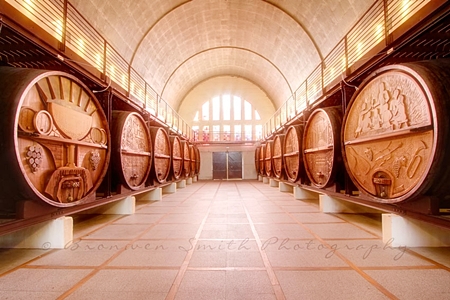
KWV’s famous Cathedral Cellar at Paarl.
Over three hundred and fifty years ago, the first wine grapes were harvested in
South Africa. They grew not very far from where modern day Cape Town now stands.
The historical heart of South African wine has always been in this region and
today most of the country’s wine production takes place in the Cape,
particularly the southwest corner near the coastal region.
These two wines come from the prestigious KWV group in South
Africa. Established in 1918, KWV is one of the leading wine and spirits
producers in the country. Their enormous and renowned cellars in Paarl
(including the famous Cathedral Cellar) cover an area of 22 hectares: over 54
acres. More than a hundred different natural wines, as well as brandies and
fortified wines are produced here for the international markets.
Wines in boxes are convenient and considerably cheaper than
buying in bottles. They are also getting better and although there are plenty of
cheapies around, some better quality wines are now available in boxes. The
Pearly Bay wines are just two of them. Of course the most important thing
about wines boxes is that unlike bottled wines, they don’t go off once they’ve
been opened. You can keep a half-empty bottle of white in the fridge for a
couple of days at the most, after which time the oxidization will render it
useless. If, like me you enjoy a glass of dry white wine as an ap้ritif before
dinner, the box is perfect because you can go back to it day after day knowing
that the wine will always be fresh.
These two Pearly Bay wines are a bit more expensive
than some of the competition, but they’re worth every baht. A three litre box
contains the same volume as four standard bottles, so the price is the
equivalent of Bt. 226 a bottle, which is considerably cheaper than any bottled
wines.
KWV Pearly Bay Cape White,
South Africa. (Villa Bt. 906, 3 litre box)
Pearly Bay - also known at Pearly Beach - actually exists.
It’s on the southern Cape coast; a vast stretch of heather-covered dunes with a
dazzling, pearly white beach.
This is one of the KWV’s best-selling wines and is evidently
very popular in Finland, where it’s the top-selling South African brand. Not
surprising really, for this wine is young and lively, with a floral aroma of
white fruit and a kind of grassy freshness. I could almost smell the sea breeze.
But perhaps that’s my imagination. Anyway, it’s a very pleasing fresh dry wine
with pears and white fruit on the taste and just enough light acidity to give it
an attractive zesty quality. It’s an easy drinker with a crisp, dry citrusy
finish and a hint of dried herbs too.
The wine is a blend of predominantly Chenin Blanc and
Colombard, both of which hail from France but have become popular in other parts
of the world. These grapes are often blended together and make light and fresh
floral wines, just like this one.
I’d enjoy drinking this wine on its own, but at just 12%
alcohol content, it would work well with light snacks, omelette or salads. It
would also help to brighten up the dismal Finnish winters.
Pearly Bay Cape Red, South
Africa.
(Villa Bt. 906, 3 litre box)
This is a very dark, purplish red wine with interesting and
attractive aromas of vanilla, black fruits and berries. There are hints of spice
and mint too. It’s quite dry and medium-bodied with a pleasant, smooth
mouth-feel. There’s quite a bit of black fruit on the taste and also a pleasant
layer of soft, firm tannin.
There is an attractive hint of spice and pepper, the kind of
taste you sometimes get from a Shiraz. This, it turns out is not altogether
surprising because there’s some Shiraz in the blend, along with the other old
favourites, Merlot, and Cabernet Sauvignon.
Although the wine has about 13.5% alcohol content, it’s a
very easy-drinker and would be fine with meals like beef casserole, grilled
sausages or traditional barbecues.
Oh, and in case you’re wondering, the initials KWV stand for
Ko๖peratiewe Wynbouers Vereniging van Suid Afrika. I am sure you feel
much better for knowing that.