|
|
 |
| AUTO MANIA:
by Dr. Iain Corness |
|
|
|

No Grand Prix this weekend
This is the holiday period for the Grand Prix circus, so
the next GP is not until September 2 at the famous Spa circuit. In the
meantime it is Playstation or reading books. However, while the drivers
might be sunning themselves on beaches all over the world (including
Thailand), the development engineers will be drawing up the next upgrades to
get them through to the end of the year. With Alonso (Ferrari) at the top of
the leader board, McLaren, Red Bull and “Lotus” will be aiming to dethrone
the Spaniard as soon as possible.
|
|
 |
Airbags for the rear?
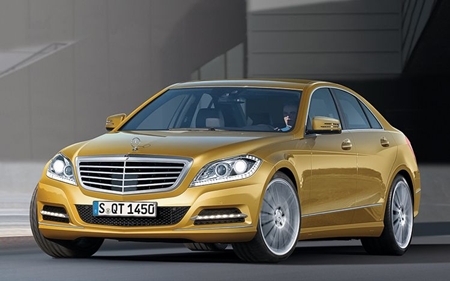
Your Benz awaits, Sir.
The Mercedes S-Class limousines are scheduled to have
inflatable rear-seat ‘beltbags’ in the 2013 models. Mercedes has confirmed it
will put its innovative inflatable “belt-bag” into production in a high-end
luxury model, thought to be the new-generation 2013 S-Class.
Since it is difficult, to the point of impossibility to have
an air-bag in front of the rear passengers, Mercedes has developed the
“belt-bag”. This is worn like a normal seatbelt, but expands to three times its
normal width when triggered by crash sensors in the front of the vehicle, which
would deploy the airbags in the front.
The wider surface area of the inflated belt helps to reduce
the unit loading to the body from the straps by spreading the load and thus
reducing chest and collar bone deformation in a severe crash.
The belts are inflated in the same way as an airbag, with an
explosive “gas generator” mounted at the top end of the belt, and will be used
in conjunction with Mercedes’ active seatbelt buckle that retracts into the seat
to reduce the risk of pelvic injury.
The seatbelts in the rear seats of Mercedes cars are already
equipped with pre-tensioners and force limiters – features that are usually only
found in front seats in most other cars.
It would appear, reading between the lines, that China will
get the rear belt-bags first as their press release indicates that the belt-bag
was developed with a particular view toward new markets, where the occupancy
rate in the rear is as much as 30 percent, making it much higher than in
Europe.”
The Chinese statistics would show that in developing markets
such as China, there is very high back-seat usage in chauffeur-driven limos and
where Mercedes-Benz sells 60 percent of its vehicles.
|
|
Anyone for an Aspid GT-21 Invictus?
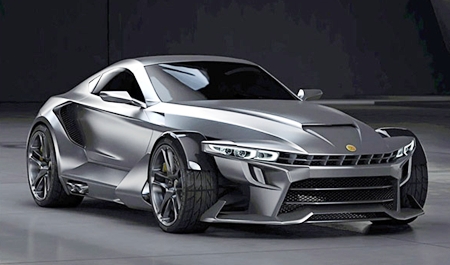
Open-wheeler.
There is a fairly radical car, built in the UK, called the
Ariel Atom with exposed chassis/frame tubes. Very light and goes like the
proverbial brown stuff off a shovel, but for sheer off-the-wall craziness, it
comes nowhere near Spain’s latest supercar, the Aspid GT-21 Invictus.
Aspid has claimed the GT-21 Invictus to be the first
four-seat GT car with an open-wheeled arrangement at the front-end. Aspid chief
designer and founder Ignacio Fernแndez Rodriguez said the company had to retain
the open-wheeled characteristics of their concept car, the SuperSport in order
to set itself apart from the crowd.
“This presented by far the biggest challenge in terms of
packaging the interior volume for the driver and passengers,” he said, “but
we’ve successfully achieved this and have therefore maintained our unique visual
identity, so the car is perceived as an Aspid the instant it’s seen.” This of
course may be so, but uncovered front wheels are just totally impractical, which
is why the automotive industry invented “mudguards” about 100 years ago! Note
the name, Senor Rodriguez “mud-guards”!
Despite this weird concept and very strange styling, it is
again claimed by Aspid that the GT-21 Invictus will return a sub-3.0 second
0-100 km/h time and a top speed of 305 km/h. Another of the claims is that the
all-up weight is less than 1,000 kg.
To go with the individual nature of this Aspid company, I was
expecting an 11 cylinder radial engine, but no, they have opted for the latest
generation Euro 5-compliant 4.4 liter BMW naturally aspirated V8 engine
generating 331 kW of power at 8,300 rpm and 440 Nm of torque at 3900 rpm.
The power is transferred through the rear wheels and matched
to a dual-clutch automatic transmission with paddle shifters on the steering
wheel.
More claims include a “new-generation” hybrid technology,
which Aspid says will improve performance while cutting fuel use and emissions,
but no further details are currently forthcoming.
Underneath the composite bodyshell (with integrated roll
cage) sits an all-aluminium double wishbone suspension set up with
racing-inspired pushrod dampers that help the car pull a claimed 1.6 g in the
corners.
Brakes are huge 400 mm discs all-round to dissipate heat at a
faster than usual rate, giving performance that is said to be on par with carbon
brakes without needing to be warmed up.
Dimension details are 4447 mm long, 1883 mm wide and 1226 mm
high, allowing a 2+2 seating layout coupled with 275 liters boot capacity.
Senor Rodriguez says, “We aim to offer a unique and
unforgettable experience when a customer buys one of our sports cars. We believe
our factory model and our relationship with each customer will be unique and set
a new standard in the market. It will be more like the relationship experienced
between a professional race driver and his race engineer and race team.” (In
some ways, this car is this century’s remake of the Bugatti Royale. Totally
impractical. I have no idea what Senor Rodriguez has been smoking, but he should
desist!)
|
|
Super tweak for the Go-Faster set
High under-bonnet temperatures can reduce the available
horsepower in any engine, so much thought goes into getting the hot air out from
the engine bay. (Even my Securitas Retro Racing Escort Mk 1 has a large vent in
the middle of the bonnet to expel the hot air.)
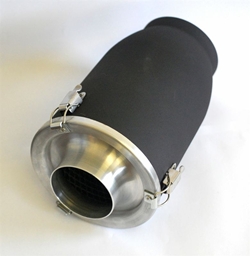
Cooling air filter.
Race and rally engineers constantly struggle to manage air
intake temperatures, particularly in production-based competition cars such the
British Touring Cars category. The increased heat generated and the restrictions
on modifications lead to the air intake temperatures rising with a noticeable
drop in power.
Now leading air filter manufacturer Pipercross believes it
has solved the issue on its flagship C7000 filtration unit thanks to the use of
a ceramic coating from Zircotec.
“One of the biggest issues in any engine bay is heat,” says
Luke Tibble, development and motorsport manager at Pipercross. “For the air
intake, it is imperative that cold, dense air is getting to the engine so it can
perform at its best.” The solution was to isolate its C7000 filter unit, a
product used by half of the BTCC grid as well as Time Attack, British Drift
Championship and track day enthusiasts, from heat with a high performance
Zircotec ceramic coating. “In previous years we tried carbon fibre, PPE and a
range of heat shields, each offering some benefit,” adds Tibble. “As a
motorsports company we constantly are looking for better solutions that provide
more performance. It was this research that led us to Zircotec.”
Zircotec already provides a range of thermal management
solutions to motorsport protecting both driver and car from the effects of heat
but applying the coating to an air filter housing was novel. “The C7000 is a
closed filtration unit with an aluminium housing,” says Ziroctec’s sales
director Peter Whyman. “We are able to plasma spray the housing to prevent heat
soaking into the filter itself. As the ceramic coating can lower surface
temperatures by 30 percent, it offers a significant reduction in air temperature
inside the unit.”
According to Pipercross, having the C7000 unit coated has
already resulted in delighted customers in the BTCC and other series.
“Zircotec’s ThermoHoldฎ based coating has contributed to keeping intake
temperatures down on the cars, ultimately providing more power,” concludes
Tibble.
After seeing the effect it’s coating offers in terms lowering
air intake temperatures, Zircotec is keen to investigate other uses where its
durable, lightweight, thin (just 300 microns) coating could be used to offer
performance advantages in other applications. “Any application that requires
cooler air intakes could benefit from using a Zircotec coating,” concludes
Whyman.
In Thailand, with the high ambient temperatures, this
Zircotec application could provide quite an advantage. A certain Mk1 Escort is
seriously looking at the possibilities.
|
|
Autotrivia quiz
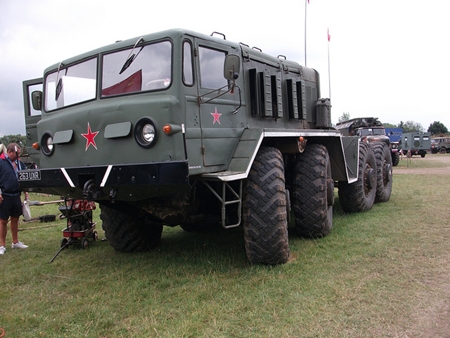
MAZ tractor.
Last week I asked who was this? He was almost 60 when he
drove his last race, winning it. During his sporting career he competed in more
than 350 races (bike and car), won 105, had 77 class wins, and 100 fastest laps.
Who was he? It was Tazio Nuvolari, the Flying Mantuan, and for many pundits,
still the greatest driver of all time. Difficult to prove or disprove, but there
is no getting away from Nuvolari’s amazing competitive history.
So to this week. In an effort to beat the ‘Googlers’, try this one. What is the
common viewing component in an MGTC and a MAZ tractor? This common component is
manufactured by the same process and has been the subject of law suits and
anti-trust legislation and the technology dates back to 1905. Enough clues, what
is it?
For the Automania free beer this week, be the first correct answer to email
[email protected]
|
|
Natter Nosh and Noggin
The next car club meeting will be at Jameson’s Irish Pub on
Soi AR next to Nova Park. The next meeting is on Monday August 13 at Jameson’s
at 7 p.m. A totally informal meeting of like-minded souls to discuss their pet
motoring (and motorcycling) loves and hates (plus lies and outright
exaggerations). Come along and meet the guys who have a common interest in cars
and bikes, and enjoy the Jameson’s specials, washed down with a few beers.
Always a fun night. Be prepared to laugh a lot at some of the antics of the
members (when they were younger)! The Car Club nights are always on the second
Monday of the month (not every second Monday)!
|
|
 |
|
|
|
E-mail:
[email protected]
Pattaya Mail Publishing Co.Ltd.
62/284-286 Thepprasit Road, (Between Soi 6 & 8) Moo 12, Pattaya City T. Nongprue, A. Banglamung,
Chonburi 20150 Thailand
Tel.66-38 411 240-1, 413 240-1, Fax:66-38 427 596
Copyright ? 2004 Pattaya Mail. All rights reserved.
This material may not be published, broadcast, rewritten, or
redistributed.
|