Dancing the night away
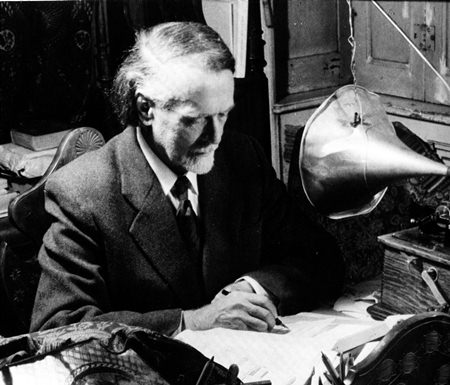
Zoltán Kodály analysing folk-song recordings.
Nobody knows when humans
started dancing, but it must have been a very long time ago. It was probably a
natural expression of joy or elation and I suspect many generations elapsed
before the concept of ritual dancing emerged. But of course, all this is so far
back in human history that we simply don’t know. Your guess it as good as mine
and to be honest, probably better.
We know that formalized
dancing was practised among the ancient Greeks, because various artifacts depict
dancers and musicians. Even so, we don’t know very much about what the music
actually sounded like. It wasn’t until the Renaissance began to dawn, that an
increasing amount of dance music was written down. Huge collections were
produced during the second half of the sixteenth century onwards, notably by
prolific composers like Michael Praetorius, Tielman Susato and publisher Pierre
Phalèse.
Leuven lies about sixteen
miles east of Brussels and Pierre Phalèse started a bookselling business there,
which developed into a successful publishing house. By 1575 he had produced
nearly two hundred music books, many for the lute - a popular instrument for
singing and dance music. At first, Phalèse outsourced his books to various
printers, but later produced his own music books using state-of-the-art
technology, movable type.
During the sixteenth and
seventh centuries, dance music of all forms flowed from the pens of many
composers, including some distinguished ones like Bach, Handel, and Georg
Philipp Telemann who wrote suites of dances, not necessarily for dancing but as
courtly entertainment.
Zoltán
Kodály (1882-1967): Dances of Galánta.
London
Philharmonic Orchestra cond. Vladimir Jurowski (Duration 15:23 Video 720p HD)
Zoltán Kodály (zohl-TAHN
koh-DAH-yee) is best known as the creator of the so-called Kodály Method.
He became interested in children’s music education in 1925 when he happened to
hear some school kids singing in the street. He was horrified by their tuneless
squawking and drew the conclusion that music teaching in the schools was to
blame. He set about a campaign for better teachers, a better curriculum, and
more class-time devoted to music. His tireless work resulted in many
publications which later influenced music education world-wide.
Kodály is most closely
associated with a teaching aid he didn’t actually invent: the hand signs. The
so-called Kodály hand signs were devised in the mid-nineteenth century by an
English minister, John Curwen and they represent each note of the scale. They
were used in the 1977 movie Close Encounters of the Third Kind, but they
didn’t seem to fit the plot and were perhaps merely included to add a bit of
gravitas to a rather implausible scene.
Kodály wrote Dances of
Galánta in 1933 using folk music of the Galánta region, now part of
Slovakia. The work is in five sections and the clarinet is especially
prominent, because it represents the traditional Hungarian tárogató, a
single reed instrument whose conical bore produces a unique sound, somewhere
between that of an oboe and that of a soprano saxophone.
Alberto
Ginastera (1916-1983): Dance Suite from “Estancia”.
Simon Bolivar Orchestra of Venezuela cond. Gustavo Dudamel (Duration: 12:52;
Video: 480p)
Alberto Ginastera (jee-nah-STEHR-ah)
is considered the most powerful voice in Argentine classical music. He studied
at the conservatoire in Buenos Aires, and later with the American composer Aaron
Copland. Ginastera’s music can be challenging, percussive, thrilling,
thought-provoking and sometimes even downright scary.
The thunderous last
movement of the dramatic First Piano Concerto was brought to fame in 1973 when
it was adapted by the rock group Emerson, Lake & Palmer. Ginastera even
approved of the arrangement, which relied heavily on keyboards and synthesized
percussion.
Much of Ginastera’s music
is nationalistic and draws on Argentine folk themes or other elements of
traditional music. He greatly admired the fine Gaucho traditions and this is
reflected in his 1942 one-act ballet Estancia (“The Ranch”). It’s a
story about a city boy who falls for a rancher’s daughter, but the girl finds
him weak and dull compared to the macho and intrepid Gauchos. Ginastera turned
the ballet music into a delightful four-movement orchestral suite and if you
haven’t heard Ginastera before, this is a great place to start. All the
hallmarks of his style are there: his love of percussive sounds, his sparkling
angular melodies and his tremendous sense of rhythm.
You would need a heart of
stone to not be moved by the dazzling last movement (at 09:04) which is an
absolute “must hear”. The closing section (at 10:47) is thrilling, with
cataclysmic percussion and brilliantly articulated playing.
The Simon Bolivar
Orchestra of Venezuela is the direct result of another dedicated music educator,
José Antonio Abreu, who developed a music education programme in Venezuela known
as El Sistema. This young Venezuelan orchestra is superb and the
brilliant, musically-gifted conductor Gustavo Dudamel clearly enjoys every
moment of this action-packed music.