Water Tax
 I
read the other night somewhere that dogs are mostly made of water. Ninety
percent of it, to be precise. Perhaps this explains why they feel the need to
stop at every tree and lamp-post to get rid of some of it. Humans of course,
also contain a lot of water. You almost certainly contain between sixty and
seventy percent water and so does everyone else. Policemen and immigration
officials are mostly composed of water. However, I wouldn’t suggest that you
tell this to an official in the Immigration Department, especially if you happen
to be applying for a visa at the time.
I
read the other night somewhere that dogs are mostly made of water. Ninety
percent of it, to be precise. Perhaps this explains why they feel the need to
stop at every tree and lamp-post to get rid of some of it. Humans of course,
also contain a lot of water. You almost certainly contain between sixty and
seventy percent water and so does everyone else. Policemen and immigration
officials are mostly composed of water. However, I wouldn’t suggest that you
tell this to an official in the Immigration Department, especially if you happen
to be applying for a visa at the time.
And another thing. Did you know that about eighty-five
percent of the wine in your glass is actually water? A fortified wine, like
sherry or port has a bit less, but a sweet wine could have as much as ninety
percent - the same as your dog. When you stop and consider how much tax we pay
on our wine, it is a sobering thought to realise that we are being taxed mostly
on water.
Some weeks ago, a letter from a reader appeared in this
newspaper asking why the price of wine in Thailand is so high compared to
neighboring countries. The answer of course, is tax. And it’s not just that the
tax is high, but that there are so many of them. In theory, you are supposed to
pay five different taxes on a bottle of wine. First, there’s the Import Tariff,
which with very few exceptions is around 54%. Then there’s the 60% Excise Tax
which is placed on certain products deemed to be luxury goods, including wine.
You then have to add in Municipal Tax and Health Tax (yes, honestly!). On top of
all that there’s VAT, which is based not only on the value of the product but
also the sum of all of the other taxes. When you finally add this lot up, the
tax on your bottle of wine works out to just over 390%. Even locally-made wines
are subject to the same taxes, although they are spared the import tariff.
But it doesn’t end there, because people expect to make a
profit, including the importer, the distributor and the retailer. Depending on
where you buy your wine, there’ll be an additional mark-up of 5-20% in shops and
supermarkets and between 100 to 300% at a restaurant. Now if that doesn’t drive
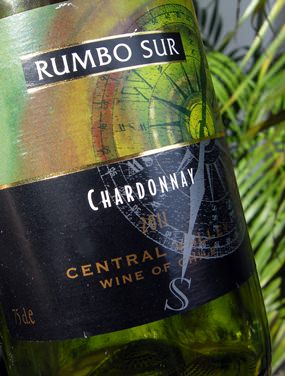
you to drink, I don’t know what will. Try a glass of Rumbo Sur Chardonnay to
ease the misery.
Rumbo Sur Chardonnay 2011
(white), Chile. (Bt. 319 @ Villa)
At first glance, I could have sworn the label said “Rambo”
but of course, it didn’t. Consulting the yellowing pages of my Spanish
dictionary it turns out that “rumbo” means a road, a course or a bearing. “Sur”
of course means “south”. So I suppose the name translates as “Southbound” or
something similar. If your Spanish is better than mine (which in itself is no
great achievement) you probably know about these things already, in which case I
am sorry to have wasted your time.
After a great deal of searching the back label with a
magnifying glass, I discovered the name “Ventisquero” in minuscule print. Now
this makes all the difference because this company has won cartloads of
international awards especially for their excellent Yali and Raminara
range of wines.
This is a pale gold with greenish hues and a lovely soft and
inviting aroma of pineapple and banana, with a dash of pomelo and lychee. I
don’t know why, but Chilean winemakers invariably manage to coax superb aromas
out of the grape. But you’ll need to give it a bit of time for the aromas to
emerge. This is Chilean to the bone, because after the seductive aromatic
introduction there’s a clean, rich and powerful taste. It’s not one of those
pussy-footing Chardonnays that lack character and personality. There’s nothing
shy and retiring about this little number, I can tell you. Perhaps there’s a
touch of the movie hero in the wine too, though it exudes a kind of feminine
charm. Daughter of Rambo, perhaps. There’s plenty of white fruit on the palate
with reminders of pineapple and peach; refreshing cut of acidity and a crisp dry
mouth-feel with a long dry and fruity finish.
Unlike many Australian commercial Chardonnays, which without
putting too fine a point on it, are about as interesting as kangaroo droppings,
this Chilean wine really has something to say. And just look at that price.
Rumbo Sur Cabernet Sauvignon
2012 (red), Chile. (Bt. 289 @ Villa)
Now here’s a super little wine which is worth every satang.
At this price it must be one of the cheapest in town, so I’d suggest you hop on
your water buffalo and lumber down to Villa before it’s all gone. The wine is a
dark ruby red wine with purple hues and a lovely gentle aroma of plums, ripe
cherry, raspberry and black currant. There are reminders of vanilla and a
pleasant touch of dill and dried herbs.
It’s a light-to-medium bodied wine which is beautifully soft
on the palate and there’s generous fruit with just the tiniest touch of acidity
to give the wine a bit of shape. The tannins are very soft and supple, so much
so that they are hardly there at all. Even so, the wine has a surprisingly long
finish. It comes at 13% alcohol content which is fairly standard for Chilean
reds these days and turns out to be a delightfully easy drinker.
And talking of water, before I was rudely interrupted by
someone droning on about Chilean wine, please resist the temptation to wash your
wine glasses with washing-up liquid unless of course, they have become
intolerably greasy. Washing-up liquid tends to have a tenacious smell that
lingers on even after rinsing, so that enticing citrus aroma of your Chardonnay
could be nothing to do with the wine. You can usually clean your wine glasses by
holding them under extremely hot water from the tap, but do be careful because
this process can result in scalded hands, broken glasses and possibly a lot of
bad language. Sadly, I speak from personal experience.
Anyway, both these wines are terrific bargains and to my mind
a whole lot better than many Australian wines costing twice the price. And you’d
never guess they’re mostly water.