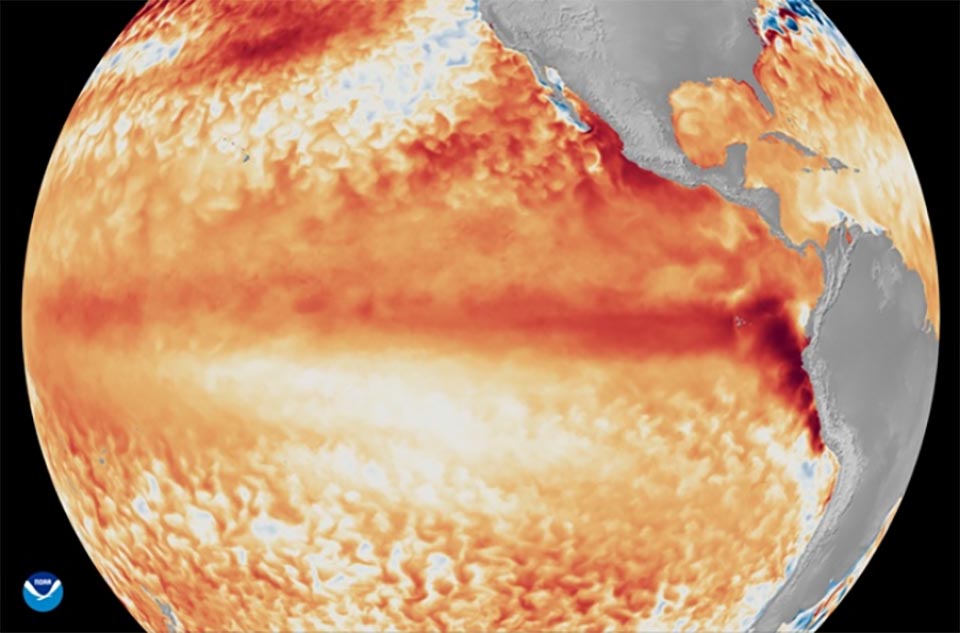
WASHINGTON, D.C. – The U.S. National Oceanic and Atmospheric Administration (NOAA) has officially declared that El Niño conditions have developed in the tropical Pacific Ocean, with forecasters warning there is a 63% chance the climate phenomenon could intensify into a very strong or “Super El Niño” by late 2026 or early 2027. The announcement comes after several months of ENSO-neutral conditions, during which Pacific Ocean temperatures remained near average. Scientists have now observed sustained warming of sea surface temperatures in the central and eastern equatorial Pacific above the El Niño threshold, along with atmospheric changes consistent with the phenomenon.
According to NOAA, there is a 63% probability that sea surface temperature anomalies in the Niño monitoring region will exceed 2°C above average between November 2026 and January 2027, a level that would classify the event as a very strong El Niño and place it among the most powerful episodes recorded since 1950. Climate models from both the United States and Europe are increasingly converging on forecasts of a significant event, raising concerns among scientists that the developing El Niño could rival or even surpass the historic 1997-98 episode, which triggered devastating floods, droughts, and economic losses across multiple continents.
The World Meteorological Organization (WMO) has also warned that El Niño is likely to influence global temperature and rainfall patterns over the coming months, increasing the risk of extreme weather events worldwide. Although El Niño develops in the Pacific Ocean, its effects are felt far beyond the region. The phenomenon alters atmospheric circulation patterns around the globe and is often associated with heatwaves, droughts, wildfires, heavy rainfall, flooding, and disruptions to agriculture and water supplies in various parts of the world.
Scientists are also closely monitoring the possibility that a strong El Niño could contribute to record-breaking global temperatures in 2027. Previous major El Niño events have amplified the effects of long-term climate warming, helping push global temperatures to new highs. While forecasters caution that every El Niño event is unique and its exact impacts remain uncertain, governments, businesses, and emergency planners around the world are being urged to prepare for the possibility of significant weather disruptions over the next 12 to 18 months.