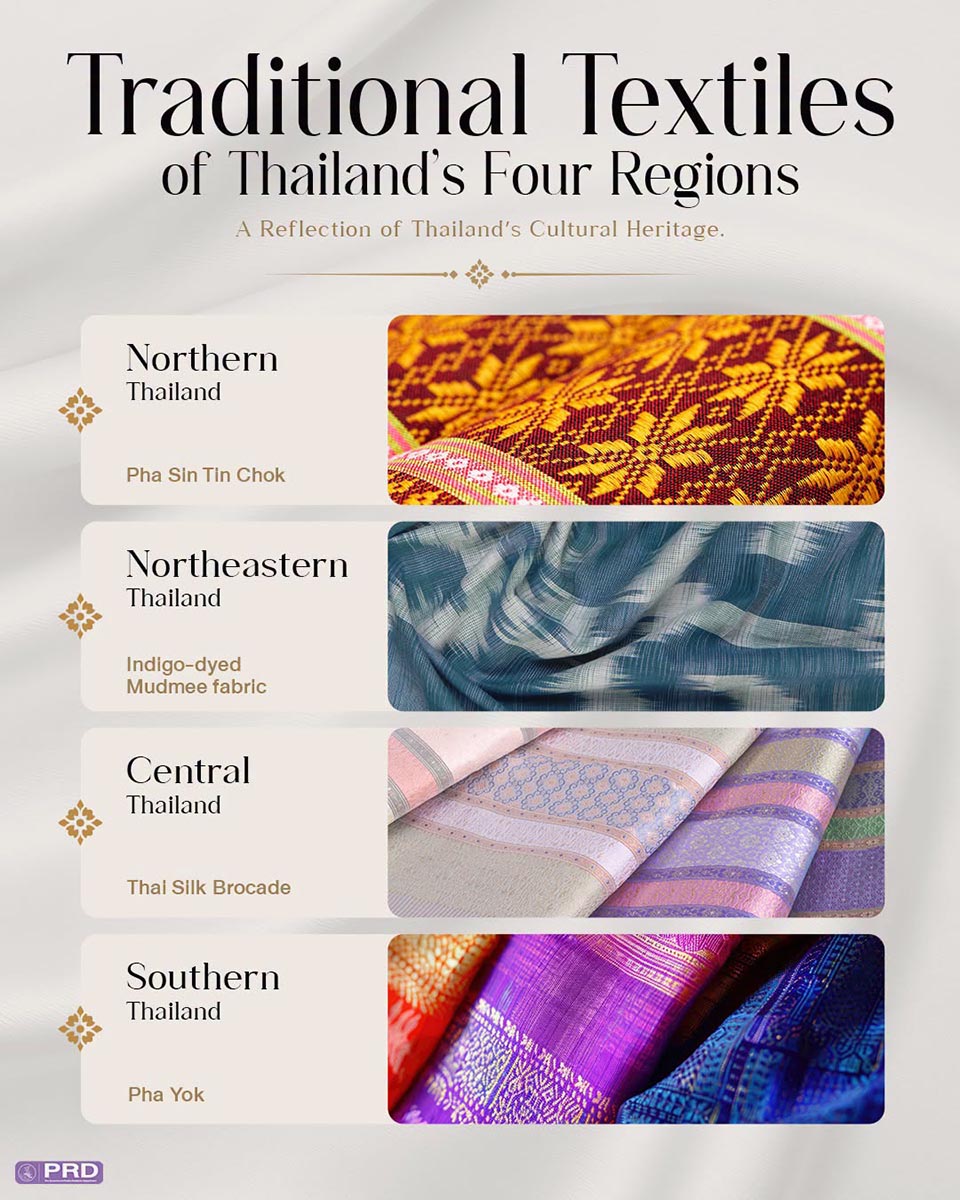
BANGKOK, Thailand – Indigenous Thai textiles vary significantly by region, province, and ethnic group, with each area possessing unique motifs, patterns, and weaving techniques.
In the North, the features of the textiles have a cultural relationship with the Tai Yuan and Tai Lue ethnic groups. They are well known for Pha Sin Tin Chok (tube skirt with a special hem piece attached), woven with large strips of silk in alternating colors. Other unique textiles in this region include Pha Mo Hom (cotton fabric dyed with natural indigo) in Phrae Province and Pha Lai Nam Lai (flowing water pattern fabric) in Nan Province. Textiles crafted by other hilltribe groups, including the Karen, Hmong, and Akha, are also well known for their unique craftsmanship and materials.
In the central region, several tribal groups, mainly Lao Wiang, Tai Dam, and Tai Phuan, migrated from Lanna cities and Laos to the central plains. Those living in Uthai Thani and Chai Nat provinces commonly weave silk brocades, while the groups in Lop Buri prefer weaving Mudmee (hand-woven fabric with patterns in weft ikat), and those in Phetchaburi traditionally weave watermelon-striped tube skirts. As for Bangkok, members of the Muslim community, known as the Cham, continue to weave silk to this day.
In the Northeast, as the local people in this region cultivate mulberries and rear silkworms, they traditionally weave silk, with the use of the weft ikat technique. Textile cultures in the Northeast are diverse. For instance, Sakon Nakhon and Mukdahan provinces are known for indigo-dyed Mudmee fabric, and the Phu Tai tribal group in Kalasin for Phraewa silk. In addition, Khit woven fabric is also widely known; it is created using a supplementary weft technique, in which threads overlap to form patterns, such as animal, plant, and geometric designs.
In the South, the culture of weaving Pha Yok, the name used in the South for brocades, is generally known, such as silk brocade, cotton brocade, and metallic threads, with prominent motifs featuring small square lattice, star-shaped floral, bead, interlacing stem, and animal patterns. The weaving groups comprise mainly Muslim Thais. Well-known textiles in this region include Phum Riang in Surat Thani Province and Pha Yok of Nakhon Si Thammarat, as well as Ko Yo and Batik. (PRD)