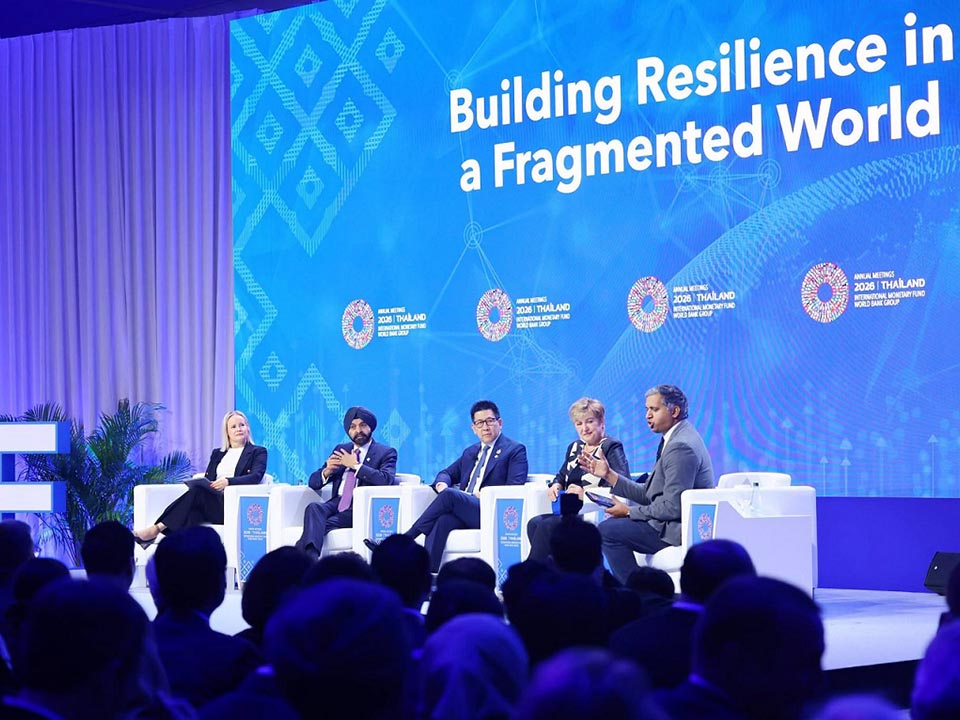
BANGKOK, Thailand – Thailand must become a “Trusted Connector” in an increasingly divided global economy, Deputy Prime Minister and Finance Minister Ekniti Nitithanprapas said on October 13, calling for foreign investment to deliver jobs, skills and stronger national capabilities.
Speaking at the “Building Resilience in a Fragmented World” discussion during the 2026 IMF–World Bank Group Annual Meetings at the Queen Sirikit National Convention Center in Bangkok, Ekniti joined IMF Managing Director Kristalina Georgieva, World Bank Group President Ajay Banga and Finland’s Deputy Prime Minister and Finance Minister Riikka Purra.
The panel examined how countries could strengthen economic resilience amid rising geopolitical tensions while preserving open markets, economic connections and international cooperation.
Ekniti said growing global divisions were shifting economic priorities away from maximum efficiency towards security, with consequences for trade, finance and investment.
Trade flows could adapt to barriers by finding alternative routes, he said, comparing them to water finding its way through cracks. Financial markets, however, faced risks from higher bond yields and borrowing costs, making economic and financial stability increasingly important.
Thailand has benefited from companies diversifying their supply chains and seeking alternative investment bases. Foreign investment promotion applications rose to account for 47% in the first half of 2026, according to figures cited by Ekniti.
He said the government was working to reduce regulatory obstacles and streamline procedures to turn investor interest into actual projects. Investment, he stressed, must create employment, develop skills and strengthen the capabilities of Thai workers and businesses.
Ekniti warned that economic fragmentation affected countries unevenly, with smaller economies often facing greater disadvantages. He said medium-sized economies such as Thailand could serve as trusted connectors, building confidence and maintaining international cooperation based on established rules.
He proposed increasing trade within ASEAN, linking digital infrastructure, advancing the ASEAN Power Grid and expanding cooperation with economies beyond the region. The goal, he said, was to turn capital into capabilities that improve people’s lives, create jobs and enhance public services.
Ekniti also highlighted the importance of building trust within societies, not just between governments. He pointed to the use of 37 traditional textile patterns from 26 communities across Thailand on acoustic panels inside the conference venue, bringing local cultural heritage into a major global economic gathering.
Georgieva also highlighted the handwoven Thai textiles, describing them as a reminder of the true purpose of global economic policymaking. The textiles brought the voices of ordinary people into a room where major economic decisions were made, she said, stressing that global leaders had a responsibility not to disappoint them. She urged participants to leave trade wars, cold wars and hot wars outside the meeting room, saying their shared task was to work together for the benefit of all people.
Banga said international trade over the past 30 to 40 years had helped developing economies create jobs, build capabilities, acquire knowledge and expand their middle classes. These developments had also supported consumption, interdependence, trust and capital flows. However, the traditional trading model between developed and developing economies was changing, with developing countries increasingly trading among themselves and building their own supply chains.
He estimated that trade within ASEAN accounted for around 50–55%, significantly higher than the proportions in South Asia and Africa. He also noted that hundreds of regional and bilateral trade agreements had been signed over the past decade, but many had not been implemented effectively.
Talent existed everywhere, Banga said, but opportunities did not. Giving people access to opportunities that matched their abilities was essential to development. He added that the World Bank’s mission included restoring hope and confidence among younger generations by helping them secure meaningful work and better futures.
Purra said economic resilience required balance, careful risk assessment and targeted policies. Finland could offer lessons from its manufacturing capabilities in strategic industries and its progress towards clean energy. She called for efforts to ease the pressures created by global fragmentation while building on existing strengths in comprehensive security and exploring opportunities to restore or deepen economic interdependence.
The discussion highlighted the challenge facing governments worldwide: protecting economic security while keeping international cooperation alive and ensuring that the benefits of trade and investment reach ordinary people. (TNA)