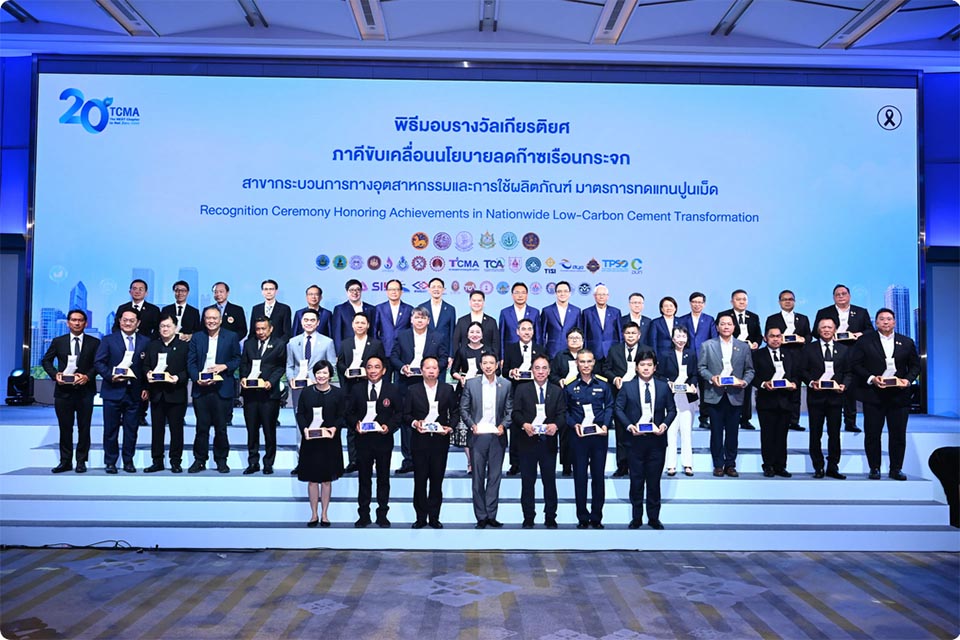
BANGKOK, Thailand – Thailand has cut more than 3.8 million tons of carbon dioxide equivalent (CO₂e) since 2019 through clinker substitution in the cement industry, reaching the milestone ahead of the schedule set under its Nationally Determined Contribution (NDC) Roadmap. Driven by the widespread use of low-carbon hydraulic cement, the achievement supports the country’s goal of reaching net-zero emissions by 2050. The achievement was announced at the “TCMA at 20: The Next Chapter to Net Zero” event, where Industry Minister Varawut Silpa-archa presented awards to 34 implementing partners, supported by six ministries, for advancing clinker substitution from policy to practice.
According to the Thai Cement Manufacturers Association (TCMA), hydraulic cement has become Thailand’s primary structural cement by reducing the clinker content—the most carbon-intensive component of cement production—while meeting Thai Industrial Standard TIS 2594. It is now widely used in infrastructure projects, public buildings, industrial facilities, and residential construction. TCMA Chairman Surachai Nimla-or said that clinker substitution reduced CO₂ emissions by more than 300,000 tons in 2021, allowing the country to reach its NDC target nine years ahead of schedule. More than 1 million additional tonnes were reduced during 2022–2023, bringing cumulative emissions reductions since 2019 to more than 3.8 million tons of CO₂e. The TCMA chief stated that the results highlight how public-private cooperation can deliver measurable climate benefits while supporting industrial decarbonization. (NNT)