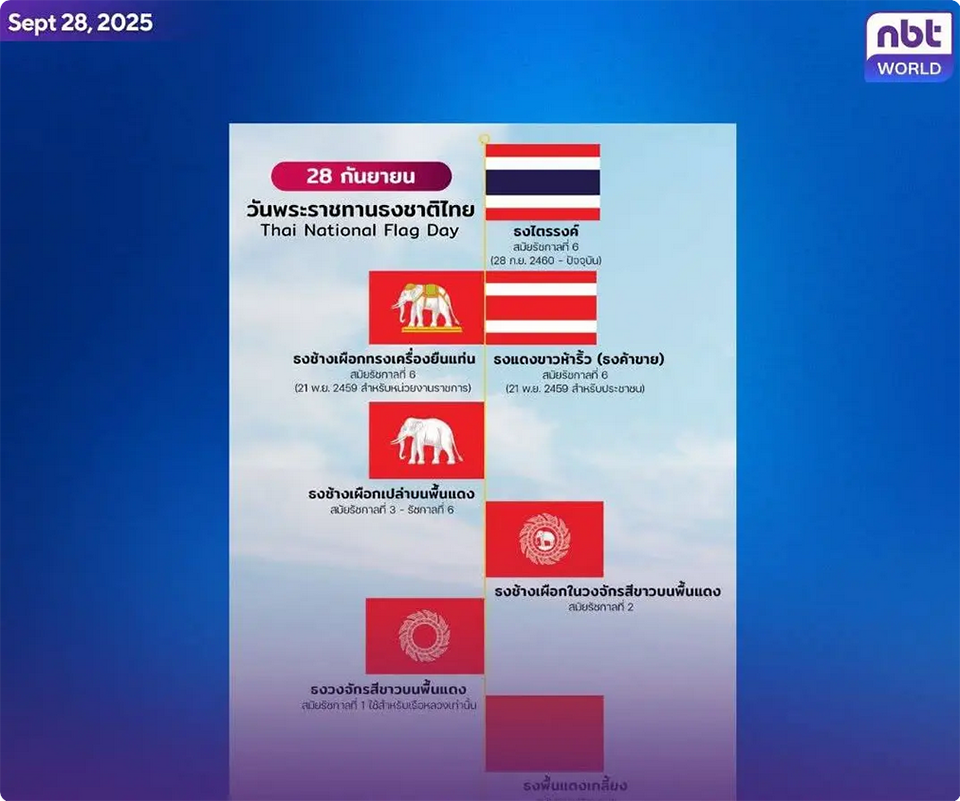
BANGKOK, Thailand – Thailand observed National Flag Day on Sunday, September 28, to honor King Vajiravudh (Rama VI), who introduced the nation’s current tricolor flag in 1917. The flag has since stood as one of the country’s most powerful national symbols, representing unity, independence, and pride.
The evolution of Thailand’s flag spans centuries. During the Ayutthaya period, the kingdom had no official flag and used a plain red banner at sea. Under King Rama I of the Rattanakosin era, a white chakra was added, creating the “Chakra Flag.” King Rama II later placed a white elephant inside the chakra, a sacred symbol of power and prosperity. By the time of King Rama III’s reign, the design had shifted to a plain white elephant on a red background, which was used internationally as Siam’s flag.
In 1916, King Rama VI introduced a new system: the “Red-White Five-Striped Flag” for general use and a “Royal White Elephant Flag” for government offices. The following year, during World War I, he altered the design again. The central red stripe was changed to dark blue, a color associated with the monarchy and Siam’s alliance with key powers. On September 28, 1917, the tricolor flag was officially proclaimed, and it remains in use today.
The tricolor flag’s colors carry symbolic meaning. Red represents the nation and the blood of those who defended it, while white symbolizes religion and purity, and blue signifies the monarchy. Together, they embody the values and unity of the Thai people.
National Flag Day serves as a reminder of the sacrifices made by past generations and the enduring strength of the Thai identity. Alongside the national anthem, the tricolor flag continues to inspire pride and a shared sense of belonging among Thais at home and abroad. (NNT)