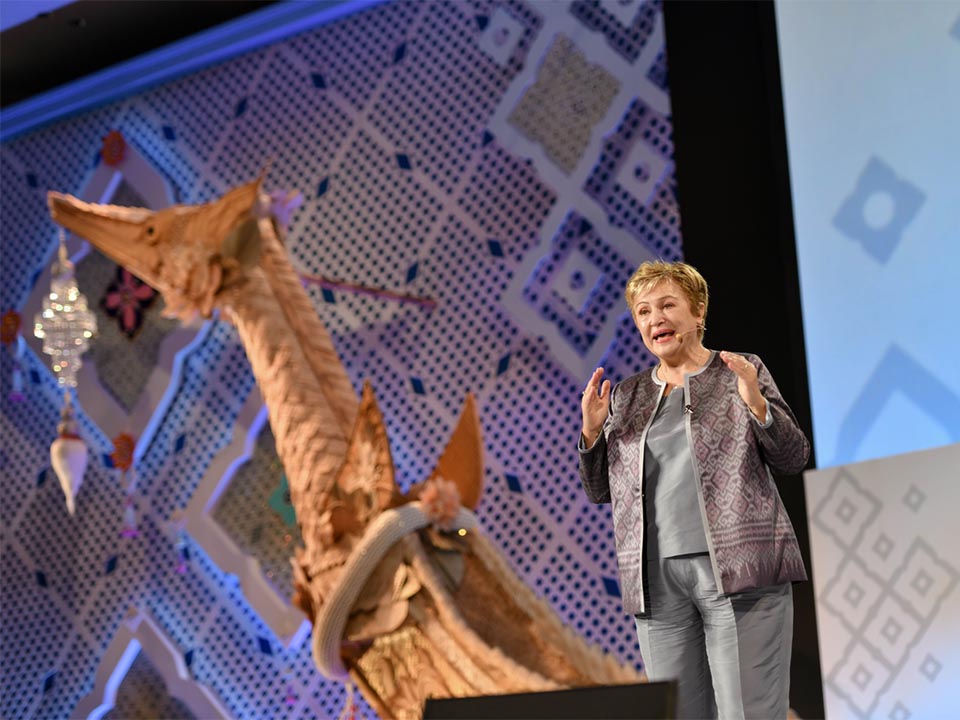
BANGKOK, Thailand – International Monetary Fund (IMF) Managing Director Kristalina Georgieva has urged countries to contain inflation, address rising public debt, and maintain economic stability amid geopolitical uncertainty and rapid technological change. Speaking at the plenary session of the 2026 IMF–World Bank Group Annual Meetings in Bangkok, she warned that global economic resilience cannot be taken for granted and called for coordinated action to manage emerging risks.
Georgieva pointed to the global economy’s steady performance despite disruptions to energy markets and international trade. The IMF’s growth forecast for 2026 remains at 3.1%, unchanged from its October 2025 projection. However, economic conditions vary widely, with conflict-affected countries facing weaker growth while economies benefiting from artificial intelligence, including the United States, India, China, and others in Asia, have seen improved forecasts. She also warned that public debt remains a concern across advanced and emerging economies, with many lower-income countries facing heavy repayment burdens.
The IMF chief identified energy disruptions, rising food prices, and AI-related investment as factors affecting inflation and financial markets. While artificial intelligence could improve productivity over time, growing infrastructure demand may add to short-term price pressures. Rising long-term government bond yields in major economies are also increasing borrowing costs internationally. Georgieva urged central banks to remain vigilant, warning that delaying necessary interest rate adjustments could require more aggressive action later.
Georgieva also called for credible medium-term fiscal plans to manage debt and preserve financial stability, especially in major advanced economies whose policies influence global markets. She urged governments to explain the need for fiscal adjustments, protect vulnerable populations, and minimize the effects on future growth. Structural reforms to improve productivity and economic potential, alongside international cooperation, were also identified as essential for navigating uncertainty and supporting sustainable development. (NNT)