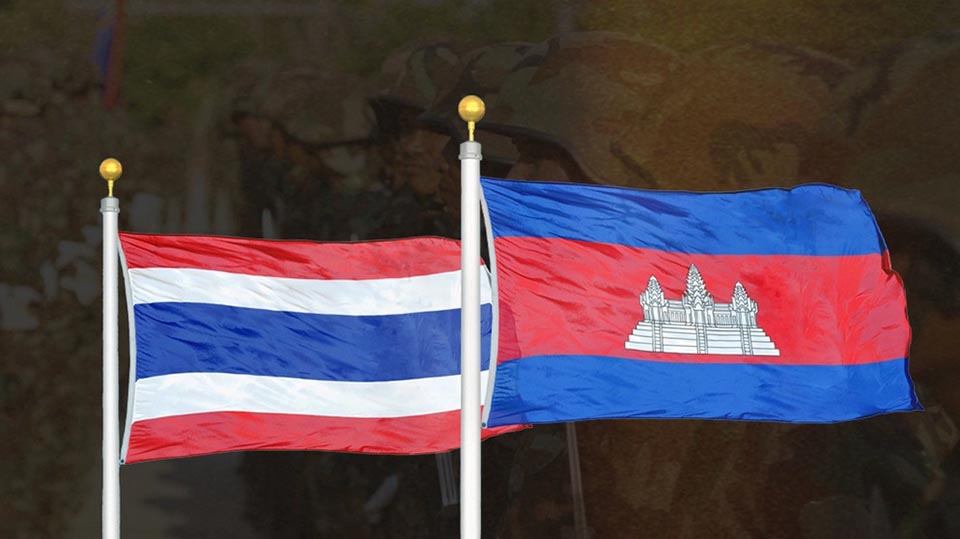
BANGKOK, Thailand – Following the recent military standoff at the Chong Bok border crossing between Thai and Cambodian troops, former Cambodian Prime Minister Hun Sen posted a strongly worded message on social media. He asserted that the Emerald Triangle area, near Chong Bok, belongs to Cambodia and claimed Cambodian troops have been stationed there since before the Paris Peace Agreements and before the signing of the 2000 Memorandum of Understanding (MOU 43) with Thailand.
His son and current Prime Minister, Hun Manet, echoed similar sentiments, stating via Facebook that both nations aim to prevent further escalation, despite rising tensions. He blamed “extremist groups” for stirring conflict. However, in a recent development, the Cambodian National Assembly voted 182 in favor of officially pursuing legal action at the International Court of Justice (ICJ).
This move has sparked concern in Thailand, with fears that Cambodia is laying legal groundwork similar to its previous ICJ case over the Preah Vihear Temple, which it won in 1962, and again partially in 2013.
Assoc. Prof. Dr. Dulayapak Preecharush, a Southeast Asia Studies expert, argued that Cambodia lacks sufficient legal standing to drag Thailand to the ICJ over the disputed area. He pointed out that the Emerald Triangle zone lacks clearly established international documentation or evidence supporting Cambodia’s claim, which is crucial for international adjudication.
He stressed that under the Joint Boundary Commission (JBC) framework and MOU 43, both sides have agreed to a bilateral process for resolving border disputes, and that remains the appropriate venue—not the ICJ.
Thailand has reiterated it does not recognize the ICJ’s jurisdiction in this matter. The JBC, which meets to discuss boundary issues, has already recorded Thailand’s stance that it rejects ICJ jurisdiction over this area.
Thai officials further explained that Thailand only accepts the ICJ’s jurisdiction on a case-by-case basis, depending on specific international treaties, and retains the right to opt out or make reservations.
On June 1, Thai Foreign Minister Maris Sangiampongsa announced that border areas remain peaceful, with border crossings fully operational. He confirmed that discussions are ongoing at multiple levels.
Thailand and Cambodia continue to work through three formal mechanisms to manage the situation peacefully:
JBC – Joint Boundary Commission
GBC – General Border Committee
RBC – Regional Border Committee
Minister Maris emphasized Thailand’s commitment to resolving the issue through these existing frameworks and stressed the importance of Cambodia respecting MOU 43, which both nations signed in good faith.
While Cambodia may be pushing for an ICJ showdown, Thailand is standing firm on its legal and diplomatic position: border disputes should be resolved bilaterally, not in The Hague. The next steps may depend not just on legal arguments, but on political will and regional stability.