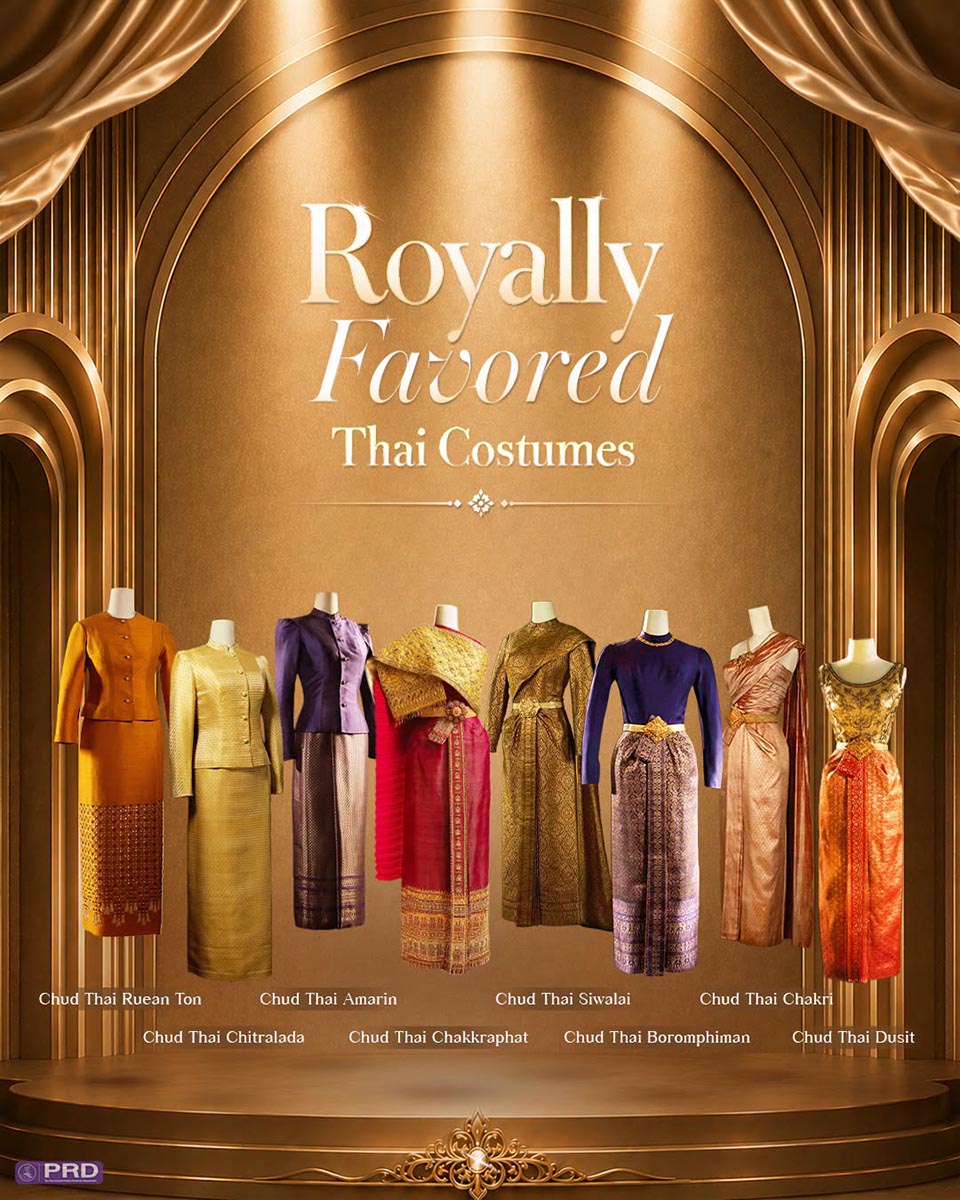
BANGKOK, Thailand – In 1960, Her Majesty Sirikit The Queen Mother accompanied His Majesty King Bhumibol Adulyadej The Great (Rama IX) on long state visits to the United States and Europe to strengthen friendly international relations. In preparation for the visits, Her Majesty observed that there was no official national costume at the time to be worn while performing her royal duties in foreign affairs overseas. Recognizing her role as the Queen of Thailand and a representative of all Thai women, Her Majesty realized that there was a need for a modern national costume that both represented Thailand’s national identity and was suitable for formal wear. The Queen then commissioned research into Thai women’s attire that reflected Thai identity.
Her Majesty’s initiative led to the creation of royally favored Thai costumes, referred to as “Chud Thai Phra Ratchaniyom.” Drawing from historical records of royal attire, the Queen saw that Thai national dress offered an appropriate ensemble for every occasion. There are altogether eight styles of the Thai national dress for ladies. These include (1) Chud Thai Ruean Ton, (2) Chud Thai Chitralada, (3) Chud Thai Amarin, (4) Chud Thai Boromphiman, (5) Chud Thai Chakri, (6) Chud Thai Dusit, (7) Chud Thai Siwalai, and ( Chud Thai Chakkraphat.
Later, Her Majesty granted permission for general Thai women to use these designs as patterns for sewing and wearing. Chud Thai soon gained more popularity and have since become the standard for formal attire at major state functions and other events, such as wedding and religious ceremonies. The costumes have also been used as the national dress for ladies, representing Thailand in world-class beauty contests. Additionally, they serve as design prototypes for the uniforms of officers in various organizations, showcasing Thai identity. (PRD)
Image credit: Queen Sirikit Museum Of Textiles