PATTAYA, Thailand – A multi-agency task force led by Chonburi Governor Narit Niramaiwong raided five luxury pool villa businesses in Pattaya on Thursday as part of a sweeping crackdown on suspected illegal foreign nominee ownership, uncovering unlicensed hotel operations and a stash of nitrous oxide, commonly known as “laughing gas.” The operation targeted businesses suspected of using Thai nominees to conceal foreign ownership of property and tourism businesses, in line with the Thai government’s campaign against illegal foreign investment.
The first property inspected was Aura Villa Reserve on Soi Arunothai 8 in Central Pattaya, a luxury development comprising 15 four-and-a-half-storey villas with private swimming pools and other high-end facilities. Chinese guests were found preparing to check out as officials arrived. Investigators found the business was registered as Aura Villa Reserve Co., Ltd., with Thai and Hong Kong shareholders. Financial records allegedly showed the villas had been operating as daily rental accommodation despite being licensed only as residential properties and lacking a hotel license.
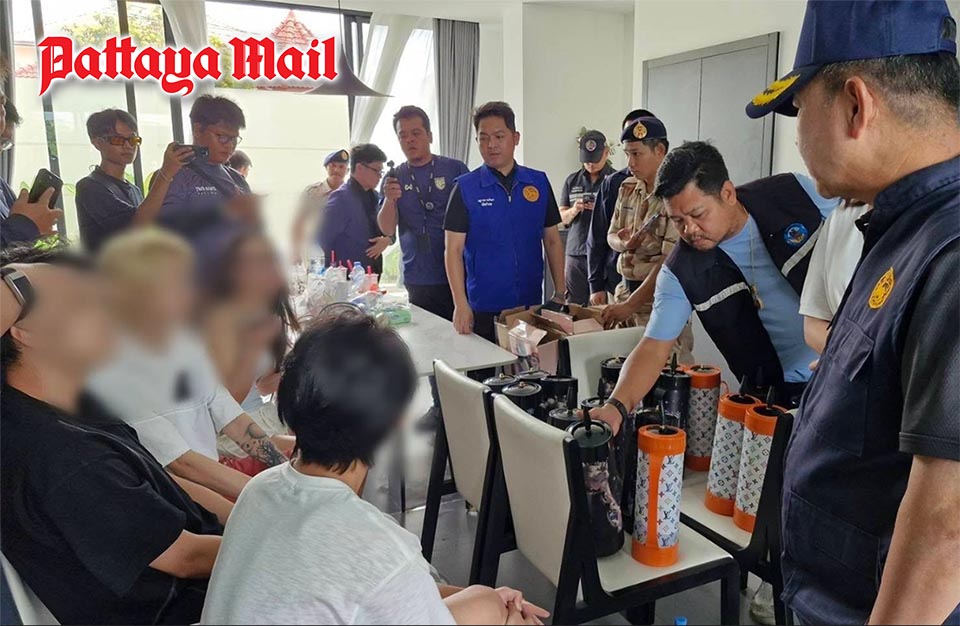
Employees told investigators the business had been operating for about five months, charging around 6,500 baht per night. Most bookings were reportedly made through travel agents who resold the accommodation to Chinese tourists for between 8,000 and 10,000 baht per night. During the inspection, Governor Narit noticed what appeared to be a cylinder on the second-floor balcony of one villa. Officers investigated and discovered 20 canisters of nitrous oxide inside the property.
Four Chinese nationals—three men and one woman—were found asleep inside the villa and were questioned by authorities. They admitted purchasing the gas through Chinese sellers via WeChat, paying around 300 yuan (approximately 1,000 baht) per canister. Police seized the cylinders as evidence and took the group in for further questioning and drug testing. Governor Narit said the coordinated operation involved multiple government agencies to tackle foreign businesses allegedly operating through Thai nominees in violation of Thai law.
Initial inspections found several properties were operating as hotels despite being licensed only as residential buildings and without hotel licenses. Authorities said criminal proceedings would begin immediately while police, immigration, tax officials and the Ministry of Commerce continue investigating shareholder structures, funding sources and who ultimately controls the businesses.
The governor revealed that some Thai shareholders claimed investments worth 70 to 80 million baht, despite having financial backgrounds that appeared inconsistent with such holdings, raising further suspicions that they were acting as nominees for foreign investors. He also disclosed that provincial authorities are investigating 349 companies suspected of illegally holding land through foreign-controlled corporate structures. Companies found in violation could be ordered to dispose of the land, with properties subject to public auction if they fail to comply within 180 days.
Governor Narit warned that both Thai nationals acting as nominees and foreign investors attempting to circumvent Thai ownership laws would face strict legal action, including imprisonment and substantial fines. He also urged pool villa and hotel operators to ensure they obtain all required licences and to remain vigilant against guests using their properties for illegal activities, including the storage or use of narcotics, psychoactive substances or other dangerous materials.