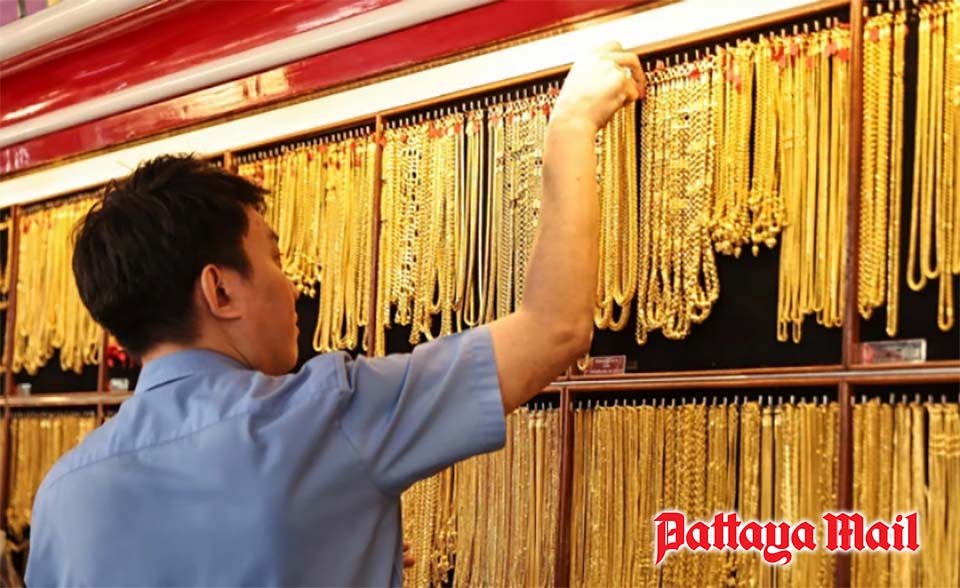
BANGKOK, Thailand –The gold trade situation is becoming increasingly concerning, especially for gold jewelry, where sales have dropped by 50%, marking the lowest point in recorded history. Small gold shops—which make up 80% of the market—are shutting down one after another. The crisis has already left tens of thousands of goldsmiths unemployed.
As of June 5, 2025, the Gold Traders Association reported that the retail price of gold jewelry was 52,800 baht per baht-weight (15.2g), with a buyback price of 50,861.80 baht. For gold bars, the retail price was 52,000 baht and the buyback price was 51,900 baht.
The sharp and continuous rise in gold prices, combined with a sluggish economy, has directly impacted purchasing power. Since gold jewelry is classified as a luxury item, it has been directly hit by the decline in consumer spending. This situation is causing significant turbulence in the gold market.
Mr. Jitti Tangsitpakdee, President of the Gold Traders Association, stated that gold trading in Thailand is currently sluggish, with jewelry sales plunging by more than 50% compared to 2024—an unprecedented drop. Gold bars, preferred by investors, are still in demand but have also seen a decline.
“This is the sharpest drop in sales ever. The economy has been persistently weak, people lack purchasing power, and gold prices have surged significantly—20% in 2024 and over 20% again in just the first half of 2025. Many gold shops have already closed, and a large number of goldsmiths are now unemployed. More closures are expected by year-end,” said Mr. Jitti.
Small-scale gold traders, such as those operating from red display cabinets, are struggling because jewelry isn’t selling. These businesses typically rely on labor costs from jewelry sales. As gold prices rise, purchasing power falls, while fixed expenses remain the same. With minimal income, continuing business becomes unsustainable—closing down is sometimes the more viable option to cut losses.
A business analysis by LH Bank’s Business Research Center revealed that, as of 2024, there were 9,728 legally registered gold shop businesses operating nationwide—an increase from 9,425 the previous year, showing signs of sector expansion. There were 491 new business registrations in 2024, up from 457 in 2023, indicating that new entrepreneurs still see potential in the gold trade.
However, despite more new entries, business closures have also risen. In 2024, 177 gold shops shut down—up from 163 in 2023. This trend reflects rising competition, increased operating costs, and changing consumer behavior, with many now buying and selling gold through online platforms.
Large and medium-sized gold businesses are still growing, maintaining customer bases and adapting to market trends. However, small businesses, which make up about 80% of the market, are facing severe income declines. This is due to higher operational costs, intense competition from online platforms, and a shift in consumer preference toward gold bars and futures trading over ornamental jewelry.
In 2025, the overall growth of the gold retail business is expected to slow. Economic recovery remains incomplete, and consumer purchasing power remains weak due to the high cost of living and persistent household debt. As a result, demand for gold jewelry is dropping, especially as it is viewed as a non-essential luxury item.
Small gold shops—relying mainly on handcrafted jewelry sales—are being hit the hardest. Their income primarily comes from jewelry-making labor fees, which are falling along with reduced demand for new jewelry.
Moreover, the persistently high price of gold is prompting consumers to sell their gold for profit instead of buying new pieces. This adds pressure to shop revenues that depend on labor fees. If gold prices remain volatile, consumers may delay purchases and opt for investments in gold bars or derivatives, leading to continued sales declines for traditional gold shops.
Another source of pressure is the drop in revenue from gold pawning services, due to reduced interest rates offered by government and private pawnshops. These institutions now offer more attractive rates than gold shops, diverting customers away from traditional pawn services at gold stores.
Additionally, tighter regulations—such as anti-money laundering (AML) laws and gold transaction reporting requirements—are increasing compliance costs, especially for smaller businesses with limited resources.
Despite these challenges, the Gold Traders Association raised the standard labor fee from 500 to 800 baht per baht-weight as of March 1, 2025. Although this offers some revenue support, the rising volatility in gold prices continues to discourage jewelry purchases.

Beyond the pricing issues and weak purchasing power, the crisis is severely impacting goldsmiths.
Mr. Boonlert Siriphattharawanit, Senior Advisor to the Thai Goldsmiths Association, noted that goldsmiths are seeing significantly reduced workloads. Currently, there are an estimated 50,000–60,000 goldsmiths in Thailand, both shop-based and freelance. With jewelry sales down by more than 50%, 20,000–30,000 of them are now effectively unemployed.
Still, he believes goldsmiths could pivot to related fields such as jewelry and accessory design. However, he admits that once they leave the trade, returning could be difficult.
“Becoming a skilled goldsmith takes years—some people train for over a decade. Shop owners are trying to retain their skilled craftsmen, fearing a future shortage when demand returns,” Mr. Boonlert said.
According to the Gem and Jewelry Institute of Thailand, goldsmith wages vary from below 100 baht to over 300 baht per piece, depending on the complexity, weight, and design of the jewelry.