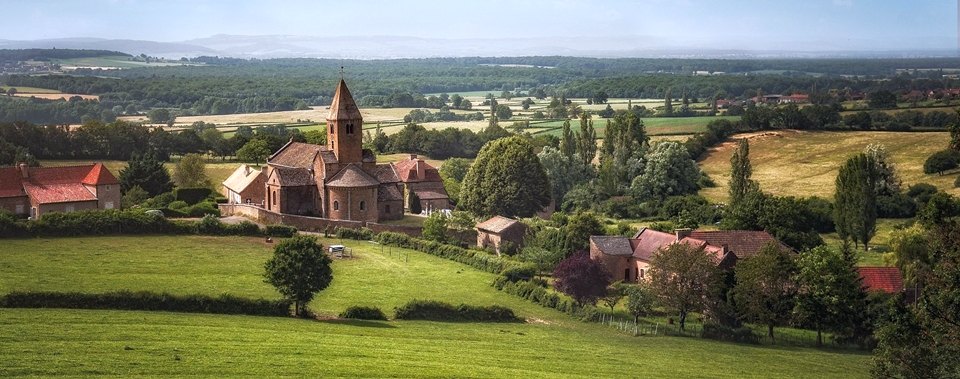
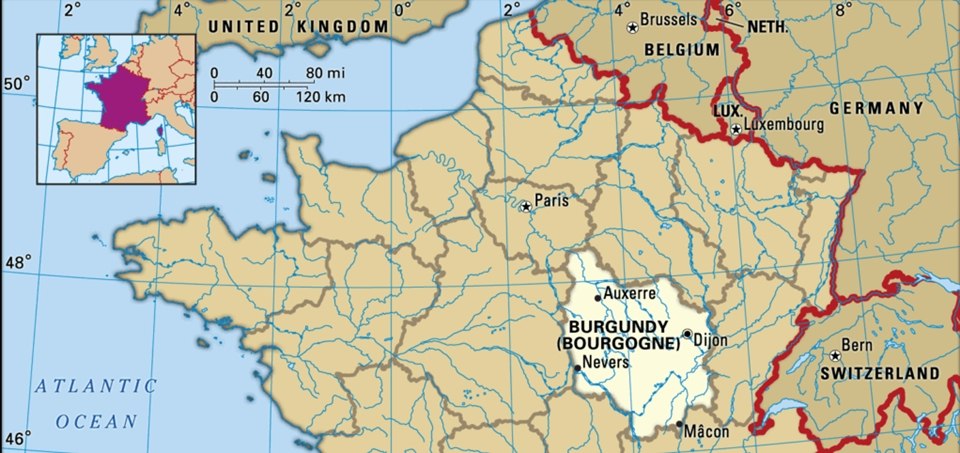
The other day, having nothing much of importance to occupy my mind, I spent a pleasant hour on Google Street View taking a virtual drive among the villages of Burgundy. Pottering along these country roads was a blissful experience, for many of them had barely changed since I’d been there myself during the summers of yesteryear. It used to be an easy drive from London, first to Paris and then along the Autoroute A6 south-east to Auxerre and on to Dijon, the historical and lively capital city of Burgundy. Many of its old streets are lined with half-timbered houses, and there are many fine restaurants. Dijon gave us the mustard after which it is named, as well as the delightful gingerbread known locally as Pain d’épices. Further south down the autoroute lies the ancient, historic walled town of Beaune and further south still, the charming city of Mâcon. With its delightful quaysides on the banks of the river Saône, Mâcon is the gateway to southern Burgundy.
Burgundy has a rich and colourful history spanning over two thousand years. It evolved from a Germanic tribal kingdom into one of the wealthiest and most powerful independent duchies in medieval Europe before joining France. During the Middle Ages, the powerful Dukes of Burgundy rivalled the French crown itself, and Burgundy is home to many historical sites including several splendid medieval abbeys. It’s the origin of the classic French dish coq au vin (“chicken in wine”), and the region also gave its name to another traditional dish, boeuf bourguignon, beef slow-cooked in red wine. It has given us some fine regional cheeses, though the pungent Époisses and Trou du Cru are not for the faint-hearted.
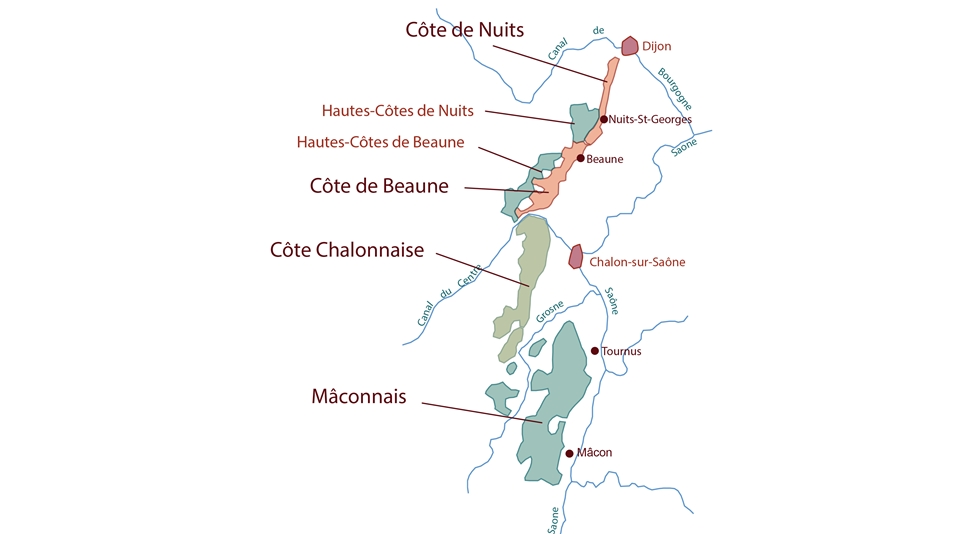
And then there’s the wine. The English writer and novelist Charles Edward Montague wrote, “Burgundy is the central, essential and typical wine; the soul and greatest common measure of all the kindly wines of the earth.” Many classic wine regions are known for either white or red wines. Burgundy is unusual in that both its white and red wines are among the finest anywhere. For over two hundred years, the vineyards of Burgundy were under the control of Benedictine and Cistercian monks. Over generations, they planted the small areas of land that were to become some of the most exalted vineyards in the world. The Burgundy wine region extends roughly 120 to 140 miles, depending on which areas you include. It’s not an unbroken chain of vineyards, but a group of different and clearly separate areas. Despite its length, the wine region itself is surprisingly narrow, sometimes less than a few hundred yards from east to west. Although this is a fairly small wine area by international standards, it contains thousands of small vineyards, each with multiple owners. Almost all the vineyards have individual names. Each vineyard, known locally as a climat, has its own soil, microclimate, geological traits and historical identity. This is why one vineyard can produce wines of a different style, quality and character from another vineyard just across the road.
Burgundy is divided into four principal wine regions, named after their main villages or communes. From north to south, they are the Côtes de Nuits (named after the sprawling hamlet of Nuits St. George), the Côtes de Beaune, the Côtes Chalonnaise and the Mâconnais. Each region produces wines of distinctive character. Driving among the wine villages of Burgundy takes you through gently rolling hills and illustrious vineyards, with names that evoke the greatest wines of Burgundy, indeed some of the greatest wines in the world. The names of some villages, such as Mercurey, Volnay, Montagny, Mersault and Pommard, have become legendary, and their names alone are music to the ears of wine lovers.
People are sometimes surprised to discover that only two grape varieties are allowed in the entire Burgundy region, although this is common knowledge in France. France’s Institut National de l’Origine et de la Qualité decreed long ago that in Burgundy, only the white Chardonnay grape and the red Pinot Noir are permissible. A few other grape varieties (notably the Aligoté) are allowed in certain regions, but their use is so minimal that they can be discounted from the overall picture. Despite this restriction, Burgundy produces a wide range of wines, ranging from simple, light drinks to some of the most sought-after wines in the world. And this brings me to the essential information for the wine buyer: how to understand the label.
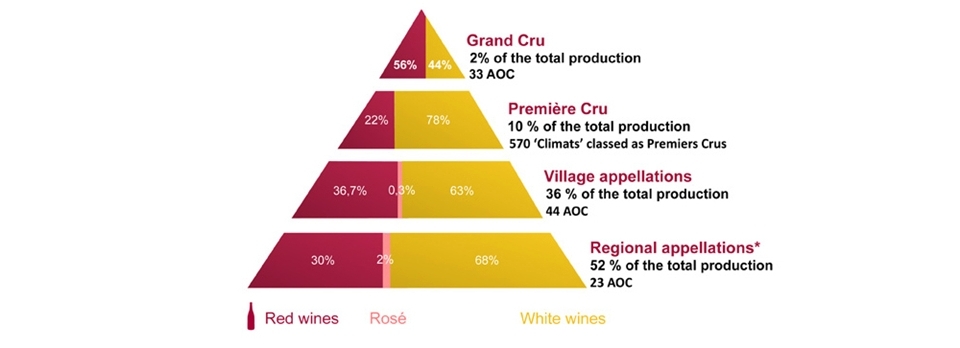
At the risk of over-simplification, there are basically four quality levels, each increasing in quality, complexity and price. In practice, it’s slightly more complicated, but this is the gist of it.
(1) At the lowest level are the cheapest wines, which are labelled Bourgogne Blanc (white) or Bourgogne Rouge (red) or just Bourgogne. They’re mostly simple gluggers: basic table wines made with grapes grown anywhere in the Burgundy region and account for 52% of the total production. Sometimes the labels list the grape variety (Chardonnay or Pinot Noir), presumably for foreign buyers. These wines lack credentials but are often light and pleasant.
(2) About 36% of Burgundy wine is named after specific villages or communes. The label shows the commune or village name in large type, e.g. Chambolle-Musigny. It is sometimes followed by the word “village” (e.g. Mâcon-Villages). These are wines made from the grapes grown in a single village, and you can expect a wine with a little more character. More expensive wines come from a single vineyard within the village, and so the vineyard’s name also appears on the label. Unlike the village name, the vineyard name is invariably preceded by a definite article, e.g. Les Charmes, Les Falaises, Les Pucelles and so on. In 1857, to enhance the reputation of local wines, the village of Gevrey borrowed the name of its most renowned vineyard, Le Chambertin and renamed itself Gevrey-Chambertin. Cunning fellows, those French. But you must admit that Gevrey-Chambertin sounds a bit more classy than plain old Gevrey. In the following years, other Burgundy villages did the same thing.
(3) The next level is Premier Cru (“First Growth”) wines, which are village wines from a particularly renowned vineyard. The vineyard name always appears on the label, and they make up 10% of total production.
(4) Grand Cru (“Great Growth”) is the highest possible designation. Only thirty-three vineyards in Burgundy (2% of the entire region) qualify for this exalted title. Some of these wines are so revered that the vineyard name alone often appears on the label, e.g. Le Montrachet, La Tache, or Le Chambertin. The name is often followed by the designation Grand Cru. These are some of the most expensive wines in the world.
Domaine de la Romanée-Conti is Burgundy’s most renowned estate, and wine enthusiasts know it simply as DRC. Quality always takes priority over quantity. In 2011, for example, the winery produced only about five thousand bottles, and today they retail from £2,000-£10,000 each depending on the vintage. La Tâche is a legendary Grand Cru red wine from Burgundy, France, produced exclusively by DRC. With a vineyard covering a mere 15 acres, these rare wines range in price from $5,000 to over $15,000 per bottle. These astronomical price tags are not unusual for rarified Grand Cru wines. One of the brightest stars in the DRC constellation is their La Tâche vineyard. A magnum (the equivalent of two standard bottles) of the 1971 vintage can be yours for $41,000 or £25,000. That’s Bt. 1,250,000. I don’t drink it very often.
Quality wines from Burgundy have never been cheap. There are several reasons. Firstly, the most exalted vineyards are small, so there’s a limit to the annual output and mass-harvesting methods are either impossible or inappropriate. Secondly, there’s an enormous world demand for Burgundy, especially from China’s nouveau-riche. Demand far exceeds supply, so prices keep rising year after year. Thirdly, Pinot Noir can be difficult to grow at the best of times, and in Burgundy’s unpredictable climate they’ll sometimes refuse to ripen properly if the weather is not to their liking.
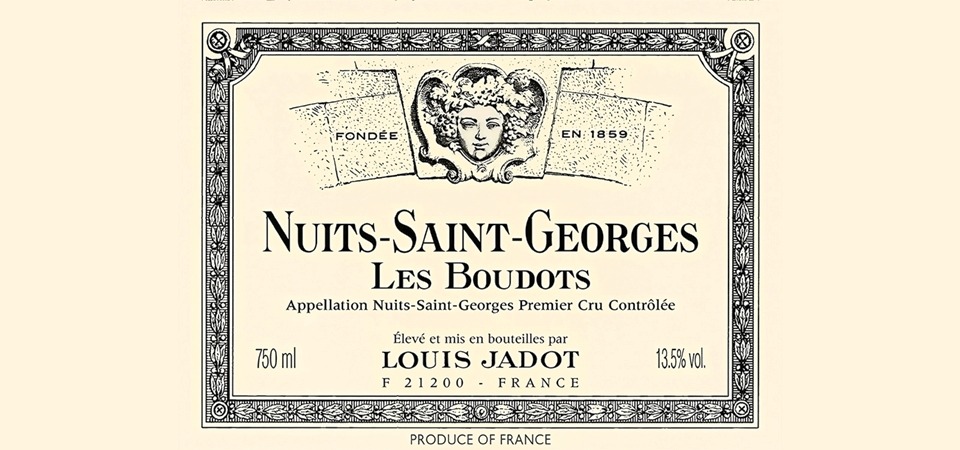
Unless your taste runs to top-flight Burgundy, you don’t need to sell the dog to buy a decent bottle. Several négociants (merchant-producers) offer excellent everyday Burgundy at reasonable prices. One of the most well-known is Louis Jadot. Founded in 1859, the company produces about 130 different wines ranging from budget Burgundies to top-of-the-range Grand Cru. Jadot wines are easy to spot, because they all carry the same distinctive yellow logo showing the head of Bacchus, who, in case you’ve forgotten, was the Roman God of Wine. Other quality names to watch for include Louis Latour, Joseph Drouhin, Bouchard Père & Fils, Chapoutier and Maison Moillard. Look for these names, and you won’t go far wrong, especially if you are seeking an entry-level wine. A quick check with two local outlets reveals that both Wine Connection and Vines to Vino have a small selection of interesting Burgundies. Here are six of them, the whites shown first.
Maison Le Nid Mâcon Villages, Blanc (white), Bt. 999 (+VAT) @ Vines to Vino
Maison Le Nid is the négociant’s name, and “Villages” indicates the wine was made from grapes grown in several unspecified villages in the southernmost Mâconnais region. This entry-level budget wine is a bright pale gold with shimmering emerald reflections and aromas of white peach, crisp green apple, citrus, white flowers, and subtle mineral notes. A clean, refreshing wine.
Moillard Pouilly-Fuissé sous la Grotte (white), Bt 1,600 @ Wine Connection
From the village of Pouilly-Fuissé, this is a full-bodied, dry white Burgundy also from the Mâconnais region. It’s a brilliant pale gold and brings aromas of apple, pear, citrus blossom and yellow fruits. It’s a round and rich wine with toasted aromas from oak ageing and a crisp, mineral finish. Full-bodied and creamy, it’s balanced by lively acidity and a long, elegant, spicy finish.
Moillard Rully “Les Falaises” (white), Bt 1,600 @ Wine Connection
Moillard is the name of the négociant and pronounced “mwah-yar”. From the village of Rully (pronounced a bit like “roo-yee”) and the vineyard named Les Falaises, this wine is from the Côte Chalonnaise in the centre of Burgundy. The wine has aromas of orange blossom, citrus and lily of the valley, along with slight woody notes. Anne Krebiehl of Wine Enthusiast writes, “Ripeness and roundness are apparent in the notes of Golden Delicious apple on the nose of this wine. The palate broadens out with ripe apple, gentle freshness and an easy texture that finishes dry.”
Mont Chauve Chassagne-Montrachet ‘En Pimont’ (white), Bt. 2,999 (+VAT) @ Vines to Vino
In November 1879, the Burgundian village of Chassagne tacked on the name of its most prestigious vineyard, Le Montrachet, to bring a bit of glitz to the name. It’s been known as Chassagne-Montrachet ever since and is situated in the central Côte de Beaune. This wine comes from a single vineyard called En Pimont, which lies at an altitude of about 700 feet – the highest vineyard in the village. This wine brings aromas of fresh citrus, pear, apple and white peach. On the palate, it balances buttery vanilla and spicy oak with peach, pear and zingy citrus. Critic James Suckling wrote, “Lemons, apricots and buttered brioche on the nose, followed by a creamy and zesty palate with a medium to full body.”
Chartron et Trébuchet Vosne-Romanée (red) Bt 3,219 (+VAT) @ Vines to Vino
From the village of Vosne-Romanée in the northern Côte de Nuits region, this wine combines elegance with depth and structure, revealing remarkable complexity. The wine is deep garnet in colour with aromas of strawberry, raspberry, blueberry and blackcurrant. With age, the bouquet will evolve into layers of candied fruit, truffle, leather and sweet spice. The palate is elegant yet powerful, with ripe tannins, splendid balance, and an exceptionally long, complex finish. Incidentally, Vines to Vino also has several entry-level Burgundies well below Bt 1,000, which you can explore on the company website.
Moillard Nuits-Saint-Georges (red), Premier Cru “Les Damodes”. Bt 4,500 @ Wine Connection
This ruby-red wine comes from the northern Côte de Nuits region, around Nuits-Saint-Georges, and is made from grapes grown in a single renowned vineyard, Les Damodes, which lies on a sunny, sloping hillside. The wine has an elegant combination of ripe red and dark fruit aromas of blackberry, strawberry, cranberry and raspberry, with hints of wood and minerality. The palate brings fresh raspberries, strawberries, cranberry, dark cherry, and plum, with a satisfying finish of oak, dried spices and a touch of damp earth. This might seem odd, but top-quality Pinot Noir often carries aromas known as forest floor: an attractive savoury mix of wet leaves and damp undergrowth.