
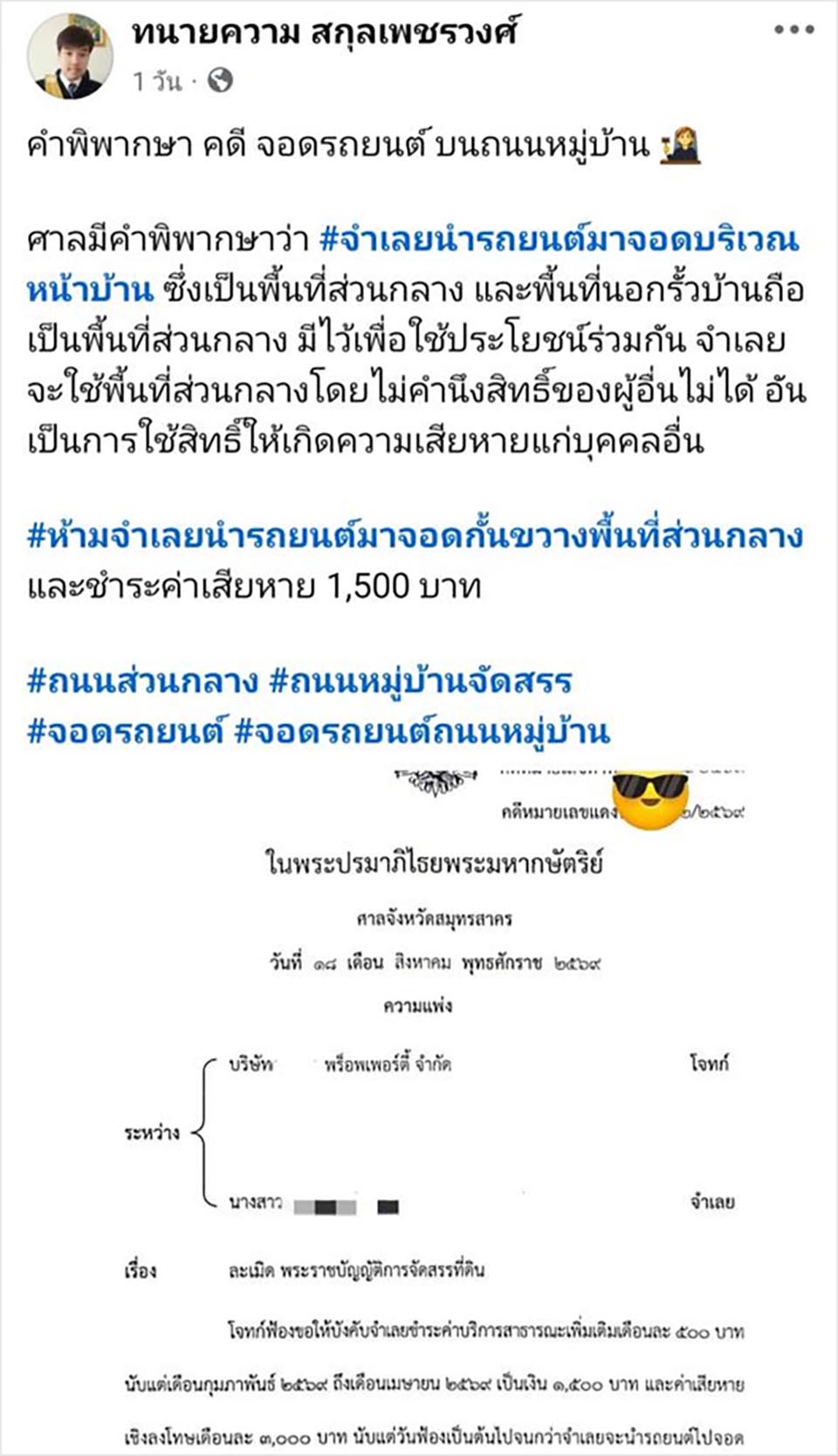
BANGKOK, Thailand – A Thai court ruling on parking outside a house in a housing estate has sparked a heated online debate after a lawyer shared the case, with many homeowners questioning where private property ends and common space begins. The ruling, publicized on September 4 by the Facebook page “Thanaikhwam (Lawyer) Sakulphetwong,” concerned a homeowner who parked a vehicle in front of the house on an area outside the property’s fence.
According to the published ruling, the area was considered common property intended for shared use by residents. The court said the defendant could not use the common area without considering the rights of others, particularly when the vehicle obstructed the shared area. The court ordered the defendant to stop parking the vehicle in a way that blocked the common area and to pay 1,500 baht in damages. The case was reported as a ruling by the Samut Sakhon Provincial Court.
The ruling quickly struck a nerve online because parking outside the home is a familiar source of disputes in housing estates across Thailand. Some commenters said they were already facing similar problems with neighbors who regularly park in front of their homes despite written estate rules prohibiting such behavior. Others said vehicles parked outside homes had made it difficult to enter or leave properties and had even resulted in minor collisions.
Others questioned whether housing-estate juristic persons should be doing more to enforce their own regulations when residents repeatedly ignore parking rules. Several commenters welcomed the ruling, saying residents should understand that the road outside their homes is not automatically their private parking space simply because it is directly in front of their property.
Some said sales staff had informed buyers before purchase that areas outside the property could not be treated as private parking spaces, yet enforcement could become difficult when certain residents continued to leave vehicles on roads or in shared areas. The debate also centered on a familiar argument from homeowners: if they pay common-area fees, why should they not be allowed to park outside their own homes? The ruling highlights why that argument does not necessarily give an individual resident exclusive rights over shared areas.
Under Thailand’s Land Development Act, roads and other infrastructure provided as part of a housing development are generally intended for the benefit of the development as a whole. The Department of Lands has also issued guidance concerning designated parking areas in housing developments.
However, the ruling should not be interpreted to mean that every vehicle parked outside every house in every housing estate is automatically unlawful. Different developments can have different regulations governing parking, and the legal status of a particular area depends on whether it forms part of the individual plot or common infrastructure, as well as the estate’s applicable rules.
A recent explanation of the case noted that some developments may allow roadside parking where it does not obstruct traffic, while others require residents to keep vehicles inside their own properties. The key issue is whether the area is private property or common space and what regulations apply to that development. That distinction may be the most important message for homeowners watching the debate.
Owning a house does not necessarily mean owning the road outside it. In a housing estate, the space beyond the property boundary may belong to everyone — meaning that using it as though it were a private driveway or parking space can affect the rights of neighbors.
For many residents, the issue is ultimately less about where one person can leave a car and more about how dozens or hundreds of households share the same limited space. The court ruling has therefore reopened a familiar question in Thai housing estates: when the road is outside your fence, is it really your parking space — or everyone’s?