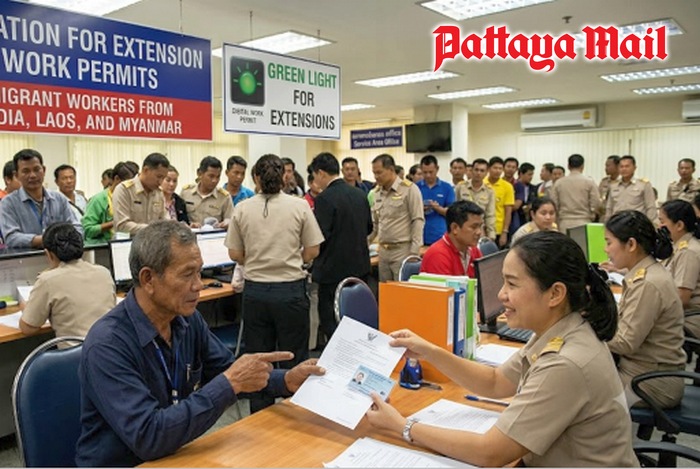
PATTAYA, Thailand – The deal was officially sealed on July 3, when the Ministry of Labour approved an emergency measure extending the stay and work permits of migrant workers from three neighbouring countries—Cambodia, Laos, and Myanmar. Amid sighs of relief from Thai entrepreneurs nationwide, the reality is clear: this move is not about diplomacy or charity. It is about bread and butter, protecting economic activity, and maintaining the cash flow that the government simply could not afford to let freeze under any circumstances.
High-level sources within the Ministry of Labour revealed that Thailand’s manufacturing, tourism, and service sectors are battling a severe labour shortage that threatens to derail the country’s economic recovery. The economic engine, only just beginning to regain momentum, risked an immediate stall if migrant workers were forced out of the system because of expired permits. The minister’s swift intervention is a tactical move designed to keep hundreds of thousands of workers legally employed rather than allowing them to slip into the underground economy, a scenario that would create significant challenges for national security and law enforcement.
The ironclad conditions: what employers must do now
While the government has given the green light, this is certainly no free ride. According to the official statement from the Department of Employment, employers must comply with a strict timetable and several non-negotiable requirements.
First, employers must promptly submit their demand list for foreign workers through the online registration portal before the deadline. Missing the deadline means forfeiting the right to participate.
Second, all migrant workers must undergo mandatory health screenings for prohibited diseases and obtain health insurance that meets the standards set by the Ministry of Public Health, helping to safeguard public health.
Third, employers must ensure that registration records are updated to secure a Digital Work Permit, allowing authorities to maintain a transparent, accurate, and auditable database for long-term workforce management.
The reality check: echoes from the private sector
Data from the Board of Trade of Thailand and the Federation of Thai Industries has consistently indicated that Thailand still requires between 300,000 and 500,000 low-skilled foreign workers to sustain infrastructure projects, manufacturing, and the export sector. This extension provides much-needed breathing room for thousands of factories and construction sites during a period of continued global economic uncertainty.
Had the government failed to act, many businesses warned that supply chains across key industries could have faced severe disruption within weeks, potentially damaging investor confidence and slowing Thailand’s economic growth.
Victor’s take on the grand scheme of Thai labour
On one hand, this measure serves as a timely bandage for an immediate crisis. On the other, it exposes a difficult reality: Thailand remains heavily dependent on low-cost migrant labour and has not transitioned to automation and productivity improvements as quickly as policymakers once envisioned.
The true measure of success will not be the number of permits approved but whether the bureaucracy can deliver a fast, transparent, and corruption-free registration process. If online filing remains slow and burdened by excessive red tape, Thailand’s economic ambitions could be undermined by administrative inefficiency and opportunities for corrupt intermediaries to exploit desperate businesses.

Furthermore, Thailand’s continued reliance on neighbouring workforces highlights a deeper structural weakness in its education, vocational training, and labour development systems, which have struggled to produce enough domestic workers willing to fill essential manual and low-skilled positions. This policy buys valuable time, but it does not address the underlying causes of Thailand’s long-term labour shortage.