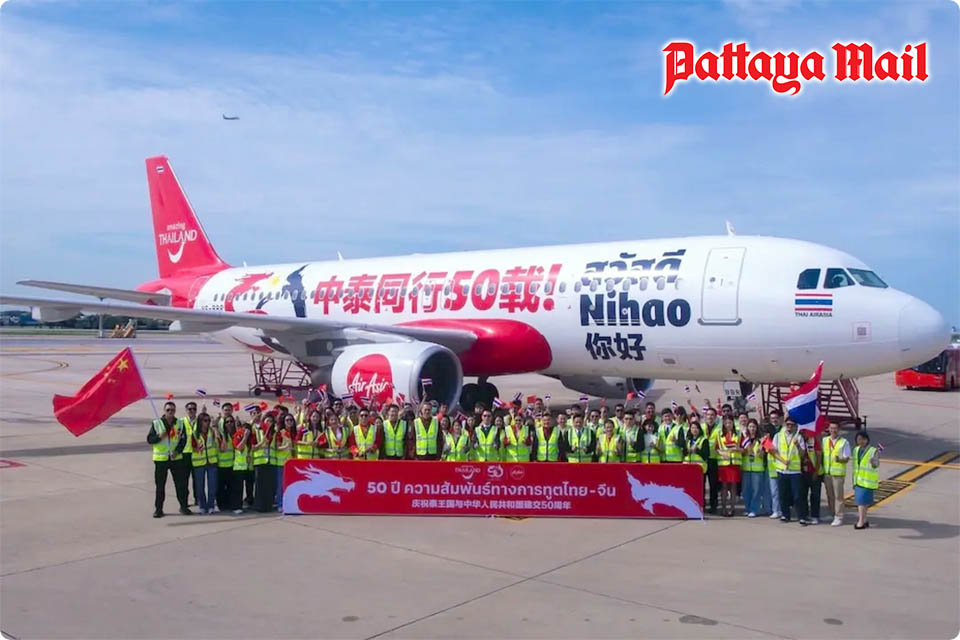
PATTAYA, Thailand – Pattaya’s tourism authorities say the city is finally seeing momentum from the new wave of Thailand–China air connectivity, anchored by Thai AirAsia’s ten direct routes to major mainland cities and the freshly unveiled “50 Years Thailand–China” aircraft livery. The airline’s A320, painted with an intertwined naga‑dragon emblem and the greetings “Sawasdee-Nihao” began service this week and is being promoted with one‑way fares from THB 500 for travel through November 2025.
The timing is critical. Chinese visitor arrivals to Thailand fell 24 percent year‑on‑year in the first quarter amid lingering safety concerns, forcing the Tourism Authority of Thailand (TAT) to trim its 2025 national target from 39 million to 35 million international arrivals.
Yet TAT remains bullish on China, projecting 4.79 million Chinese travellers and THB 270 billion in revenue for the full year—figures Pattaya depends on to keep hotel occupancy above 70 percent in the high season.
Two policy shifts are tilting the odds in the resort city’s favour. First, Thailand and China activated a mutual 30‑day visa‑exemption scheme earlier this year, eliminating paperwork for most leisure visitors.
Second, the AirAsia campaign links Bangkok’s Don Mueang hub with ten mainland gateways—including Guangzhou, Shanghai, and Xi’an—feeding travellers directly onto airport shuttles and tour buses bound for Pattaya within two hours of landing.
Local businesses are already feeling the lift. Booking data from major online travel agencies show a 17 percent month‑on‑month rise in Chinese reservations for Pattaya hotels since the promotional fares opened on 9 July, according to the city’s Hotel Association. Tour operators report that day‑trip excursion sales to Nong Nooch Tropical Garden and Coral Island have doubled compared with May.
Connectivity at U‑Tapao–Rayong–Pattaya International Airport is the final piece of the puzzle. Though still a secondary gateway, U‑Tapao now handles about 100 scheduled flights a month, serviced by four airlines from seven airports—figures local officials say will climb once charter operators from Chengdu and Chongqing resume winter schedules. “Every new seat into U-Tapao shaves at least two hours off the transfer time and brings Pattaya closer to hitting its tourism revenue targets,” said a senior TAT official.
Industry analysts caution that air seats alone will not erase safety worries, but the combination of visa‑free entry, celebratory branding, and bargain fares is a potent confidence signal. If the current booking trend holds, Pattaya’s tourism council projects the city could finish 2025 just five percentage points shy of its pre‑pandemic Chinese arrival peak—well ahead of the national rebound curve.
For hoteliers, the strategy is finally lining up: “We needed an emotional hook for Chinese guests and a hassle‑free path to get here. The dragon‑naga jet gives us both.” Whether the momentum carries through Golden Week in October will determine if Pattaya can claim full victory in Thailand’s year‑end numbers, but for now the city is no longer merely watching the China market—it is riding its slipstream.