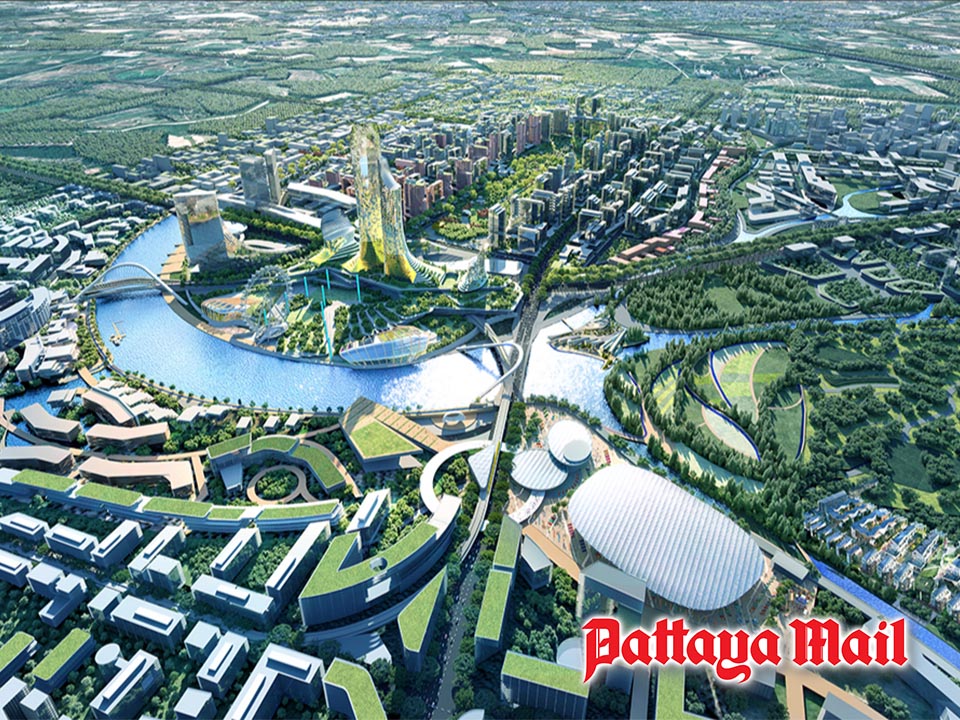
CHONBURI, Thailand – Major infrastructure projects in Thailand’s Eastern Economic Corridor (EEC) are moving ahead, while plans for a 15,000-rai smart city in Huai Yai are taking shape with more than 15 Thai and international investors already expressing interest.
Kothong Thongtham Na Ayudhya, acting director of the EECiti Project Management Office under the Eastern Economic Corridor Office (EECO), said key infrastructure projects remain on track under the EEC’s five-year development framework. Construction of Runway 1 at U-Tapao International Airport is 13.8% complete, while Thai Airways International’s maintenance, repair and overhaul (MRO) facility is awaiting a date for contract signing.
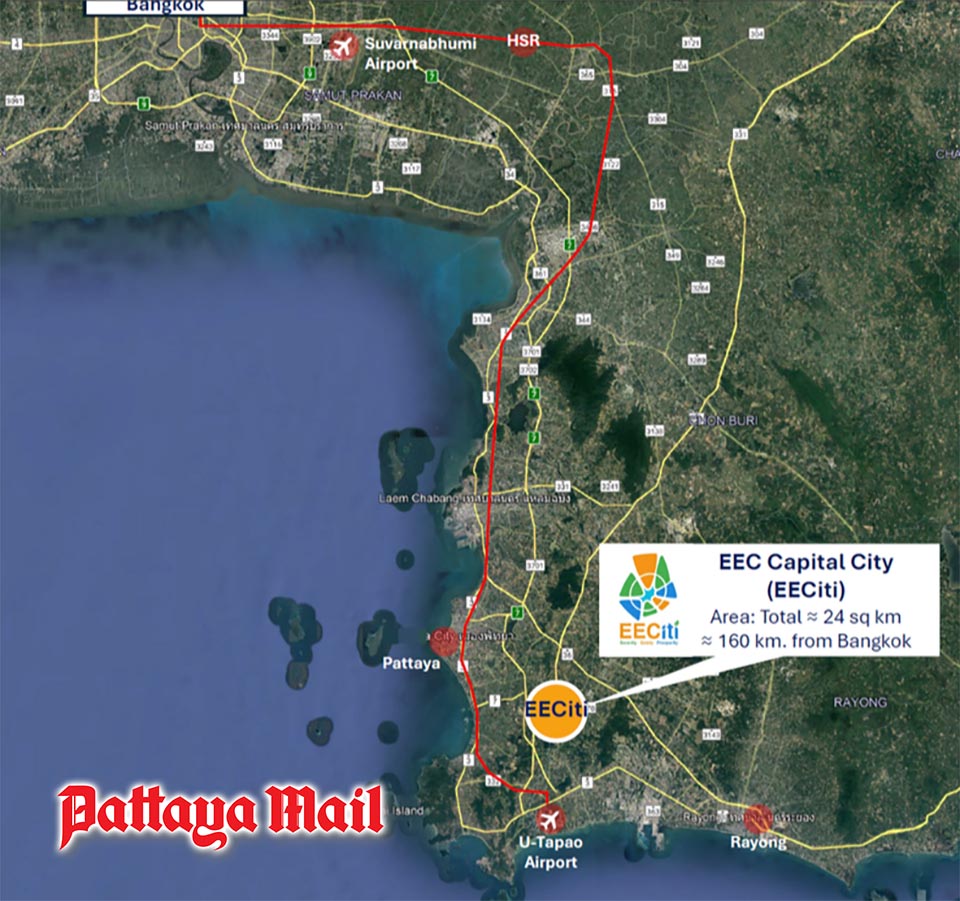
The third phase of Laem Chabang Port and the third phase of Map Ta Phut Industrial Port are expected to be completed in 2029. The high-speed rail project linking Don Mueang, Suvarnabhumi and U-Tapao airports remains subject to national-level policy decisions. Akaratong said the uncertainty surrounding the high-speed railway would not prevent development of EECiti, which is about 10 kilometres away and can also be accessed via Motorway 7 and Route 331.
From an academic perspective, he said there had been discussion about reducing the planned train speed from 250 kilometres per hour to 160 kilometres per hour. Feedback from Japanese residents in Si Racha suggested that 160 km/h would be sufficient if the service provided convenient connections between key destinations. A lower design speed could also reduce construction costs and improve the project’s financial viability, potentially making financing easier to secure, he said.
72 billion baht utility investment
EECiti’s supporting utility infrastructure is expected to require an investment of 72 billion baht, with the private sector invited to participate through a public-private partnership (PPP) model. The system would bring 10 utility services under a single management structure, covering clean energy, water supply, wastewater, waste management, digital infrastructure, disaster prevention, roads, public transport, underground utility networks and green spaces. A bidding process is expected to open in mid-2027, with a private-sector operator targeted for selection in 2028.
15,000 rai smart city planned for Huai Yai
The EECiti project covers about 15,000 rai in Huai Yai, Bang Lamung district, Chonburi. About 91% of the land is currently classified as agricultural reform land. Compensation has already been paid for about 6,000 rai earmarked for the first development phase, while funding will be needed for additional areas. The overall development framework spans 15–20 years and is divided into three phases, with total investment projected at more than 1.1 trillion baht. The city is designed to accommodate about 350,000 people over the longer term.
The development will be divided into six main zones: a central business district with government facilities and landmarks; a medical zone; an education zone covering schools through universities; a sports and entertainment zone; a bio-circular-green economy (BCG) zone; and a mixed-use zone combining residential and commercial development.
The sports zone would expand State Sports Authority land from 371 rai to 1,500 rai to create an Olympic-standard sports complex. The area is also being considered in connection with potential bids to host the 2038 Asian Games or 2040 Olympics.
The first phase is expected to cover 6,000 rai, with development initially focused on medical facilities and housing. More than 15 major Thai and international investors, particularly hospital and property developers, have already expressed interest following initial market testing.
Development is expected to begin in 2028, with the first phase designed to take about five years.
The project is expected to influence land values and housing demand in surrounding areas including Huai Yai, Nikhom Phatthana, Sattahip, Khao Chi Chan, Wat Yansangwararam and Chak Ngaeo.
Data centres also under consideration
EECO is also considering attracting data-centre investment to EECiti, provided projects are compatible with the smart city’s Net Zero 2050 concept. A Japanese company is currently testing a clean-energy data-centre model. If the project proves successful over the next two to three years, EECO would be prepared to consider allocating space for such facilities.
EEC property market shows signs of recovery
Mana Nimitrwanich, director of the Real Estate Information Center (REIC), said the EEC housing market is entering an important transition as demand increasingly needs to come from actual residents rather than being driven primarily by investment and infrastructure development. REIC data for the second quarter of 2026 showed 65,908 residential units available across the EEC, valued at 276.193 billion baht. Supply fell 3.8%, while unsold inventory declined 5.3%. The absorption rate stood at 2.3% per month.
If no new supply entered the market, the estimated time required to sell existing inventory would fall from 54 months to 41 months, indicating improving demand. However, Mana said purchasing power remains constrained by household debt, tighter lending conditions and higher development costs, meaning recovery is unlikely to be uniform across all locations and price segments. Chonburi has potential for a condominium recovery linked to tourism and foreign purchasing power, particularly in Pattaya, Bang Saen and Si Racha.
Rayong continues to see demand for low-rise housing from industrial workers and employees, with homes priced between 3 million and 5 million baht among the more popular segments.
Chachoengsao, meanwhile, is increasingly developing from a satellite residential area for Bangkok into a new residential market linked to infrastructure and logistics networks.
REIC also reported a significant rise in construction permit applications in the EEC. Chonburi recorded two consecutive quarters of increases, with 4,359 low-rise units and 1,105 condominium units, representing a 69.9% increase from the same period a year earlier. Rayong recorded 1,634 low-rise units in permit applications, while Chachoengsao saw increases for four consecutive quarters, reaching 1,214 low-rise units in the second quarter. The figures indicate that developers are seeing renewed opportunities as demand for housing in the EEC gradually improves.