
Looking at Planet Earth from space at a certain angle gives the impression that our world is covered entirely by water. Perhaps aliens, if there are any in this corner of the galaxy, refer to it as “The Blue Planet”. On the other hand, perhaps they don’t. The sea covers over 70% of the Earth’s surface, so it’s not surprising that it has played such an important part in human development and exploration. Some writers have suggested that the sea has also become part of human consciousness, which is why it forms the background to so many stories, novels and films. Jacques-Yves Cousteau, the ocean explorer and film-maker wrote, “The sea, once it casts its spell, holds one in its net of wonder forever.”
My early years were spent on a small island in the Irish Sea and our house lay within a stone’s throw of the water’s edge. The sea was part of life and I became used to seeing it in all its changing moods. Oddly enough, the Irish Sea was rarely blue, even during the summer. It was usually grey or green. Sometimes it changed to a kind of milky blue-green colour. I later discovered that the colour was caused by things called phytoplankton, microscopic organisms of seemingly endless exotic designs which live near the surface of the water.
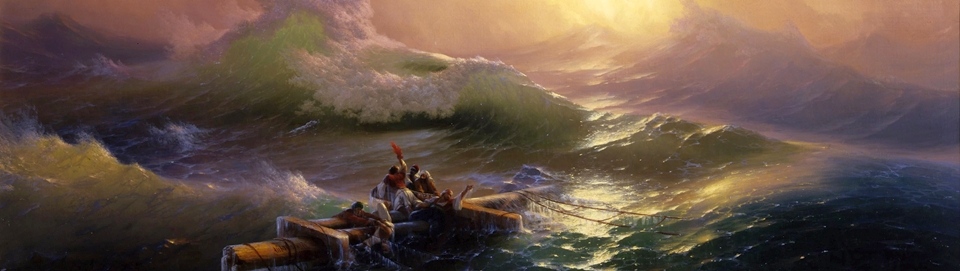
For human beings, the ocean has always been more than water: it’s a mirror of the emotions with its own language of rhythm and flow. The Dutch painter Vincent van Gogh said, “The heart of man is very much like the sea, it has its storms, it has its tides and, in its depths, it has its pearls too.” The depths and colours have captivated artists, poets and composers for centuries. Ivan Aivazovsky springs to mind, the nineteenth century Russian painter, regarded as one of the greatest marine artists in history. It’s easy to see why, for he has an uncanny ability to capture the turbulent movement of water in a single motionless image.
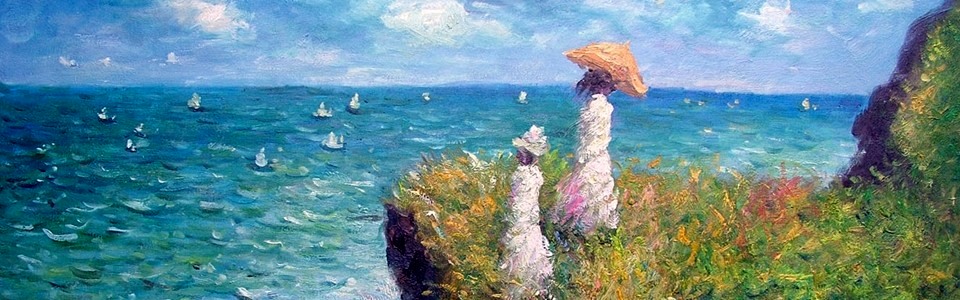
Then there’s the incomparable and heavily-bearded Claude Monet. Art historian Isabella Meyer writes, “Monet was a pioneer of Impressionism and is renowned for his breathtaking seascapes that capture the essence of the sea in its various moods and atmospheres. With a masterful use of light, colour and brushstrokes, Monet’s seascapes transport viewers to coastal scenes filled with movement, tranquility and dynamic beauty. From the shimmering reflections on water to the dramatic interplay of sky and sea, Monet’s seascapes are not just artistic renderings, but immersive experiences that evoke a deep connection with nature’s ever-changing elements.”
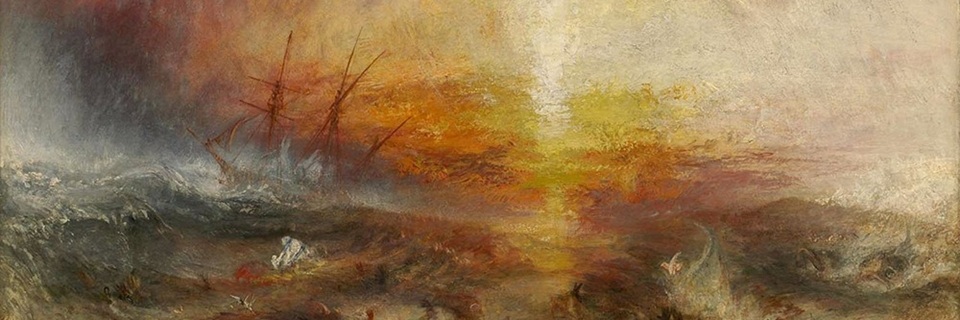
To many British people, J. M. W. Turner is perhaps a more familiar name. He was known for his expressive colouring, imaginative landscapes and restless, sometimes violent marine paintings. He painted over a thousand visionary seascapes. Turner was born only five years after Beethoven yet it always seems to me that his paintings, and especially the marine paintings, were stylistically many years ahead of their time. The British artist John Constable created many notable seascapes when he was staying in the English seaside town of Brighton during the late 1820s. He dismissively described Brighton as “Piccadilly by the seaside”.
The sea has had an enduring influence on literature. Walt Whitman, Alfred Lord Tennyson, John Masefield and Samuel Taylor Coleridge were inspired by the continuously changing moods of the sea. In the sultry British autumn of 2005, a poetry magazine called Magma invited readers to vote for their favourite poems. The results were announced at the Old Royal Naval College in Greenwich, which as it turned out, was an appropriate venue. Britain’s favourite poem was John Masefield’s poem Sea-Fever (“I must go down to the seas again”). You may recall that the first verse contains the yearning line, “And all I ask is a tall ship and a star to steer her by.” The line was quoted by Captain James T. Kirk in a 1980s episode of the iconic television series Star Trek.
In Britain, you can’t go far without coming to a coastline, which is perhaps why the sea has influenced so many British artists, writers and composers. Benjamin Britten was born in the coastal town of Lowestoft. It’s the most easterly town in the British Isles and there, the young composer found inspiration from the sea. Edward Elgar and Ralph Vaughan Williams were among the most influential British composers in the early part of the twentieth century and Elgar’s Sea Pictures are still a great favourite in Britain. In 1905, the conductor Sir Henry Wood composed his Fantasia on British Sea Songs, celebrating the centenary of the Battle of Trafalgar. Sir Henry also founded London’s Promenade Concerts, a famous series of summer concerts which have been held almost every year since 1895. They’re known as “The Proms” and Wood’s Fantasia on British Sea Songs is traditionally played at the final concert of the season.
Sir Arnold Bax (1883-1953): Symphonic Poem: Tintagel. London Symphony Orchestra cond. Sir Antonio Pappano. (Duration: 16:47; Video: 1080p HD)
The English composer Arnold Bax came from a family of Dutch descent, which explains his slightly odd surname. While still a teenager, Bax fell under the spell of all things Irish and especially the poetry of William Butler Yeats. When he was nineteen, Bax went to Ireland and visited the most isolated and secluded places he could find. He taught himself Gaelic and in later years, under the pseudonym of Dermot O’Byrne, he wrote many successful plays, poems and short stories. Ironically though, his most famous orchestral work was inspired not by Ireland, but by the restless Atlantic seas around the West Country of England.

Tintagel village and its medieval castle lie on the Atlantic coast of Cornwall and they’re closely associated with the stories surrounding the legendary King Arthur and the Knights of the Round Table. Bax visited the ruins of Tintagel Castle during the summer of 1917 and was so captivated with the haunting atmosphere that he began writing this thrilling symphonic poem. Completed in 1919, it has become his best-known work and at one point, quotes a theme from Wagner’s Tristan and Isolde, an opera that was also set in and around the coast of Cornwall. The expansive, at times almost Hollywood-style music is meant to depict a castle standing heroically on the rocks, lashed by the waves of the Atlantic. And as Bax himself admitted, the spirit of the Arthurian legends is not far away. It’s all thrilling stuff.
Claude Debussy (1862-1918): La Mer Three Symphonic Sketches. Royal Concertgebouw Orchestra cond. Bernard Haitink (Duration: 27:23; Video: 1080p HD)
The Dutch conductor Bernard Haitink, who died in 2021 was a highly respected and award-winning musician, well known for his characteristic approach to conducting in which he intervened as little as possible and let the music speak for itself. He began his conducting career with the Netherlands Radio Philharmonic in 1957. Later he became principal conductor of the Royal Concertgebouw Orchestra in Amsterdam and held that position for twenty-seven years.

Debussy was a contemporary of Monet, although twenty years younger. His music was sometimes described as “impressionist” but Debussy evidently disliked the term. The composer was about forty when he began this evocative work in 1903. He described it as trois esquisses symphoniques pour orchestra (“Three symphonic sketches for orchestra) and the movements are entitled (1) From dawn to midday on the sea, (2) Play of the waves and (3) Dialogue between the wind and the waves. It’s a symphonic poem in all but name and Debussy evoked the mood and colours of the sea through unexpected harmonies, unusual melodic lines, and surging orchestral colours. The musical language was quite advanced for the time and at the first performance in Paris, the work was not well-received, even by some of Debussy’s admirers. Some years were to pass before the work became accepted. Today, this masterpiece of orchestration has become one of the most popular and influential orchestral works of the twentieth century.
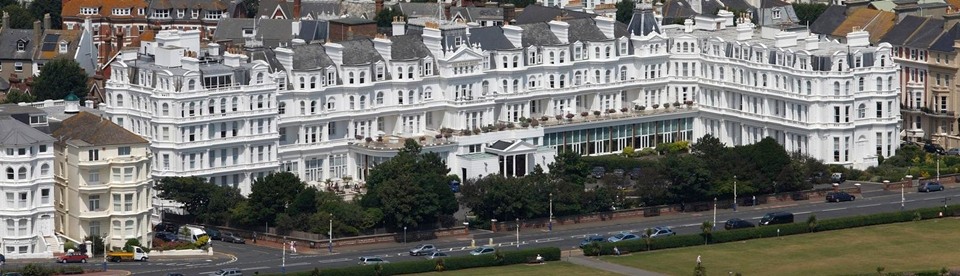
Debussy completed La Mer in March 1905. He spent part of the summer correcting the publisher’s proofs while staying in at the palatial Grand Hotel in Eastbourne on England’s south coast. In a letter to his publisher, Debussy described Eastbourne as “a charming peaceful spot: the sea unfurls itself with an utterly British correctness.” Eastbourne’s Grand Hotel has long been associated with music. Radio broadcasts of light classical music started there in 1925 and were described as “music from the palm court” although few people realised that the hotel didn’t have a palm court. The Grand Hotel has welcomed many famous guests and still dominates the sea front of Eastbourne. The rooms in which Debussy stayed are now called The Debussy Suite. (“A spacious bedroom, large lounge, a luxurious bathroom…substantial balconies with stunning sea views.”) If you crave a self-indulgent experience with musical connections, you can book The Debussy Suite for your own holiday in Eastbourne. Don’t forget your credit cards.
Incidentally, Eastbourne was also where the English composer Frank Bridge completed his orchestral suite The Sea in 1911. And talking of maritime themes, you might remember that mawkish ballad which begins, “The boy stood on the burning deck”. Most people don’t know any more of it, let alone the title or the name of the author. The poem is called Casabianca and it was written in 1826 by an English poet of some distinction named Felicia Dorothea Hemans. It would have given me immense satisfaction to tell you that she wrote the poem while staying in Eastbourne. But she didn’t.