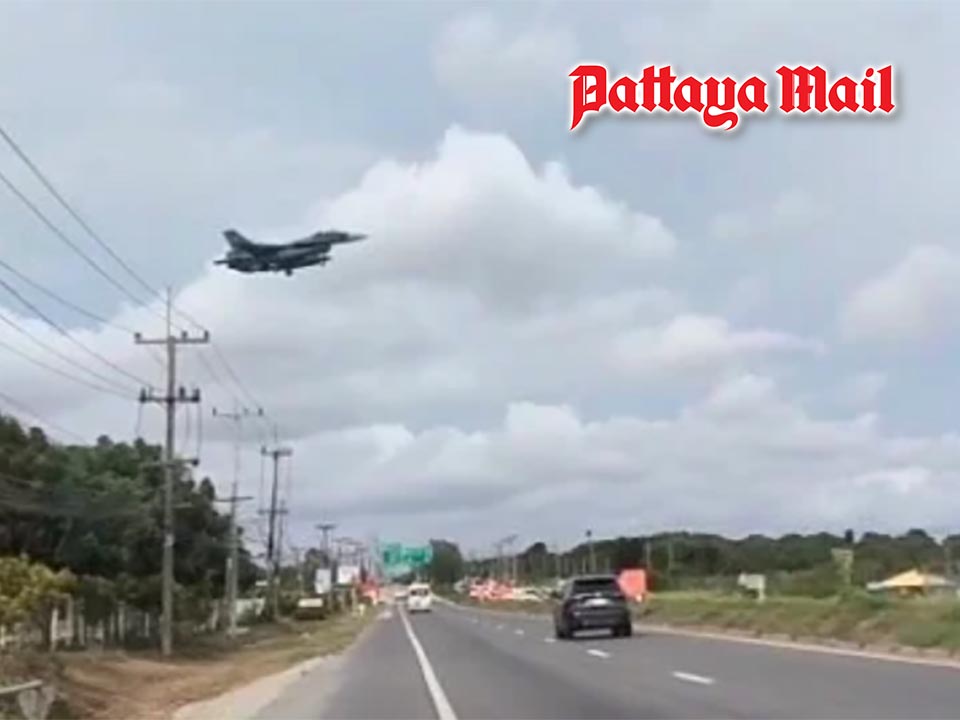
CHONBURI, Thailand – One military chapter closed in Chonburi on September 6, while another made history. As the USS Abraham Lincoln sailed away from Laem Chabang after a five-day visit, Japanese F-2A/B fighter aircraft arrived at U-Tapao International Airport for a refueling stop before continuing to India for Exercise Veer Guardian 26. The arrival marked the first time Japanese combat aircraft have landed in Thailand since the end of World War II, making the brief stop at U-Tapao a significant moment for Thailand-Japan defense cooperation.
The Japan Air Self-Defense Force (JASDF) mixed formation was scheduled to stop at U-Tapao before continuing to India, where the Japanese and Indian air forces will conduct Veer Guardian 26 from September 9 to 21 at Jodhpur. The group stopping in Thailand includes five F-2A/B “Viper Zero” fighters, two C-2 transport aircraft and two U.S. Air Force KC-135 aerial refueling tankers, according to reports on the deployment. The F-2 arrival is particularly notable because Japan and Thailand have long maintained friendly relations, but previous Japanese military aircraft visits to Thailand have generally involved support aircraft such as transports and tankers rather than frontline fighter jets.
The F-2 itself is a uniquely Japanese development based on the American F-16 design. Produced by Mitsubishi Heavy Industries with Lockheed Martin involvement, it was developed to meet Japan’s specific requirements, particularly maritime defense and strike missions. Compared with the F-16, the F-2 has a larger wing, greater fuel and weapons-carrying capacity and extensively upgraded avionics. The aircraft also became notable for incorporating advanced Japanese systems, including an active electronically scanned array radar.
The fighters stopping in Thailand belong to the JASDF’s 8th Air Wing at Tsuiki Air Base in southwestern Japan. Japan is sending three F-2As with around 110 personnel to participate in Veer Guardian 26, where they will conduct air-combat training with Indian Air Force aircraft. For India, the exercise represents the first time Japanese F-2 fighters will operate from Indian soil. The Japanese aircraft are expected to train alongside Indian Su-30MKI fighters, strengthening interoperability and operational understanding between the two air forces.
For Thailand, however, the significance comes before the fighters even reach India. Their brief stop at U-Tapao places Thailand along an increasingly important route for international military aviation and highlights the airport’s role in supporting long-distance deployments. The timing also makes the scene at Chonburi particularly striking. Earlier in the day, the enormous USS Abraham Lincoln and its accompanying U.S. Navy ships began departing Thailand after a five-day port visit that brought nearly 5,000 American sailors and Marines to the area.
Then, only hours later, Japanese fighter aircraft arrived in the same province. For residents around U-Tapao, the appearance of the distinctive F-2s offered a rare sight — Japanese frontline fighters on Thai soil for the first time since the Second World War. The aircraft are not staying for an exercise in Thailand. Their stop is part of a longer journey to India, where Japan and India are continuing to deepen their air-force cooperation. But for Chonburi, September 6 became a remarkable day in its military aviation story: one major foreign military presence sailed away from Laem Chabang, while another arrived in the skies above U-Tapao.