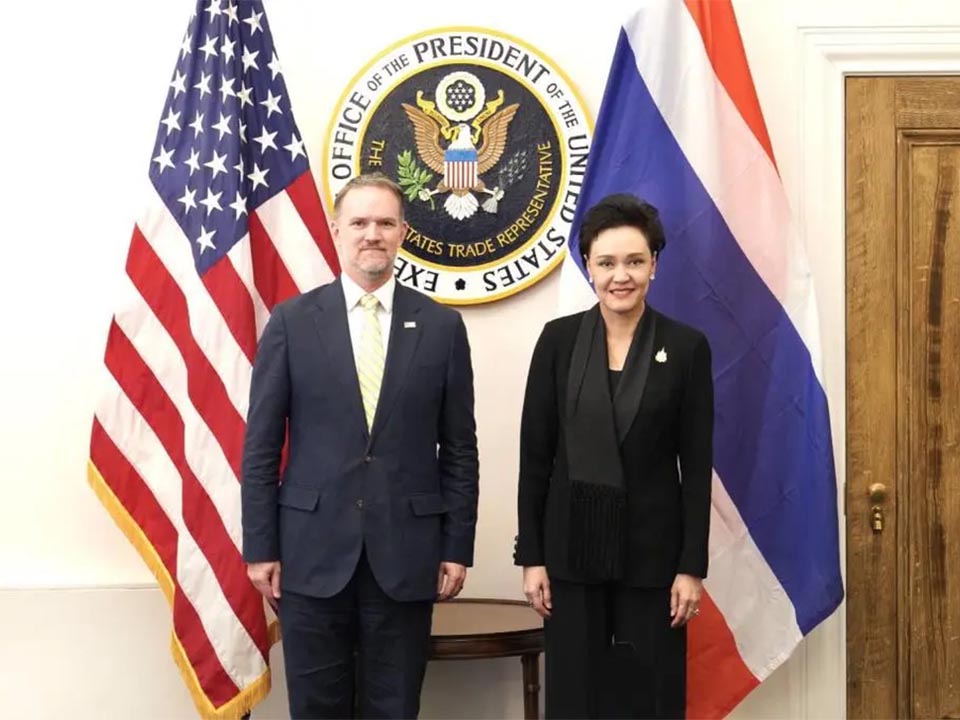
BANGKOK, Thailand – Thailand and the United States have reached an agreement on the key elements of the Agreement on Reciprocal Trade (ART), with only technical details remaining to be finalized. Deputy Government Spokesperson Lalida Persvivatana stated that Deputy Prime Minister and Commerce Minister Suphajee Suthumpun met with U.S. Trade Representative Jamieson Greer and Deputy U.S. Trade Representative Rick Switzer in Washington, D.C., on September 1, 2026.
The talks achieved significant progress ahead of the United States’ decision on its Section 301 investigation into structural excess capacity and production. The U.S. side assured Thailand that any resulting tariff rate would be fair and allow Thai products to remain competitive. The United States is Thailand’s largest export market, valued at 2.37 trillion baht and supporting over 400,000 domestic jobs. The government stated that the negotiations aim to protect export orders, manufacturing, employment, and income, especially in the industrial and agricultural sectors.
Thailand previously faced a 36% reciprocal tariff under the U.S. International Emergency Economic Powers Act. This rate was reduced to 19% after a joint statement and the announcement of an ART framework on October 26, 2025. The United States later imposed a 10% tariff on all countries under Section 122. Thailand is also covered by two Section 301 proceedings regarding structural excess production capacity and the absence of an import ban on goods produced with forced labor.
The deputy spokesperson said Thai and U.S. officials negotiated for four consecutive days to resolve outstanding differences. Technical teams will now finalize provisions on non-tariff barriers, digital trade, and commercial opportunities. In 2025, bilateral trade exceeded three trillion baht. Thailand exported 2.37 trillion baht in goods to the United States and imported about 700 billion baht, resulting in a trade surplus of roughly 1.68 trillion baht. (NNT)