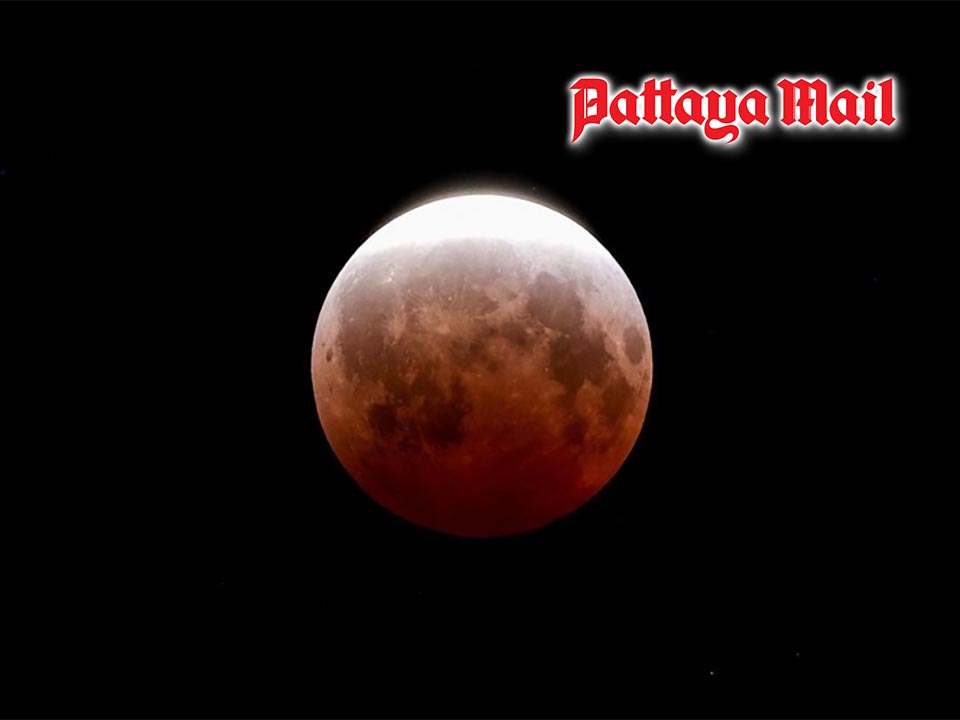
BANGKOK, Thailand – Skywatchers in parts of the world were treated to a striking “Almost Blood Moon” on Aug. 28, when a partial lunar eclipse caused Earth’s darkest shadow, known as the umbra, to cover as much as 96.2%–96.3% of the Moon’s surface.
Although the event was classified astronomically as a partial lunar eclipse, the Moon appeared almost entirely orange-red or deep coppery red, with only a small bright sliver remaining on one side. The appearance made the partial eclipse look remarkably similar to a total lunar eclipse.
The phenomenon was most clearly visible throughout North and South America, including the United States, Canada, Mexico, Brazil, Argentina, Chile, Peru and parts of the Caribbean. Much of the Americas experienced the eclipse during the late-night and early-morning hours from Aug. 27 into Aug. 28, allowing the Moon to remain high enough in the sky for observers to follow the event from beginning to end.
Some parts of Western Europe and West Africa also had an opportunity to see the eclipse, although only during part of the event as the Moon was setting toward the horizon. The United Kingdom, France, Spain, Portugal, Morocco and Nigeria were among the areas with partial visibility. Asia, including Thailand, as well as Australia and New Zealand, could not see the phenomenon because the eclipse occurred on the opposite side of the Earth. The event coincided with morning and daytime hours in these regions.
The entire phenomenon lasted approximately 5 hours and 38 minutes, including the penumbral phase. The deepest point of the eclipse, known as the Maximum Eclipse, occurred at 04:13 UTC on Aug. 28, corresponding to approximately 11:13 a.m. Thailand time.