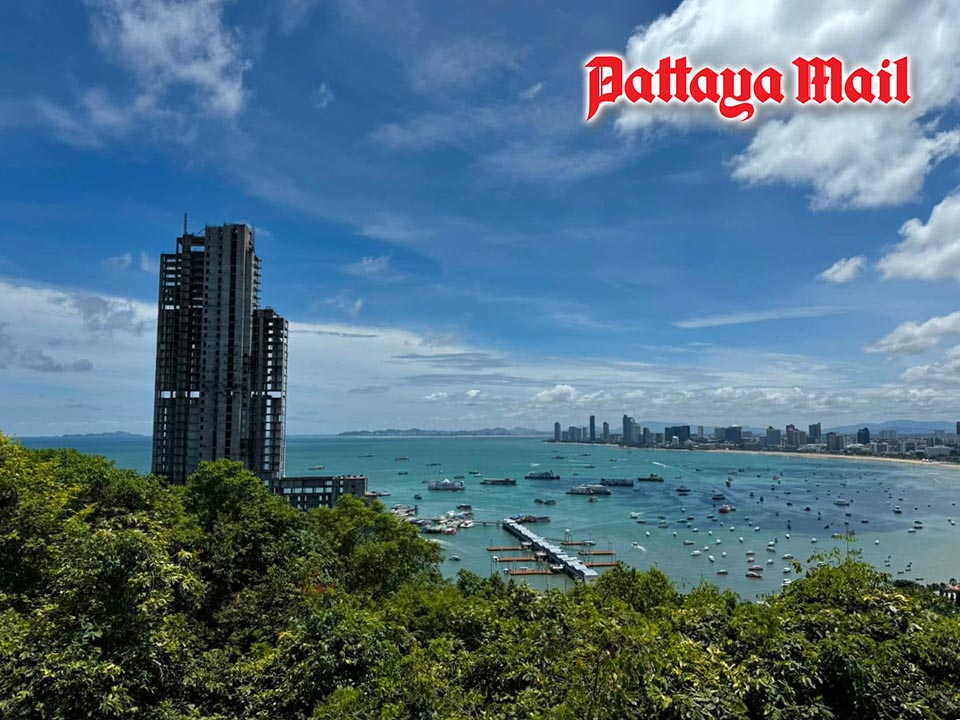
PATTAYA, Thailand – For years, the abandoned building overlooking Pattaya Bay from the Pratamnak Hill viewpoint has stood as one of the city’s most visible eyesores. Now, with its demolition repeatedly postponed, a simple question deserves a clear answer: when will it finally come down?
The structure is difficult to ignore. From one of Pattaya’s best-known viewpoints, visitors looking across the bay are confronted not only by the city skyline and sea, but by a neglected concrete shell that has remained standing for far too long.
What should have been dealt with years ago has instead become a familiar feature of the landscape.
The latest delay only adds to the frustration. Government authorities have ordered action, but the process continues to move between agencies, with local administration and the Land Department appearing to pass responsibility back and forth. Meanwhile, there is still no firm demolition date that the public can point to and say: this is the day it will finally disappear. And that raises another obvious question: who is going to pay for it?
If demolition is required, taxpayers deserve to know which agency will foot the bill, how much it will cost and who will ultimately be responsible for carrying out the work. If there are legal obstacles, officials should explain precisely what remains to be resolved. If a court order is required, the public should be told whether one has been sought and where the case stands. What is not acceptable is allowing the issue to drift indefinitely while different agencies continue tossing the problem back and forth.
For a city that depends heavily on tourism, first impressions matter. Pattaya spends millions promoting its beaches, viewpoints, nightlife and modern tourism image, yet one of the most prominent views of the bay still includes a derelict structure that has become almost symbolic of administrative paralysis.
The building is now more than an eyesore. It risks becoming a monument to a deeper problem that Thailand has struggled with for generations: corruption, questionable development and a system in which responsibility can become so fragmented that nobody appears to be responsible. That is perhaps the most embarrassing part.
A visitor does not see the paperwork, contracts, land records, government departments or legal arguments. They simply see an abandoned building sitting on a hillside overlooking one of Thailand’s major tourist destinations. And they may reasonably wonder why nobody can make it disappear.
Pattaya does not need another promise that the building will eventually be demolished. It needs a clear deadline, a clearly identified responsible agency, a transparent explanation of the legal position and a public accounting of the demolition cost. Until then, the Bali Hai building will continue to stand — not as a landmark Pattaya can be proud of, but as an unwanted monument to a problem that has been allowed to remain far too long.