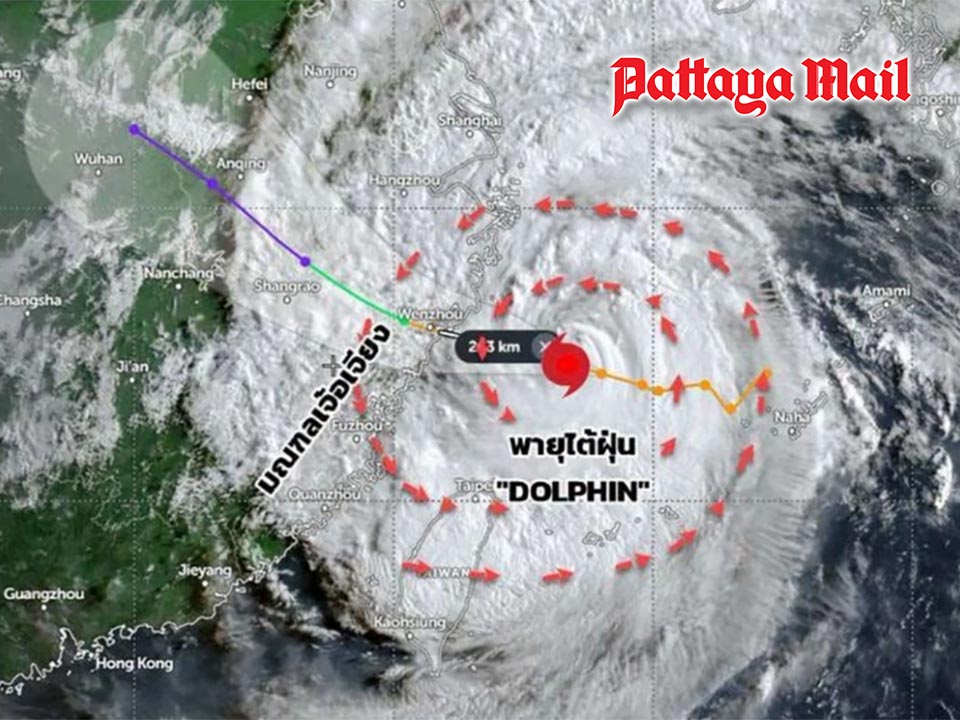
BEIJING, China – Typhoon Dolphin weakened after sweeping along China’s eastern coast but continued to unleash heavy rain on Monday, disrupting air and public transport and triggering widespread evacuations across the country. China’s National Meteorological Center issued its lowest-level typhoon warning on Monday morning after the storm weakened following its movement along the coast of Zhejiang province on Sunday. The agency warned that parts of eastern and central China would continue to face heavy rainfall in the coming days.
State broadcaster CCTV reported that authorities issued the highest-level flash-flood warning for parts of eastern and southern Zhejiang. The storm caused major disruption in Shanghai, where the city’s two main commercial airports recorded 943 cancelled flights, according to the airport authority. Several public transport services, including local railway lines, were also suspended.
Ningbo International Airport in Zhejiang was scheduled to resume flights around midday Monday, but warned passengers that delays and cancellations could continue because the effects of the typhoon had not completely passed. Hangzhou resumed some subway services Monday morning after suspending several lines on Sunday.
The storm triggered widespread evacuations over the weekend, with more than one million people moved to safety. CCTV reported that more than 900,000 people were evacuated in Wenzhou, Zhejiang, with more than 1,500 emergency shelters opened across the city. Xinhua reported that more than 150,000 people were evacuated in Fujian province and more than 200,000 in Shanghai. Northern China is also preparing for severe weather later this week. Five districts in Beijing issued red alerts for heavy rain on Monday, with authorities warning of possible landslides and flooding.
Typhoon Dolphin had prompted China’s highest-level warnings over the weekend, resulting in more than 1,000 flight cancellations and mass evacuations before the storm weakened.
The disruption comes only two weeks after Typhoon Noul struck Guangdong in southern China, with authorities describing it at the time as the strongest typhoon to hit the country this year. Severe weather also caused major damage across southern and central China last month. Authorities reported 39 deaths after Typhoon Maysak triggered major flooding in Guangxi, while storms and powerful winds linked to the system killed 11 people and injured 331 in central Hubei province.
Scientists have warned that the intensity and frequency of extreme weather events are expected to increase as global temperatures rise due to greenhouse-gas emissions from fossil fuels. China remains the world’s largest greenhouse-gas emitter but is also a global leader in renewable energy and has set a target of achieving carbon neutrality by 2060.