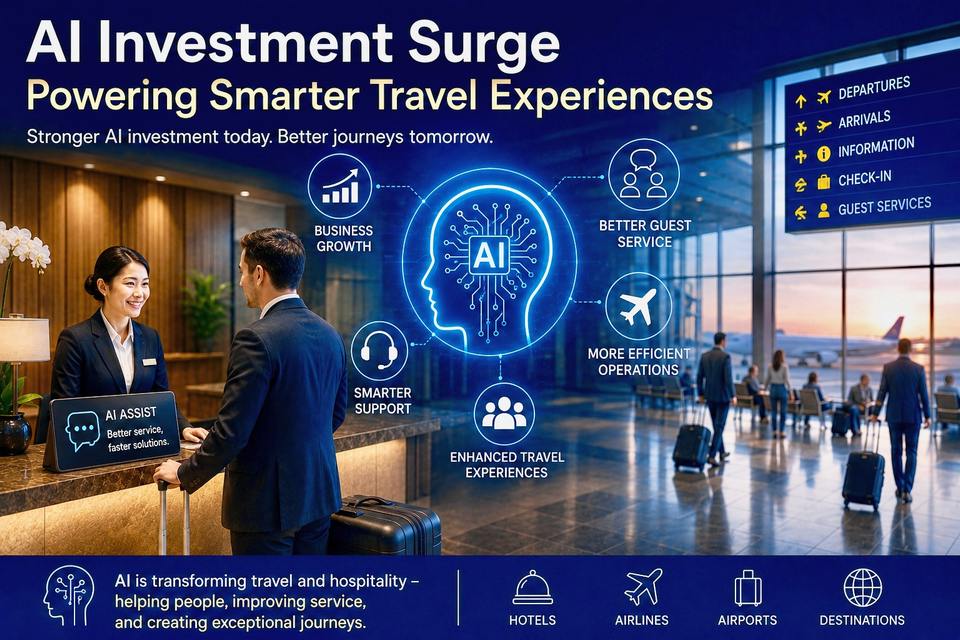
BANGKOK, Thailand – Microsoft’s latest financial results have renewed investor confidence that artificial intelligence is delivering measurable commercial returns, bringing encouraging news for the global travel and tourism industry, where AI is rapidly transforming the way businesses operate and serve customers.
The technology giant’s latest earnings provided the evidence many investors had been waiting for: massive investment in AI infrastructure is generating real revenue growth rather than simply increasing costs.
Driving that performance was Microsoft’s Azure cloud platform, which recorded stronger-than-expected growth as demand for AI services continued to accelerate. Azure provides the computing power, storage and AI capabilities that enable businesses to develop and deploy artificial intelligence applications without investing in costly infrastructure. It also hosts AI models, including OpenAI’s ChatGPT, allowing organisations worldwide to integrate advanced AI into their daily operations.
Microsoft also reaffirmed its commitment to heavy AI investment, noting that customer demand still exceeds available computing capacity—a clear indication that the AI expansion remains in its early stages. Investors responded enthusiastically. Microsoft’s share price jumped about 15 percent, adding nearly US$450 billion in market value in a single trading session—the largest one-day gain ever recorded by a publicly traded company.
The results answered one of the market’s biggest questions following the recent semiconductor downturn: would the world’s largest technology companies slow their AI spending? Microsoft’s response was an emphatic no.
Other technology leaders reinforced that message. Amazon reported continued strength in Amazon Web Services while increasing planned AI investment to around US$220 billion in 2026. Although Meta acknowledged pressure on margins from its AI spending, it also reaffirmed its long-term commitment to artificial intelligence.
The announcements triggered a strong recovery in semiconductor stocks, including South Korean chipmakers SK hynix and Samsung Electronics, key suppliers of the advanced high-bandwidth memory chips essential for AI computing.
Why it matters for travel and tourism
Having spent more than four decades in hotels and tourism, I have witnessed the industry’s transformation through computerised reservations, the internet, online booking platforms and mobile travel. Artificial intelligence is the next major milestone in that journey.
What was once an emerging technology has quickly become a practical business tool. Hotels are increasingly using AI to respond more quickly to guest requests, personalise communications and improve operational efficiency. Airlines are employing AI to optimise schedules, predict maintenance needs and streamline operations, while destinations and travel companies are using intelligent systems to improve customer engagement and simplify travel planning.
One of the most encouraging developments has been the enthusiasm with which younger hospitality professionals have embraced AI since the industry’s recovery from the Covid-19 pandemic. They are using it to analyse data, prepare reports, improve communications and enhance guest service—not to replace people, but to support them.
AI is also becoming more visible in frontline hospitality operations. Hotels, restaurants and airports are using intelligent assistants to provide information, support concierge services and respond more efficiently to customer enquiries, allowing staff to spend less time on routine administrative tasks and more time delivering genuine personal service.
In my view, this can only benefit the industry. Hospitality has always been, and always will be, about people. AI cannot replace warmth, empathy or authentic human interaction. Instead, it gives employees more time to focus on what matters most—creating memorable experiences for guests.
Microsoft’s latest results therefore represent far more than another strong technology earnings report. They confirm that investment in AI infrastructure is continuing at scale, ensuring that travel and tourism businesses will have access to increasingly powerful tools to improve productivity, service quality and the overall guest experience. For an industry built on delivering exceptional experiences, that is welcome news indeed.

 About the author
Andrew J. Wood is a Bangkok-based travel writer, media executive and former hotel general manager with more than four decades of experience in Asia’s hospitality and tourism industry. A former Director of Skål International, Past President of Skål Asia, Skål International Thailand and Skål International Bangkok, he currently serves as Vice President of Skål International Bangkok. A respected commentator on travel, aviation, hospitality, technology and business trends, he has received Skål International’s Order of Merit and Membre d’Honneur for his contribution to global tourism. His articles are widely published in leading regional and international media.