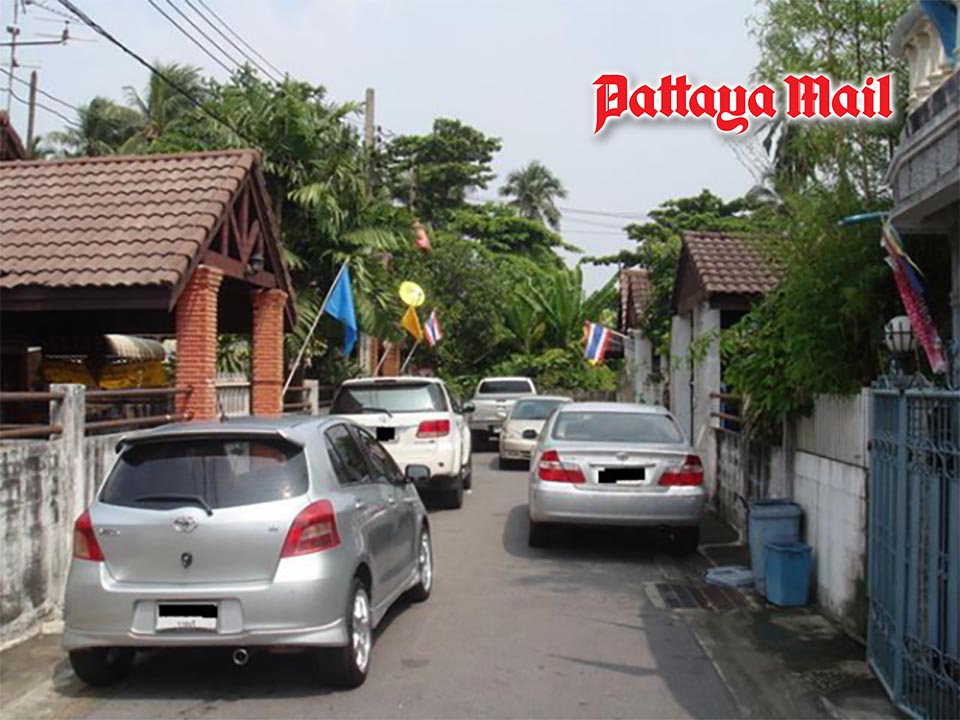
PATTAYA, Thailand – A dispute involving a car parked outside a neighbor’s home has reopened a wider debate in Thailand over parking habits, property rights and who should pay when damage occurs. The case began when a vehicle owner parked outside a neighbor’s house, reportedly across from their own home. The neighboring property was said to be rarely occupied, but later pieces of concrete from the building fell onto the parked vehicle, causing damage. When the car owner requested compensation, the homeowner allegedly refused responsibility and told the owner to take the matter to court. Police accepted the complaint and recorded the details, but explained that the dispute was a civil matter requiring the parties to seek compensation through legal procedures.
The incident attracted strong reactions online, with opinions divided. Some people argued that the homeowner should be responsible because the damage came from the property. Others said the vehicle owner should not have parked outside someone else’s home in the first place.
Dr. Peerapat Foithong, spokesperson for the Lawyers Council of Thailand, explained that the two issues involve separate legal matters. He said that under Section 436 of Thailand’s Civil and Commercial Code, a person living in a building can be held responsible for damage caused by objects falling from the property or being thrown from the premises. However, the parking issue is a separate matter. Roads and common areas outside homes generally do not belong exclusively to the homeowner. Residents do not automatically have ownership rights over the road in front of their property.
Vehicles can usually park along public roads if they do not break traffic rules or cause problems. However, parking that blocks a driveway, prevents residents from entering or leaving, or creates a disturbance may violate traffic regulations and could also be considered a public nuisance under Section 397 of the Criminal Code. Dr. Peerapat said that even if the car owner was wrong for parking in an inappropriate location, it does not automatically remove the homeowner’s responsibility for damage caused by falling objects. He said the two matters should be considered separately and encouraged neighbors to negotiate solutions rather than immediately turning disputes into long legal battles.
The case has also highlighted a wider urban problem in Thailand, where many households own multiple vehicles but have limited parking space. Urban planning expert Associate Professor Dr. Sonchai Lobyaem, head of the Urban Design and Planning Department at Silpakorn University, said parking conflicts are far more common in Thailand than in many neighboring countries. He pointed to Japan as a possible example for Thailand to study. In Japan, people generally need proof of having a parking space, known as a parking certificate or “Shako Shomeisho,” before purchasing a vehicle. The system was introduced decades ago to reduce street parking problems and prevent vehicles from blocking homes and public roads.
Experts say Thailand needs both stronger enforcement and better city planning. While police action such as fines, wheel clamping and enforcement can help, it will not fully solve the problem without more public parking facilities, especially in crowded city and commercial areas.
The dispute reflects a growing challenge in Thai cities: finding a balance between personal convenience, legal rights and respect for shared public spaces.