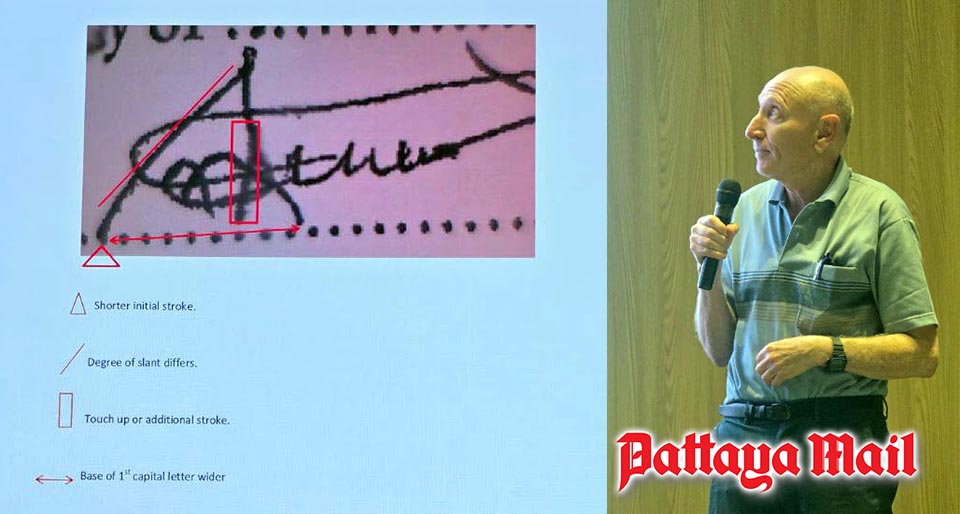
PATTAYA, Thailand – Mike Maran, Forensic handwriting expert, returned to the Pattaya City Expats Club on Wednesday, July 1, for a presentation that blended audience participation, personality-based graphology and the more exacting discipline of forensic document examination.
Mike is a recognized expert on handwriting. He opened his presentation by challenging the audience to think of handwriting as “brain writing.” He said that handwriting is not simply a product of pen and paper, but a reflection of habits formed in the brain. No two people write exactly alike, and even one person’s signature naturally changes from one signing to the next.
Mike reinforced the distinction between the two fields, graphology and forensic. Graphology, he explained, seeks to infer character traits from handwriting, while forensic handwriting and document examination focuses on whether a signature or document is genuine.
The first part of the presentation introduced members to graphology. Mike outlined the features analysts observe, including letter size, slant, letter connections, upper and lower letter zones, margins, spacing, baselines, T-bars, I-dots and signatures. Small handwriting, he suggested, may indicate concentration or introversion, while large writing may point to someone who enjoys attention. Rounded letter connections might suggest an easier-going nature, while angular writing can indicate tension or worry.
One of the liveliest portions of the morning came when Mike asked audience members to sign a sheet of paper, exchange it with a neighbor, and then respond by show of hands as he described signature features. He said a legible signature suggested a person who is genuine, honest, straightforward and reliable. An illegible signature, by contrast, could suggest someone who avoids commitments or values their own time highly, although he cautioned that in some professions an unreadable signature may simply be a time-saving habit.
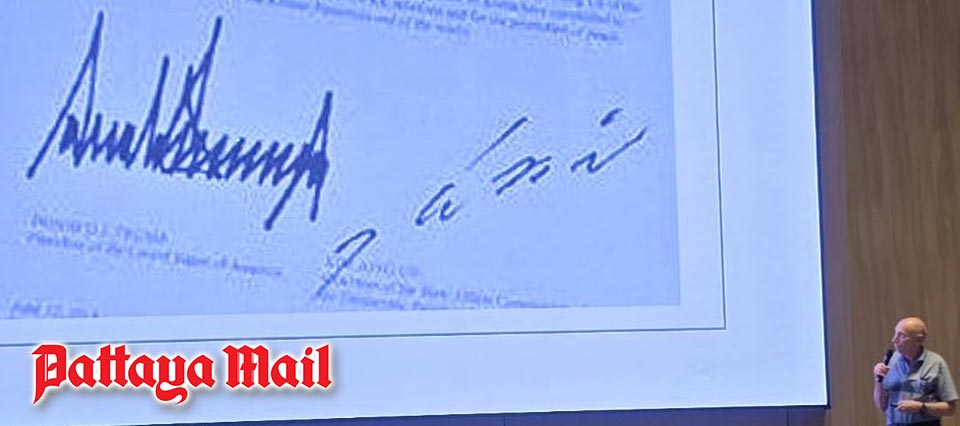
The exercise was lighthearted, but Mike repeatedly reminded the group that signatures should not be judged in isolation. A signature is a public image, he said, and should be compared with a person’s broader handwriting before drawing fuller conclusions. People may write, print and sign in different ways, and a signature can change because of age, health, emotional state, environment, writing surface or instrument.
The second part of the talk turned to Maran’s main professional work: forensic document examination. He described cases involving disputed wills, financial fraud, altered checks, malicious notes, forged signatures and documents that may have been cut and pasted or electronically manipulated. Many of the disputes he noted, involve money, family conflict or legal claims.
Mike emphasized that original documents are far more useful than photocopies because important evidence can be lost in reproduction. Under a microscope, examiners can study pen pressure, line quality, rhythm, hesitation, touch-up strokes and other microscopic details. A signature that appears convincing to the naked eye may reveal problems when magnified, especially if the signer consciously tried to imitate another person’s writing.
Rather than offering opinions in percentages, Mike said forensic document examiners use a scale of probability ranging from inconclusive to identification. He said he is cautious about conclusions, particularly because reports may end up in court and must be defensible under cross-examination. The examiner’s responsibility, he stressed, is to remain neutral, even when hired by one side in a dispute.
During the question-and-answer session, members asked about fountain pens versus ballpoint pens, the significance of initials, how alcohol or age can affect handwriting, and whether people commonly use different signatures for formal and informal purposes. Mike said context matters: the writing instrument, surface, pace of signing and purpose of the document can all influence the result.
By the end of the presentation, Mike had shown the audience that handwriting can be both a window into personality and a practical forensic tool. His central message was that while graphology can make handwriting entertaining and revealing, forensic document examination requires disciplined comparison, original evidence and careful, impartial judgment.
Following the presentations, MC Ren Lexander brought everyone up to date on upcoming Club events followed by the Open Forum portion of the meeting where questions are asked and comments made about Expat living in Thailand, especially Pattaya. To learn more about the PCEC, visit their website at https:/pcec.club. A video of the presentation will be uploaded to the PCEC’s YouTube Channel at https://www.youtube.com/@pcecclub6255/videos.