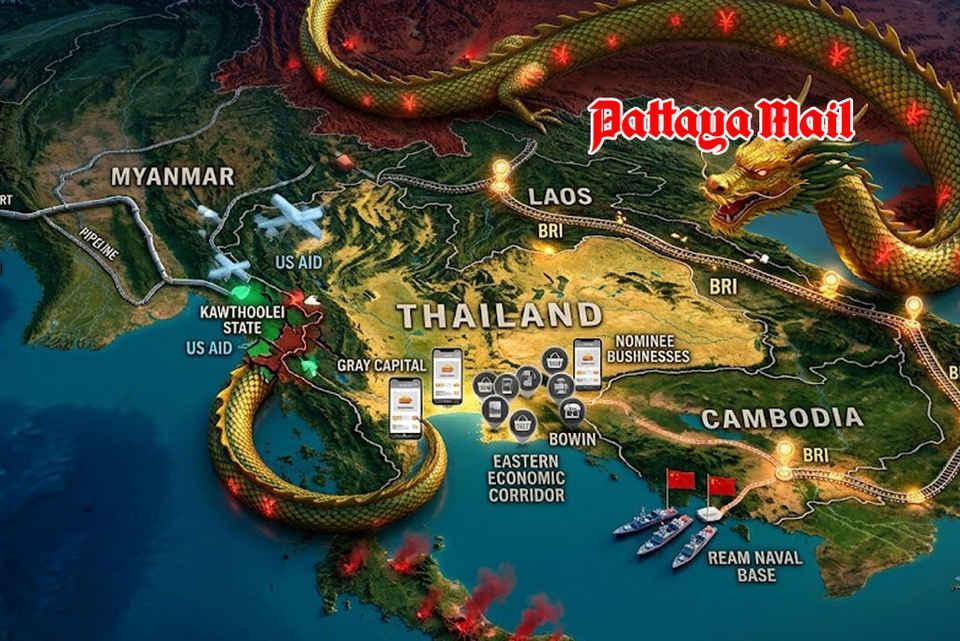
PATTAYA, Thailand – If we look at the broad map of Thailand at this moment, what is happening is not just a series of coincidences involving individual neighboring countries. Instead, it is a calculated geopolitical squeeze radiating from Beijing, forming a dragon’s encirclement that is closing in on Thailand from all directions by leveraging the vulnerabilities of our neighbors. The ultimate endgame of this strategy would leave Thailand in a position devoid of leverage and make it extremely difficult to navigate independently in the future.
The encirclement board: When neighbors become pawns of the dragon
Imagine Thailand’s major economic arteries and strategic spaces being handed over one by one. To our east, Cambodia has completely fallen under China’s sphere of influence. The establishment of the Ream Naval Base and the backing of the Funan Techo Canal project are not merely internal economic matters for Phnom Penh. They represent the institutionalization of Chinese military power right at the doorstep of the Gulf of Thailand, Thailand’s primary maritime trade gateway and security zone. Should Thailand ever make a move that displeases China, Cambodia could serve as the vanguard to pressure Thailand by both land and sea.
Meanwhile, to our west, a Myanmar deeply scarred by civil war has little choice but to sacrifice everything to appease Beijing. Naypyidaw has cleared the path for Chinese investments and the China-Myanmar Economic Corridor to cut straight through to the Indian Ocean. Even as the United States attempts to disrupt China’s strategy by backing ethnic armed organizations seeking to establish an autonomous Kawthoolei State along the Thai border, this interference only drags Thailand deeper into a proxy conflict. If Thailand allows the United States to use its territory to counterbalance China, we could immediately face the wrath of Beijing and the Myanmar military junta. But if Thailand refuses, we must shoulder the endless burden of refugees, border clashes, and prolonged instability.
This encirclement is further compounded by the unrest in Thailand’s Deep South, which remains a chronic security vulnerability that major powers continue to monitor. The situation acts like a shackle, preventing Thailand from fully mobilizing its resources to counter external strategic threats while leaving a permanent opening for international organizations or foreign powers to use humanitarian or human rights pretexts to pressure Bangkok at any time.
Infiltration from within: A state within a state cloaked in gray economies
Even more alarming than the military encirclement at our borders is the internal encirclement being executed through hybrid warfare. The industrial zones of Bowin, Chonburi, and Rayong serve as the clearest reflection of this reality. Chinese gray-market syndicates forced out of Cambodia and Myanmar due to recent crackdowns have not vanished. Instead, they have systematically flowed into Thailand’s grassroots economy through networks of Thai nominees, taking over local logistics, retail businesses, and food delivery platforms.
This is not merely a search for livelihoods; it is the construction of a closed Chinese economic ecosystem. Every baht spent by Thai consumers is siphoned out of the country while bypassing the Thai tax system. Simultaneously, nominee networks linked to other geopolitical blocs, including Israel and Western interests, are entering the real estate and technology sectors, using Thailand as a safe haven for capital amid escalating tensions in the Middle East. Consequently, Thailand’s domestic economy risks becoming increasingly dependent on foreign capital networks with ties to their respective governments.
Thailand’s destination when neutrality becomes isolation
When all the pieces on the board are finally set, Thailand may wake up to find that moving forward independently has become nearly impossible. Politically, Thailand’s long-cherished bamboo diplomacy—bending with the wind while maintaining neutrality—could become increasingly difficult to sustain. As our immediate neighbors align more closely with China, Thailand’s influence within ASEAN could diminish, reducing its ability to shape regional policy without Beijing’s support.
Militarily, Thailand could face growing strategic isolation. Surrounded by a Chinese naval presence in Cambodia, a Myanmar junta dependent on Beijing, and a Thai-Myanmar border influenced by Western-backed ethnic forces, Thailand’s military posture could become increasingly defensive, with fewer reliable partners to depend upon.
Economically, Thailand could be reduced to little more than a transit route and consumer market within supply chains dominated by China. This extends from macro-level infrastructure, such as high-speed railways, to micro-level services, including food delivery platforms. Local Thai businesses could face mounting competitive pressures, while the national economy becomes increasingly tied to the Chinese yuan and policies originating from Beijing.
This, according to this perspective, is the essence of the encirclement. China would not need to deploy troops to conquer Thailand. Instead, it could use neighboring countries to apply strategic pressure while employing gray-market capital to weaken Thailand from within. The objective would be to gradually erode Thailand’s strategic autonomy until the country ultimately finds itself with few viable options beyond following the path drawn by the Dragon.