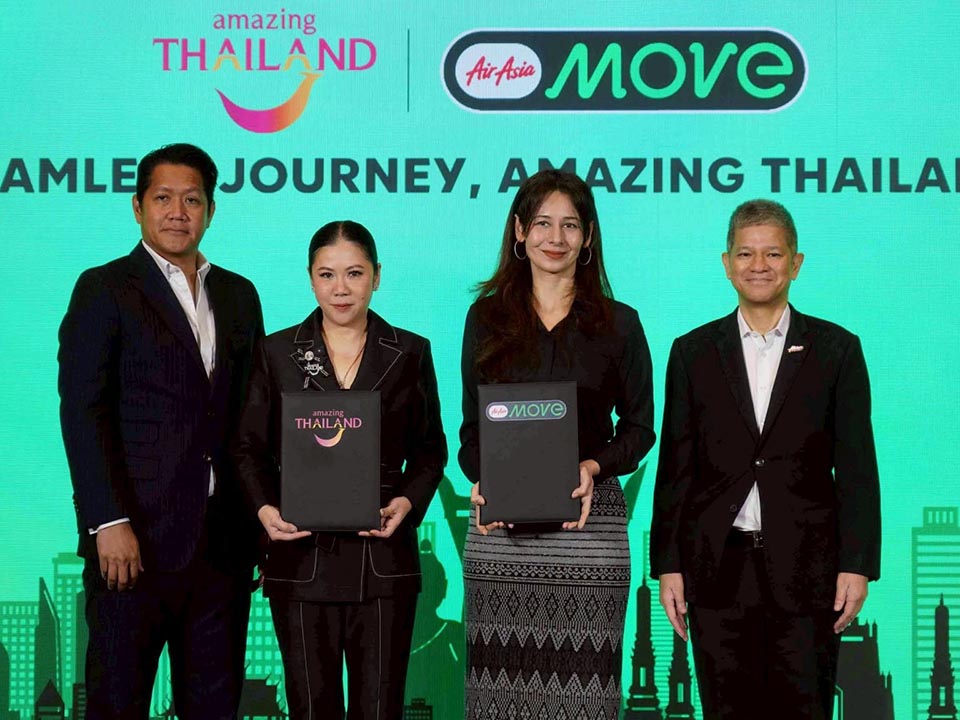
BANGKOK, Thailand – The Tourism Authority of Thailand (TAT) and AirAsia MOVE, one of Asia’s leading online travel agencies, today signed a Memorandum of Understanding (MOU) under “TAT x MOVE: Seamless Journey, Amazing Thailand” to expand digital travel promotion, connect traveller insights with targeted campaigns, and stimulate travel to and across Thailand. The MOU covers co-branded campaigns, content promotion, and joint marketing initiatives across TAT’s channels and the AirAsia MOVE platform. The three-year partnership aims to strengthen Thailand’s position as a world-class tourism destination and apply traveller insights from key markets across Asia and beyond to more focused destination marketing.
Ms. Thapanee Kiatphaibool, TAT Governor, said, “Digital platforms are reshaping how travellers discover, plan, and experience destinations. Through AirAsia MOVE’s regional reach and traveller insights, TAT can connect online inspiration with real travel choices, support major and emerging destinations, and create stronger opportunities for local tourism businesses nationwide. This collaboration advances the Platform Economy under the Amazing 5 Economy framework, while reinforcing TAT’s direction to promote UNESCO Creative Cities, green destinations, and tourism growth that delivers wider value across the country.”
AirAsia MOVE will activate its regional platform and more than 17 million monthly active users to raise awareness of Thai destinations, spotlighting Thailand’s ‘Five Must-Do’ experiences. The partnership will connect travel interest with local tourism operators, broaden access to emerging destinations, and support wider distribution of visitor spending nationwide. Ms. Nadia Omer, Chief Executive Officer of AirAsia MOVE, said, “This partnership with the Tourism Authority of Thailand is a pivotal step in advancing regional travel. By actively supporting the ‘Platform Economy’ pillar of the Amazing 5 Economy framework, AirAsia MOVE is uniquely positioned to accelerate this growth. Over the next three years, we will leverage our expansive ecosystem and data-driven insights to transform traveller aspiration into action, directly funnelling demand to local operators, empowering communities, and fostering sustainable economic growth across Thailand.”
The collaboration supports TAT’s strategic move to convert travel interest into visits, broaden visitor flows across destinations, and create wider value for tourism businesses nationwide. In support of the collaboration, AirAsia MOVE shared seven travel trends shaping Thailand tourism in the first half of 2026, based on traveller behaviour and booking data across its regional travel ecosystem. Asia remained the primary driver of inbound travel, with Malaysia, India, China, and Indonesia continuing as top source markets for Thailand. Younger travellers continued to influence travel patterns, with the 30–39 age group remaining among the largest traveller segments. These travellers seek more personalised and meaningful experiences, including adventure, local culture, culinary discovery, and immersive activities. Free Independent Travel also remained strong, with solo travellers accounting for 59.57% of all bookings.
India emerged as a star market, with family and large-group travellers making up more than 43% of Indian visitors, many staying for seven to 15 days. Travellers from India also recorded the highest revenue per booking on the platform, with demand increasingly coming from secondary cities including Bengaluru, Chennai, Kochi, and Ahmedabad. Indonesia demonstrated strong loyalty and meaningful travel opportunities, with couple travellers accounting for 24.71% of Indonesian bookings and 73.4% of seats sold coming from AirAsia Members. The trend points to opportunities for destinations such as Krabi, Chiang Mai, and Samui to attract Indonesian travellers seeking authentic local experiences, nature, wellness, and memorable getaways.
The United States remained an important long-haul source market, with travellers aged 50 and above accounting for 32% of US visitors on the platform. With a 77% round-trip booking rate, these travellers tended to stay longer, spend more, and use Thailand as a gateway to Southeast Asia. East Asian travellers from China, Japan, South Korea, and Taiwan continued to show strong spending power, with more than 70% staying in Thailand for up to five days, creating opportunities for premium short breaks, city escapes, festivals, and event-driven tourism. These insights support TAT’s efforts to sharpen product promotion, respond to changing traveller behaviour, and connect more visitors with meaningful travel experiences across Thailand. (TAT)