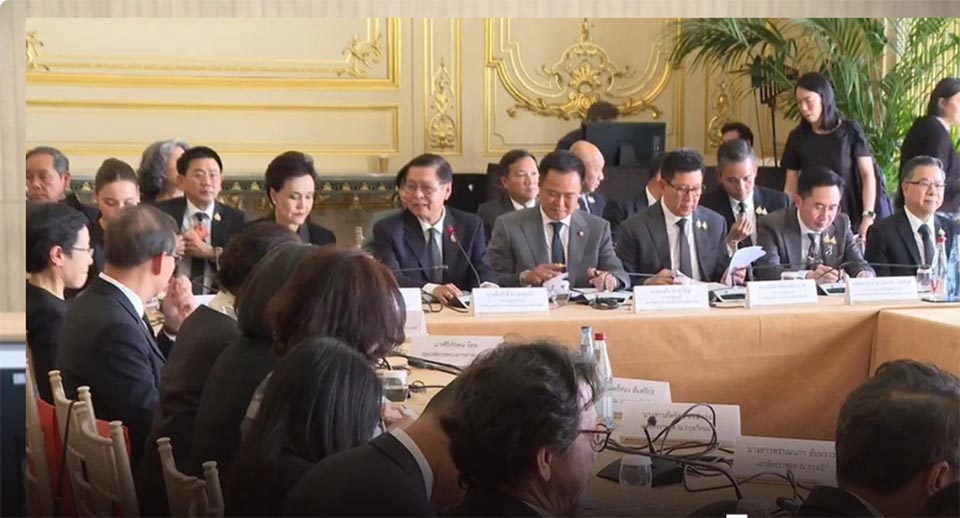
PARIS, France — Thailand is accelerating its economic diplomacy agenda in Europe, with Prime Minister Anutin Charnvirakul urging Thai ambassadors and consuls across 24 European countries to intensify efforts on key trade and investment priorities, particularly the Thailand–European Union Free Trade Agreement (FTA) and the country’s bid to join the OECD. Speaking at a meeting with Thai diplomatic missions in Europe, the Prime Minister emphasized that ambassadors must actively position Thailand as a top-tier investment destination, not defined by low-cost labor, but by its readiness, resilience, and integrated supply chain ecosystem. He said Thai representatives abroad should act as “marketing directors” for the country, tasked with building confidence among European governments and private sector investors that Thailand is a reliable base for business expansion in Asia.
A central focus of the briefing was the long-stalled Thailand–EU FTA negotiation, which the government now aims to push forward more aggressively. The Prime Minister stressed that reducing tariff and non-tariff barriers with the EU would significantly expand market access for Thai goods, particularly high-quality agricultural products, industrial goods, and key export sectors.
He also highlighted a shift toward more coordinated government operations, instructing agencies to work in “cluster-based integration” to eliminate bureaucratic fragmentation and accelerate trade negotiations and investment facilitation.
On international economic positioning, Thailand reaffirmed its goal of joining the OECD within three years, shortening its previous five-year target. The government views OECD membership as a strategic step to raise regulatory standards, strengthen economic credibility, and align Thailand more closely with advanced economies. The meeting underscored Thailand’s broader strategy to reposition itself as a competitive regional hub amid shifting global supply chains, with European markets seen as a key pillar in its export-driven growth agenda. (TNA)