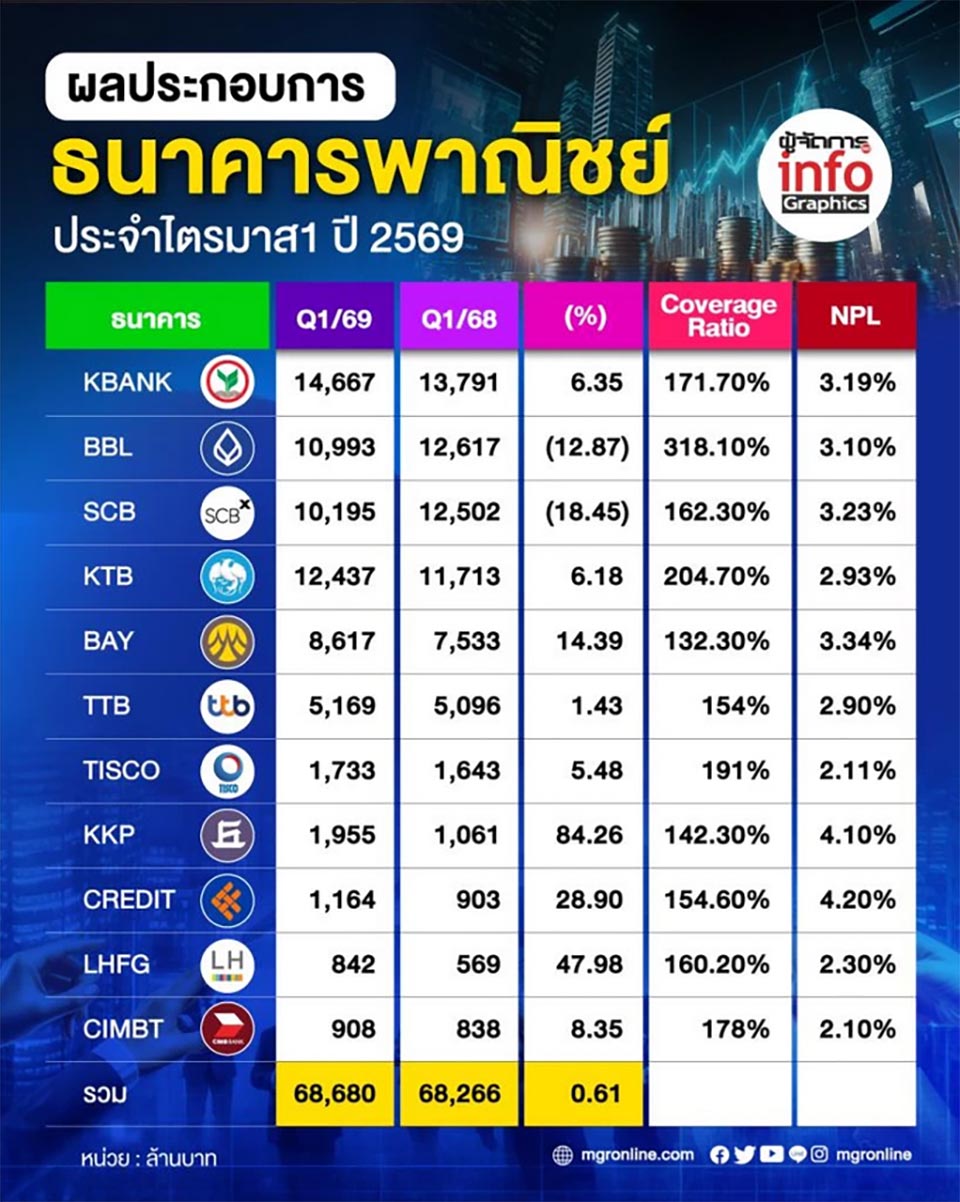
PATTAYA, Thailand – Thailand’s banking sector reported modest profit growth in the first quarter of 2026, as lenders moved to strengthen financial buffers amid rising global uncertainty.
According to combined results from 11 major banks—including Kasikornbank, Bangkok Bank, SCB X, Krung Thai Bank, and Bank of Ayudhya—total net profit reached 68.68 billion baht, up slightly by 0.61% from 68.27 billion baht in the same period last year.
Despite the increase, banks continue to face pressure from declining interest income, following a series of policy rate cuts by the Bank of Thailand since last year. Loan yields have adjusted downward, while overall credit growth remains subdued in line with a fragile economic recovery.
Asset quality across the sector remains relatively stable, with non-performing loans (NPLs) largely unchanged or fluctuating only slightly. Banks have maintained cautious lending practices, particularly toward higher-risk segments.
However, a key trend in the first quarter was a noticeable increase in loan-loss provisions. Financial institutions are building reserves in anticipation of potential economic headwinds, including the impact of escalating geopolitical tensions—particularly the conflict involving the United States and Iran—which has driven global oil prices higher.
Rising energy costs are expected to ripple through the Thai economy, increasing business expenses and household living costs, while placing additional strain on vulnerable groups still recovering from the pandemic.
With uncertainty surrounding the duration of the conflict, banks have raised their coverage ratios—reserves set aside relative to bad loans—as a precaution against potential deterioration in asset quality.
Analysts say the sector’s cautious stance reflects growing concern that external shocks could weigh on Thailand’s economic momentum in the months ahead, even as early signs of recovery begin to emerge.