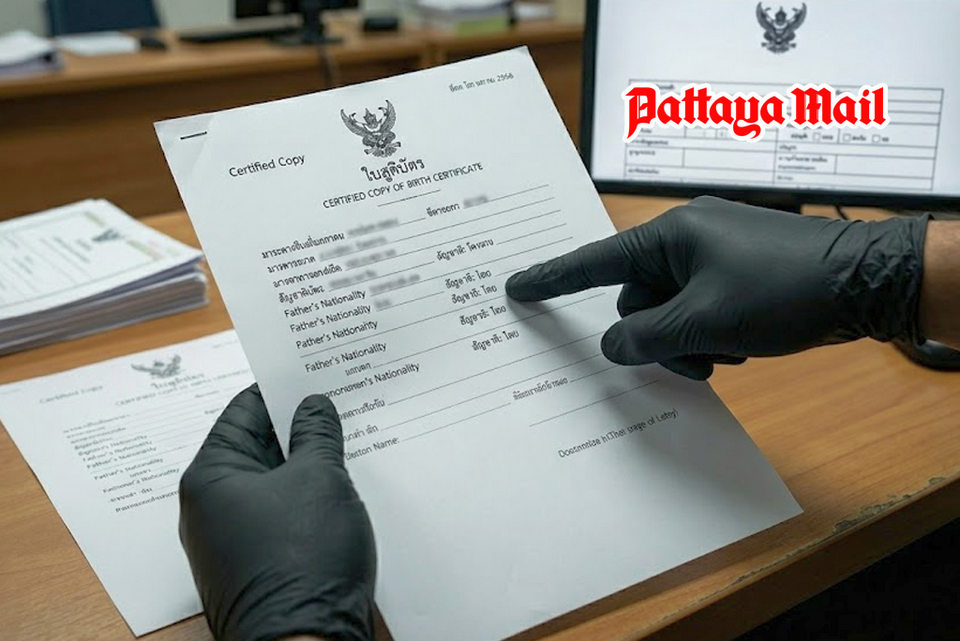
PATTAYA, Thailand – The recent scandal involving fraudulent birth certificates in Nakhon Ratchasima has sent shockwaves through the legal and business sectors. Recent findings from official investigations reveal a “civil registration crime” that is far more sophisticated and systematic than initially thought. This is not merely a case of filing false information; it is a calculated undermining of the integrity of Thailand’s civil registration system at its very foundation.
1. The modus operandi “Creating Thais” in a legal vacuum
Preliminary investigations have flagged at least 27 suspicious birth certificates, all sharing a distinct, recurring pattern. Fabricated Family Structures, These records list a “Chinese national” as the mother and a “Thai national” as the father to claim Thai citizenship through the bloodline principle (Jus Sanguinis). Minimal Fees for Massive Gain, Reported bribes range from 10,000 to 30,000 THB per case a trivial sum when weighed against the immense “future value” of the legal rights obtained. Geographic Red Flags, Most tellingly, these certificates were issued in districts “without hospitals.” In modern civil registration, an unusual volume of out-of-hospital births (home births) in a specific area is a major red flag indicating systematic fraud.
2. Cyber warfare in civil registry – Erasing the paper trail
The most concerning administrative aspect of this operation is the level of technical evasion involved. Credential Theft The perpetrators allegedly stole the login usernames and passwords of other government officials to enter data into the system. Anonymity & Lack of Accountability This was done with the explicit intent of “shielding the actual culprits from being traced.” By hijacking credentials, they effectively dismantled the state’s accountability and audit trails.
3. The Perspective of Victor Law Firm – Why is this more dangerous than a “Nominee”?
As legal consultants managing international clients and complex commercial contracts, we must clearly distinguish between a Nominee Structure and Identity Creation.
Nominee – This involves using an ‘existing Thai national’ as a front to hold rights or assets. In these cases, the state retains the ability to audit the financial trail or investigate the underlying relationships to revoke those rights.
Fake Identity – This represents the ‘injection of a new persona’ into the national database. If undetected at the source, these individuals effectively become Thai citizens by law. They gain the ability to acquire land, incorporate businesses, or even travel on Thai passports with absolutely no visible irregularities on their records. In simpler terms a nominee structure is the borrowing of a name, but birth certificate fraud is the fabrication of a legal bloodline to seize permanent rights.
4. A signal of strict state enforcement
The fact that authorities detected anomalies based on “districts without hospitals” proves that the Thai government has moved beyond simple “surface checks.” They are now utilizing Data Analytics to identify deep-seated irregularities.
Victor Law Firm Pattaya anticipates that this phenomenon will lead to, Strict Due Diligence For real estate or sensitive business transactions, authorities will dig deeper into the origins of a party’s nationality, rather than taking ID documents at face value. Integrity Risk Firms or consultants involved in “opaque” structures risk being classified as accomplices in a scheme that threatens national security.
The Korat case is merely the tip of the iceberg a glimpse into an organized effort to use “Thai legal status” as a gateway to rights reserved for Thai nationals. This wave of strict enforcement is a clear signal: in today’s Thailand, “Transparency” is no longer an option; it is an absolute requirement for doing business.