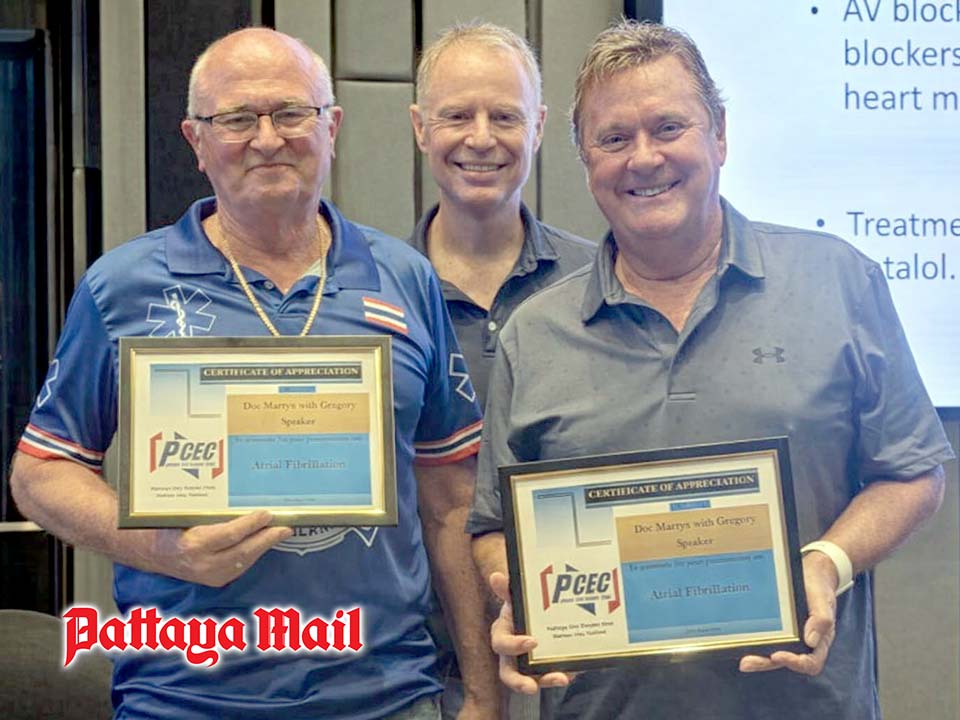
PATTAYA, Thailand – On Wednesday, March 25, members and guests of the Pattaya City Expats Club were treated to a practical, case-driven lesson in heart rhythm disorders as “Doc” Martyn Green used a real consultation to explain how atrial fibrillation (AF) is diagnosed, why it matters, and how one deceptively simple question can change a patient’s course.
In his presentation, Doc Martyn described AF as a common “tachy-arrhythmia” in older adults, often detected by an “irregular” pulse. He walked the audience through the basics of the heart’s electrical system and what clinicians look for on an ECG, noting that AF typically shows chaotic activity without the clear P-waves seen in normal rhythm.

Beyond palpitations and fatigue, he stressed the condition’s long-term stakes: an elevated risk of stroke, which he cited as roughly 2–5% per year. Martyn explained that when the atria fibrillates rather than contracts, blood can pool and clot; if a clot travels to the brain, it can cause a stroke. He also flagged brief episodes of temporary vision loss (amaurosis fugax) as a symptom that warrants prompt medical investigation.
For some patients, he said, treatment can include pulmonary vein isolation (PVI), a form of ablation that creates targeted lesions around the pulmonary veins—areas that can trigger abnormal electrical signals—to reduce the likelihood of AF episodes.
Doc Martyn based much of the talk on a recent series of consultations with club member Gregory Sparks, who joined the session. Sparks described a decade-long history of paroxysmal AF that gradually became more frequent, along with worsening tiredness and reduced tolerance for exertion. Martyn said the turning point came when he asked Sparks a direct question: whether he was short of breath.
Sparks had been taking amiodarone, a potent anti-arrhythmic drug. Martyn warned the audience that the medication can carry significant side effects and said shortness of breath raised concern for early pulmonary fibrosis. He described the situation as urgent and said he initiated a treatment plan immediately, explaining that routine chest X-rays may miss early changes and that vigilance for symptoms is critical.
But the case also highlighted a second, counterintuitive warning sign: a slow heart rate. Martyn pointed to rhythm strips showing rates in the mid-50s to low-60s even when AF or flutter had been suggested—far lower than the rapid rates commonly associated with AF. He argued this pattern was more consistent with atrial fibrillation with a slow ventricular response, likely linked to atrioventricular (AV) node dysfunction or AV block.
In such cases, he said, management may differ from the typical “rate-control” approach. Martyn told attendees that ablation of a dysfunctional AV node combined with pacemaker implantation can restore dependable rhythm support, improve exercise tolerance and help patients regain day-to-day capacity.
During the Q&A, Martyn repeatedly returned to lifestyle as a major driver of cardiovascular risk, urging members to cut down on sugary drinks and avoid processed foods. He encouraged whole-food choices—such as brown or black rice instead of white—and discussed healthier fats, including omega-3s. He also urged regular activity, telling the audience that “exercise” matters more than the specific sport: “Just do it.”
On detection, he said AF can often be suspected by simply learning to take one’s own pulse and noticing an irregular pattern. He also noted that blood-pressure devices and consumer wearables can provide helpful clues, while emphasizing that clinical assessment and appropriate testing remain important. Questions from the floor also touched on coronary calcium scoring as an indicator of calcification burden in the coronary arteries.
Following Doc Martyn’s presentation, Miss Sakunrat (Cartoon) Jek-om briefly introduced a new electric-vehicle (EV) taxi service aimed at airport transfers, highlighting a smoother ride and offered discounted rates for Pattaya City Expat Club members.
Cartoon said she purchased the EV after a recommendation and has been running the service for about three months, describing the vehicle as “smooth” and “very good.” She noted that EV transport options may become increasingly important for airport travel as regulations and market preferences shift.
After the presentations, MC Ren Lexander brought everyone up to date on upcoming Club events. This was followed by the Open Forum where questions are asked and comments made about Expat living in Thailand. To learn more about the PCEC, visit their website at https:/pcec.club. To view the videos of the presentation, visit the PCEC’s YouTube Channel at https://www.youtube.com/watch?v=HgJJgXkhNJc&t=32s for Doc Martyn and https://www.youtube.com/watch?v=I7DTl980y7s for Cartoon.