
The other day, an article in Popular Mechanics (of all things) caught my attention. It described how scientists are making progress in understanding the “language” of whales. Humpback whale “language” consists of vocalisations which are sometimes described in musical terms. Music and spoken language are more closely related than you might suspect. Of course, they both use the medium of sound, but they both use rhythmic patterns and phrases; both use tone, dynamics and pitch to convey meaning and they both serve as a means of social interaction. And both can express the most profound and powerful human emotions. Recent studies in neurology have revealed that language and music are processed in the same areas of the brain, which perhaps is why they are so closely related in human history and culture.
We humans are relative newcomers to our planet. The first homo sapiens appeared about 315,000 years ago, the blink of an eye in geological terms. Whales on the other hand, have been evolving for thirty million years. They are the world’s largest and longest-living mammals. The enormous bowhead whale, a resident of the Arctic regions can live for over two hundred years. In many indigenous communities and ancient cultures, whales are considered sacred beings, messengers, or sources of wisdom and their presence is deeply woven into cultural identity and spirituality. You might be surprised to know that dolphins and porpoises are also whales. They might be surprised to know too.

Not until 1949 was it realised that whales can communicate by sounds. In that year, a team of American researchers were conducting underwater acoustic experiments in Bermuda. It was rumoured that they were attempting to detect the sounds of Russian submarines. Whether they succeeded was not revealed but in the process, they unwittingly captured the sounds of humpback whales. The recording equipment could not have been simpler: it was an office dictating machine known as the Gray Audograph which had been invented a few years earlier. At about the same time, scientists William Schevill and Barbara Lawrence recorded the sounds of beluga whales in Canada’s Saguenay River using – oddly enough – another Gray Audograph. Two decades later, Dr Roger Payne and Frank Watlington made whale recordings of their own, which appeared in an album entitled Songs of the Humpback Whale. It sold over 100,000 copies.

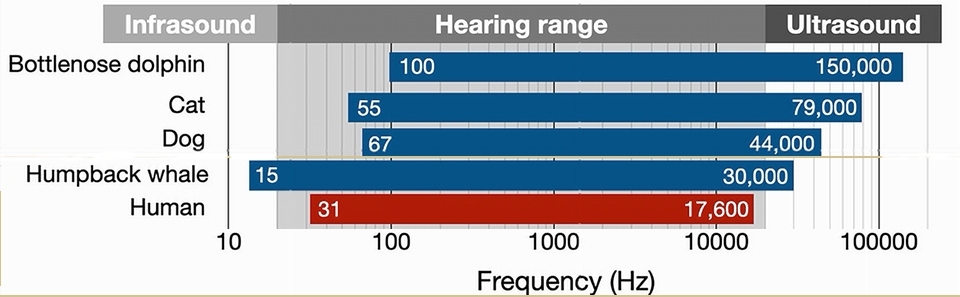
Science writer Zoe Cormier explains, “The deep ocean, the largest habitat on earth, is also the darkest. At 3,000 feet underwater sunlight disappears completely. It’s not surprising that dolphins and whales rely on sound more than any other sense to understand, navigate and manipulate their world.” The pitch or “frequency” of sounds is measured in Hertz (Hz), which has nothing to do with rented cars, but represents vibrations or cycles per second. The lowest note on a piano is about 27Hz, and the highest about 4,000Hz. While humans can hear sounds averaging between 31Hz to 17,600Hz, bottlenose dolphins can hear up to 150,000Hz – far beyond the range of dogs which are remarkably sensitive to ultrasound frequencies. Blue whales make deep, resonant calls at 14Hz which are inaudible to humans. These calls are so powerful that under the right conditions, they can travel for up to a thousand miles.
Although the word “song” is often used to describe the pattern of sounds made by humpback and bowhead whales, don’t expect to hear something like Where Have All the Dolphins Gone? Humpback whale songs consist of whistles and and eerie human-like wailing. Their songs are complex and each can last for up to thirty minutes. They are mostly sung by males during the breeding season and characterized by their intricate patterns and variations.
In contrast to the song-like sounds of humpback whales, sperm whales have a strangely percussive language. Camille Bromley of National Geographic describes it as “powerful staccato clicks that call to mind a thumbnail dragging over the teeth of a metal comb.” But do all these clicks, whistles, grunts and wails have a purpose? We know that some sounds are used for navigation, but what about the other sounds? Are the whales merely announcing their presence, sending messages, or making song-like sounds just for the fun of it? And what do the sounds mean, if anything? No one yet knows what the whales are saying, but the latest research may give us a glimpse into this tantalizing marine sound-world.

Dr David Gruber is an American marine biologist and the creator of Project CETI, an acronym for Cetacean Translation Initiative. Founded in 2020, it’s an international project involving a large team of scientists who are attempting to understand whale vocalizations using A.I. In May 2024, the initial findings were published in the journal Nature Communications. The research paper described how sperm whale communications are far more complex than was previously realised. Vocalizations are arranged in well over a hundred known repeatable patterns described by the researchers as a “sperm whale phonetic alphabet.” Professor Gruber wrote, “Little by little, the sperm whales are divulging their secrets of how they’re communicating to us.” Even so, the exact meaning of the whale communications – for the time being at least – remains unknown.

If you were to drive out of the sprawling conurbation of Boston and Cambridge along Massachusetts Avenue, you would soon arrive in the pleasant town of Arlington. It was the home of the American-Armenian composer Alan Hovhaness who was to become one of the 20th century’s most prolific composers. It’s estimated that he wrote well over 500 works including 67 symphonies, 22 concertos, 67 sonatas for various instrumental combinations and 7 operas. During the 1930s and 1940s, Hovhaness famously burned many of his earlier works and claimed that a thousand pieces had been consigned to the flames.

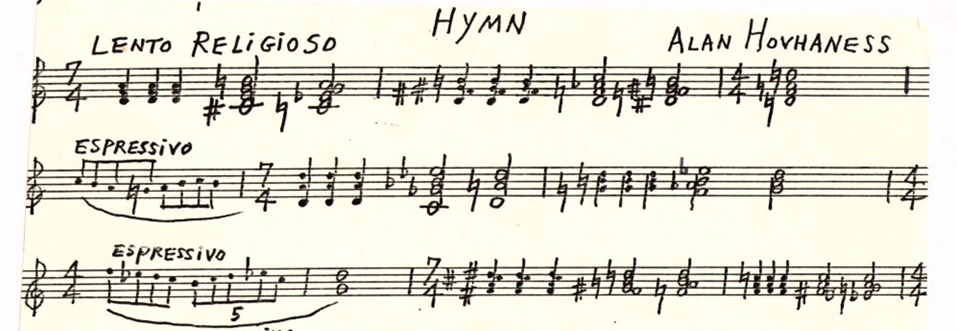
His music varies enormously in style and at times, it can sound quite cinematic. On other occasions, little seems to happen. The music often consists of long unison melodies and sections of simple harmonies with virtually no thematic development. Ardem Tajerian writes, “Hovhaness rejected musical trends. His music was criticized for being deeply old-fashioned. Yet, some see him as the forerunner of minimalism. His unique melodies are pure and straightforward and his recognizable style comes through in every piece.” Hovhaness often uses aleatoric (“chance”) elements in his work, in which the score instructs groups of players to perform a repeated pattern of notes for a specified period. He called this technique “spirit murmur”. Although this is essentially a simple concept and easy to write, it gives the listener the impression of musical complexity. Although on the surface, much of his music is attractive, some of his work strikes me as approaching the naïve. Curiously enough, his unsophisticated musical handwriting looks more like that of a student, rather than that of a professional composer.
His iconic orchestral work And God Created Great Whales was commissioned by conductor Andre Kostelanetz and first performed by the New York Philharmonic in June 1970 with Kostelanetz conducting. As you may have realized, the title comes from Genesis 1:21 in the King James version of the Bible. Hovhaness interspersed the orchestral passages with recordings of songs from humpback and bottlenose whales. The eerie sounds are strangely compelling and bring a timeless, haunting quality to the music. Some of the recordings were borrowed from the successful album of whale songs published by Dr Roger Payne and Frank Watlington the previous year.
The music opens with a passage of “spirit murmur” for strings, which consists of rising and descending scale patterns, purposely out of synchronization with each other. It leads to a cinematic section of simple chords on the brass and woodwind over the repeating string patterns. Above what the composer describes as “water sounds” we hear a folk-like melody from the violins. The melody could almost have come from Vaughan Williams. The tune is taken up by the flutes and repeats several times until the first whale sounds appear at 03.02, accompanied by the lower strings and percussion.
The music continues pretty much in the same vein throughout, with dramatic loud passages contrasted with sections which are almost silent. In many ways, this is a remarkable work, though perhaps not one that can sustain repeated listening. There is another version of the piece on YouTube which shows the full orchestral score. If you can understand music notation, it’s worth a look, for the handwritten orchestral score is both fascinating and revealing. If you feel an urge to explore more of the music of Alan Hovhaness, a good starting point might be his most popular work, the Symphony No. 2, subtitled Mysterious Mountain.

Composed in 1955, it’s typical of the composer: an approachable, cinematic-sounding melodic style that falls easily on the ear. Hovhaness himself said, “Simplicity is difficult, not easy. Beauty is simple. All unnecessary elements are removed – only essence remains.” In his obituary for Hovhaness in June 2000, the American conductor Gerard Schwarz wrote, “Hovhaness wasn’t an innovator like Stravinsky or Schoenberg. He wasn’t trying to change things. He was just trying to bring beauty and sensitivity into the world.”