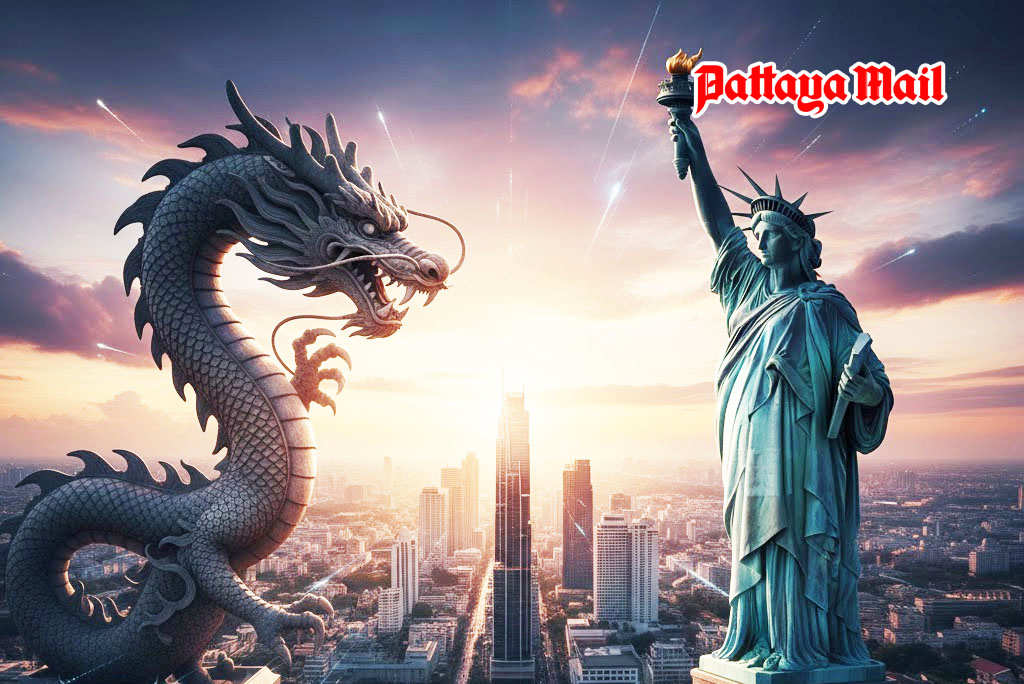
PATTAYA, Thailand – The world of 2026 is no longer unipolar, yet it is not a world where China has fully replaced the United States either. What we are witnessing is a structural rivalry China striving to evolve from the “factory of the world” into a global innovation powerhouse, while the United States and the G7 continue to hold the levers of the existing international order. In this emerging dual structured world, Thailand particularly the Eastern Economic Corridor (EEC) and Pattaya has become more than a bystander. It is a strategic platform where capital, technology, and geopolitical influence intersect. The central question is no longer whether China can grow or whether America can contain it. The more practical question is this if Thailand maintains a policy of strategic neutrality, how will expatriates live and operate in a country positioned between two competing giants?
China’s transformation from manufacturing hub to technology power
China today exports far more than goods. It exports entire industrial ecosystems. In Thailand’s EEC, companies such as BYD, Great Wall Motor, and Changan Automobile have established production bases for electric vehicles and battery systems. These investments bring not only assembly lines but engineers, executives, and supply chain managers creating a new wave of Chinese expatriates in Pattaya and nearby Sri Racha. This new demographic differs fundamentally from the mass-tourism wave of the past. They are long-term residents with purchasing power, seeking modern condominiums near industrial hubs, international schools for their children, and technologically integrated living environments.
Meanwhile, Chinese tourism itself has evolved. The era of zero-dollar group tours has given way to independent, digitally fluent travelers who rely on platforms such as Alipay and WeChat for seamless, cashless transactions. Even street vendors in Pattaya increasingly adapt to these systems to remain competitive. China’s outward expansion is therefore not merely commercial it is structural.
The structural limits to China becoming “Number One”
Yet despite its rapid ascent, China faces formidable barriers. The semiconductor battlefield remains central. Export controls targeting advanced chips from firms like NVIDIA, along with restrictions on high end lithography equipment produced by ASML, reflect a strategy often described as “small yard, high fence.” The objective is not to block all trade but to restrict access to the most strategically critical technologies AI accelerators, quantum computing components, and advanced chip architectures.
Financial architecture represents another constraint. The global system still revolves around the U.S. dollar and payment infrastructure such as SWIFT. While China promotes alternative arrangements within emerging blocs, no parallel network yet commands equivalent global trust or liquidity.
Trade policy has also become more strategic. Under the administration of Joe Biden, the United States has imposed higher tariffs on Chinese electric vehicles and solar panels, citing unfair subsidies and national security concerns. Europe has taken similar steps. What is often described as “green protectionism” reflects the blending of environmental standards with industrial defense.
The result is a world in which China may dominate manufacturing scale and green technology deployment, particularly across the Global South, but still faces structural resistance in becoming the uncontested leader of the global system. Leadership today is not only about production capacity; it is about rule-making power, financial dominance, and technological gatekeeping areas where Western institutions remain deeply entrenched.
Thailand as the strategic middle ground
As China encounters barriers in Western markets, it accelerates investment in countries like Thailand. Establishing production in the EEC enables goods to carry a “Made in Thailand” label and potentially access broader markets under different trade frameworks. This surge of capital brings opportunity jobs, infrastructure, technology transfer but also scrutiny. The United States and its allies will inevitably examine whether Thai-based production genuinely meets rules-of-origin standards or merely serves as a rebranded extension of Chinese supply chains.
Thailand therefore walks a careful path of strategic hedging welcoming Chinese investment while preserving regulatory transparency and alignment with global norms.
Life for expats in a neutral Thailand
For expatriates, this geopolitical balancing act has practical implications.
First, legal stability becomes paramount. If Thailand maintains transparent, internationally recognized legal standards, expatriates from China, Europe, the United States, India, and beyond can operate without feeling drawn into geopolitical crossfire. Neutrality must be credible, rooted in rule of law rather than rhetorical positioning.
Second, financial integration matters. As long as Thailand remains connected to global banking systems and avoids sanctions exposure, expatriates can transfer funds, invest in property, and manage cross-border business with confidence. Any perception that Thailand functions as a sanctions-evasion hub could trigger financial risk that would directly affect foreign residents.
Third, opportunity may expand precisely because of geopolitical tension. Multinational corporations restructuring supply chains need regional managers, engineers, compliance officers, and consultants. Pattaya, located near the EEC and major transport infrastructure, can evolve into a residential base for regional executives seeking a politically stable yet economically dynamic environment.
Finally, social diversity will deepen. Chinese engineers, Indian investors, European retirees, and American digital entrepreneurs increasingly coexist in the same urban space. If managed wisely, Pattaya can transform from a tourism-driven city into a genuinely international living hub one that benefits from, rather than suffers under, global realignment.
A world without a clear winner
The global landscape of 2026 is not a story of decisive victory. China continues to expand its industrial and technological reach. The United States and the G7 retain influence over financial systems, advanced technologies, and high-consumption markets. Neither side can easily displace the other. In such a world, countries that rush to choose sides may narrow their strategic options. Those that manage disciplined neutrality anchored in transparent governance and diversified partnerships can convert rivalry into leverage.
For Thailand, the challenge is not merely to remain neutral, but to remain credible. Accept Chinese investment while demanding genuine technology transfer. Uphold international standards to reassure Western partners. Position itself not as a proxy battlefield, but as a trusted bridge. If Thailand succeeds, Pattaya will not simply be a resort city adapting to changing tourism patterns. It will become a neutral platform in a divided world a place where expatriates can live, work, and invest with confidence, even as global powers compete for primacy.
In an era defined by rivalry rather than resolution, neutrality if managed intelligently may prove to be Thailand’s greatest strategic asset.