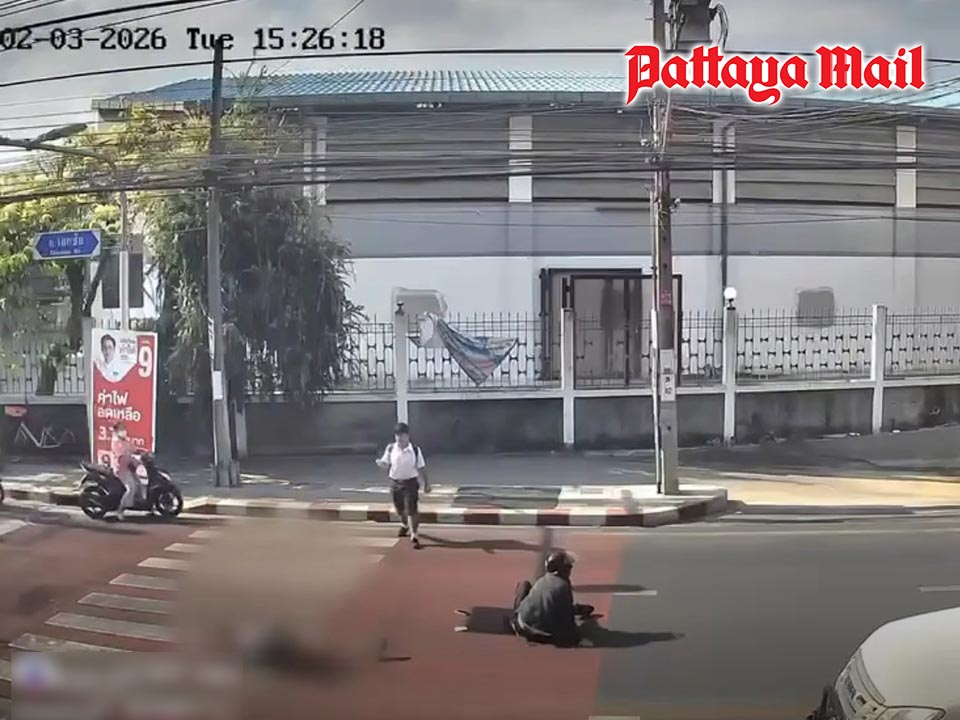
PATTAYA, Thailand – The recent case of a schoolchild being struck at a pedestrian crossing has once again laid bare a deeply uncomfortable reality on Thailand’s roads: when responsibility is shared by everyone, it is effectively owned by no one.
Pedestrian crossings are meant to guarantee priority and safety for people on foot. In practice, they often fail to stop vehicles at all. Cars and motorbikes routinely pass through red lights and zebra crossings even when pedestrians are already crossing, turning what should be a place of protection into a zone of uncertainty and fear.
Much of the danger stems from driver and rider behavior. Motorbikes in particular are frequently seen weaving through crossings without slowing down, while some drivers appear genuinely unaware that a zebra crossing carries any legal obligation. Many residents argue this behavior has been learned over time, reinforced by the absence of meaningful consequences.
Public frustration increasingly points toward enforcement. Police are often visible carrying out helmet checks and document inspections, yet are rarely stationed at known danger points such as school crossings and busy pedestrian zones. Residents question why red-light violations at crossings are not routinely punished, noting that visible enforcement or automatic camera systems would quickly change behavior.
Driving education has also come under scrutiny. Many observers believe that the meaning and legal importance of zebra crossings are either poorly taught or not taught at all. As a result, some motorists do not deliberately ignore the rules — they simply do not understand them. Calls have grown for stricter licensing standards, alongside free or low-cost testing opportunities to allow unlicensed riders to enter the legal system rather than continuing to operate without training.
Responsibility does not stop there. Road design itself often works against safety, with faded markings, poor lighting, and poorly positioned crossings offering little warning or protection. Without traffic-calming measures, raised crossings, or cameras, painted lines alone provide little more than a false sense of security.
Pedestrians, meanwhile, have adapted to the danger in their own way. Many locals now avoid zebra crossings altogether, believing it is safer to cross elsewhere where they can better judge traffic behavior. This defensive habit may reduce immediate risk, but it further erodes the purpose of crossings and normalizes lawless driving.
Some residents have called for a national public education campaign to explain pedestrian crossings, highlight penalties for violations, and reinforce respect for vulnerable road users. Suggestions include animated public service announcements aimed at children, not only to teach them road safety, but to reach adults who continue to ignore the rules.
What becomes clear is that pedestrians — and certainly children — are not the problem. Responsibility lies with drivers and riders who ignore the law, authorities who tolerate weak enforcement, and systems that allow unsafe design and poor education to persist.
Until enforcement becomes consistent, education improves, and violations carry real consequences, zebra crossings will remain symbolic rather than protective. And until that changes, every new incident forces an increasingly uncomfortable question into the open: if Thailand says it values children, why do its roads continue to place them in harm’s way?