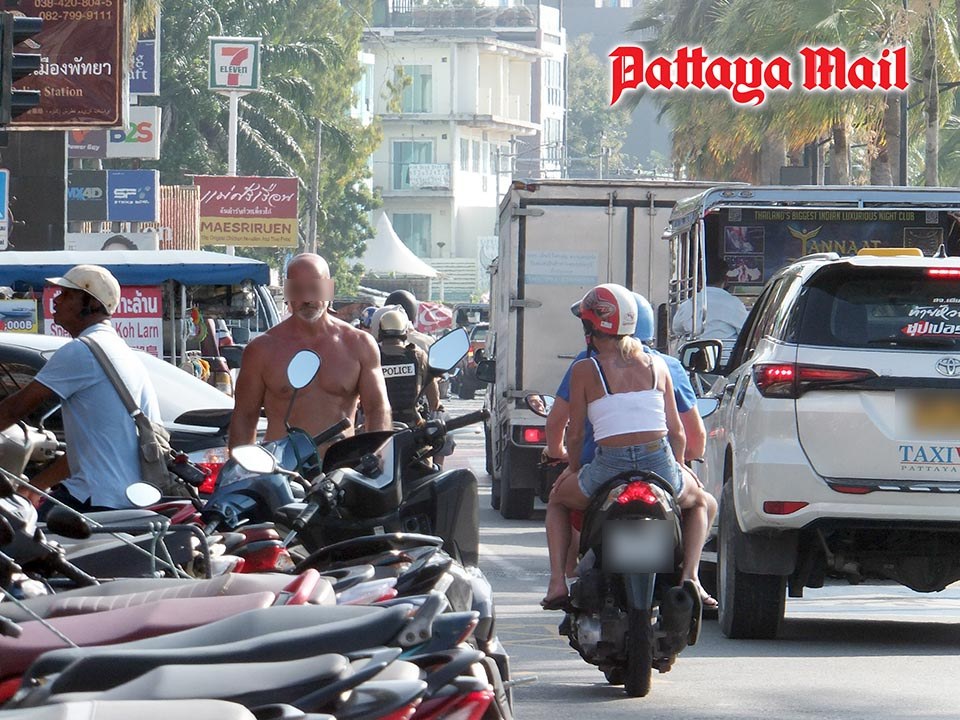
PATTAYA, Thailand – A foreign tourist’s blunt observation has reignited debate over road safety in Pattaya, cutting to the heart of a long-running argument about whether the city’s streets are dangerous by design — or dangerous because of those who use them.
“People say Pattaya’s roads are dangerous for motorcyclists,” the visitor remarked. “You could just as easily turn that around and say Pattaya’s dangerous motorcyclists put road users at daily risk — and it would be just as true.”
The comment follows the circulation of recent video footage showing motorbikes and cars driving straight through a red light while pedestrians were already crossing at a marked zebra crossing. Vehicles pass within inches of people on foot, prompting visible anger from foreign pedestrians, while Thai pedestrians calmly step aside — a reaction many say reflects long familiarity rather than real safety.
Pedestrian crossings across Pattaya are increasingly dismissed by residents and visitors alike as little more than painted lines. In a city where red lights are routinely ignored and enforcement is rarely visible, both pedestrians and riders are left to rely on instinct rather than signals.
The danger, however, is not one-sided. Images of a wrecked motorbike from a recent accident serve as a reminder that riders themselves are also victims of the same environment. When traffic signals are treated as optional and crossings lose their meaning, collisions become a shared risk rather than a single-group problem.
The footage has reignited questions about the purpose of Pattaya’s pedestrian crossings. Long-term visitors frequently compare the situation to countries such as the UK, where traffic is legally required to stop the moment a pedestrian steps onto a crossing. In Pattaya, drivers and riders rarely slow down, let alone yield.
Many residents say they now avoid zebra crossings altogether, believing it is safer to cross elsewhere where they can better judge oncoming traffic. Others point out that riders are often forced into sudden swerves or emergency braking when pedestrians step out on a green signal, only to find traffic still flowing through the intersection. In both cases, crossings are seen as offering a dangerous illusion of safety.
Public frustration has increasingly focused on enforcement — or the lack of it. Residents question why police are not stationed at known problem crossings to penalize red-light violators, noting that even short-term enforcement would likely change behavior immediately. Some argue the issue is no longer weak enforcement, but effectively no enforcement at all.
Among locals, the prevailing advice is stark: never assume anyone will stop, even when the light is green and the crossing is marked. Others express deeper cynicism, suggesting road rules are treated as optional and that meaningful improvement is unlikely without sustained, visible policing.
What unites most views is a shared conclusion — Pattaya’s pedestrian crossings are not functioning as intended. Without consistent enforcement and respect for traffic laws, both pedestrians and motorcyclists remain exposed, and accidents are seen as inevitable.
Until that changes, residents warn that road safety in Pattaya depends less on signs, signals, or painted lines, and more on constant personal vigilance — whether crossing on foot or riding on two wheels.